Author: 魚丸
學英文時,許多人曾因不清楚連綴動詞是什麼,連綴動詞後面加什麼,或感官動詞與連綴動詞差別而感到困惑。在本文中,ELSA Speak 將幫助你逐步掌握連綴動詞用法,辨識常見情形,並透過例句加以練習。
- 連綴動詞用來連接主詞與主詞補語,描述主詞的狀態或特徵,而非表達動作。
- 連綴動詞後面通常接形容詞、名詞/名詞片語或介系詞片語。
- 常見類型包括 Be 動詞、表示變化、持續狀態及感覺的連綴動詞。
- Look、sound、smell、taste、feel 可作連綴動詞或感官動詞,需依語意與句型判斷。
連綴動詞是什麼?
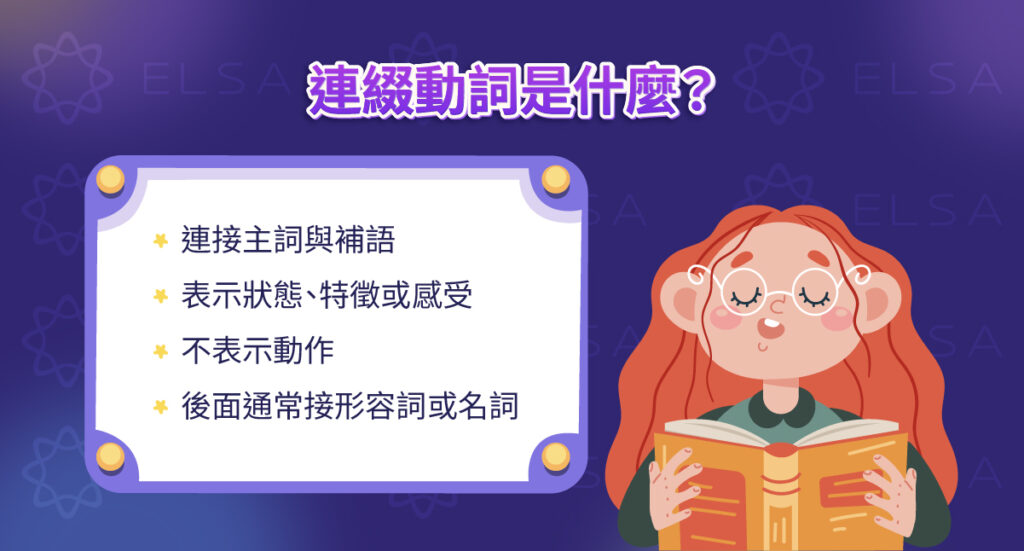
連綴動詞 英文(Linking Verbs)用於將主詞(S)與主詞補語(SC)「連結」起來,用以描述主詞的狀態或特徵,而非表達動作。因此,連綴動詞後面通常接形容詞(adjective),其中動詞 “to be” 是最常見且最具代表性的連綴動詞。
英文連綴動詞用法與結構
連綴動詞+形容詞
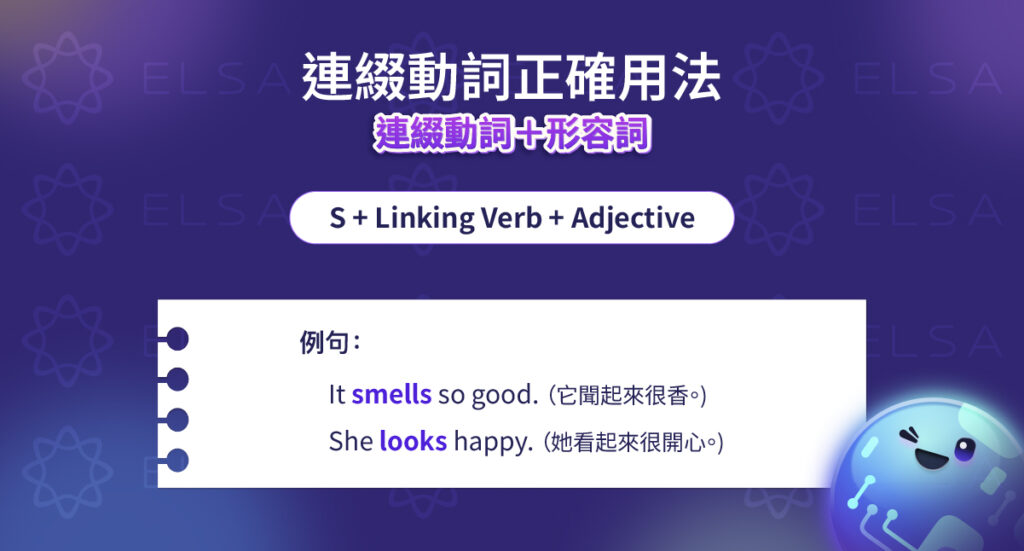
這是連綴動詞最常見的結構。連綴動詞後面通常接形容詞,用以描述主詞的狀態或特徵。
句型結構:
| S + Linking Verb + Adjective |
例句:
- It smells so good. (它聞起來真的很香。)
- She looks happy. (她看起來很開心。)
連綴動詞英文何時搭配名詞?
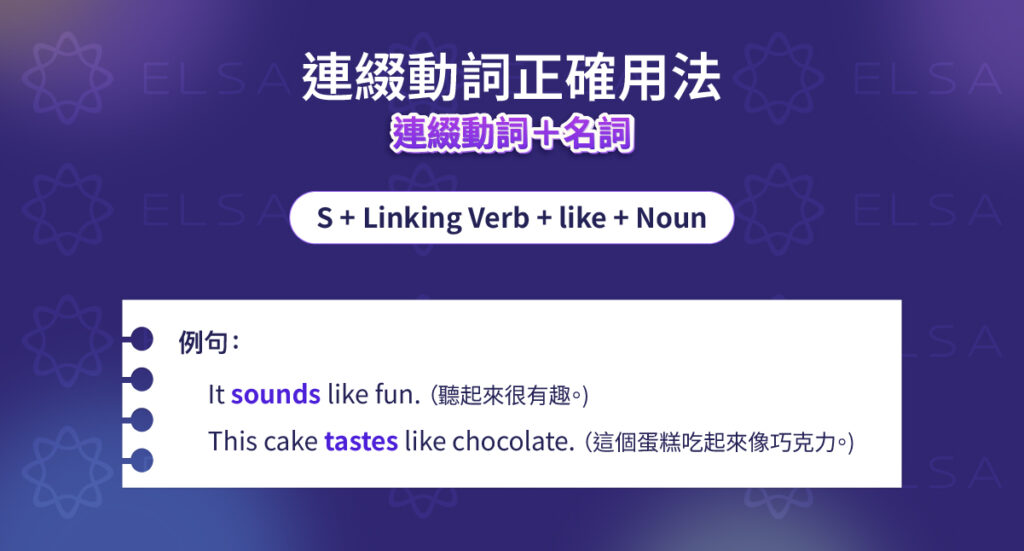
對於 look、sound、smell、taste、feel 等表示感覺的連綴動詞,也可使用 like+名詞,表示 “看起來/聽起來/感覺像……”。
句型結構:
| S + Linking Verb + like + Noun |
例句:
- It sounds like fun. (聽起來很有趣。)
- This cake tastes like chocolate. (這個蛋糕嚐起來有巧克力的味道。)
關於名詞的文章:不可數名詞是什麼?用法、例子以及與可數名詞的區別
連綴動詞有哪些?
Be 動詞
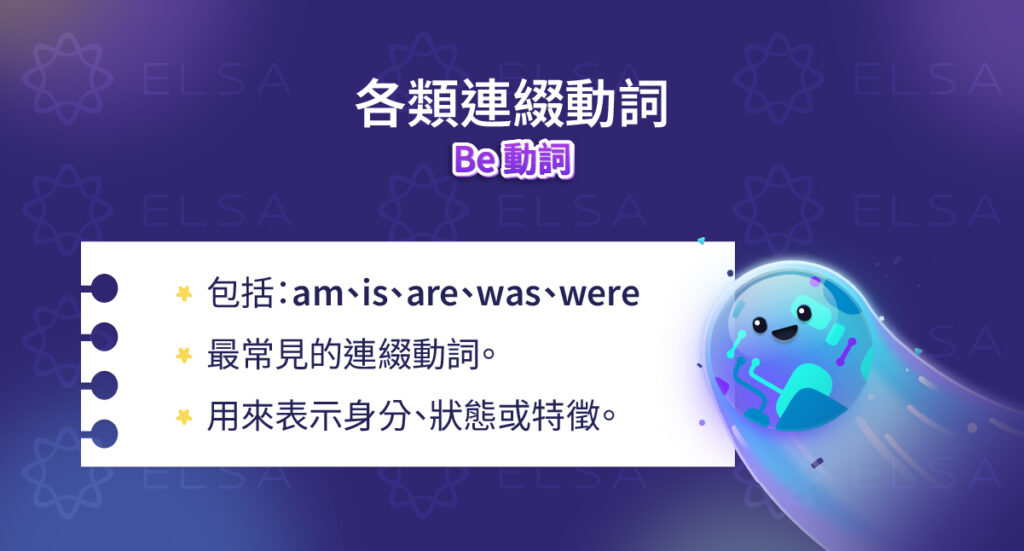
| 連綴動詞 | 例句 |
|---|---|
| am | I am happy. (我很開心。) |
| is | She is a teacher. (她是一位老師。) |
| are | They are excited. (他們很興奮。) |
| was | He was tired yesterday. (他昨天很累。) |
| were | We were late. (我們遲到了。) |
表示變化的連綴動詞
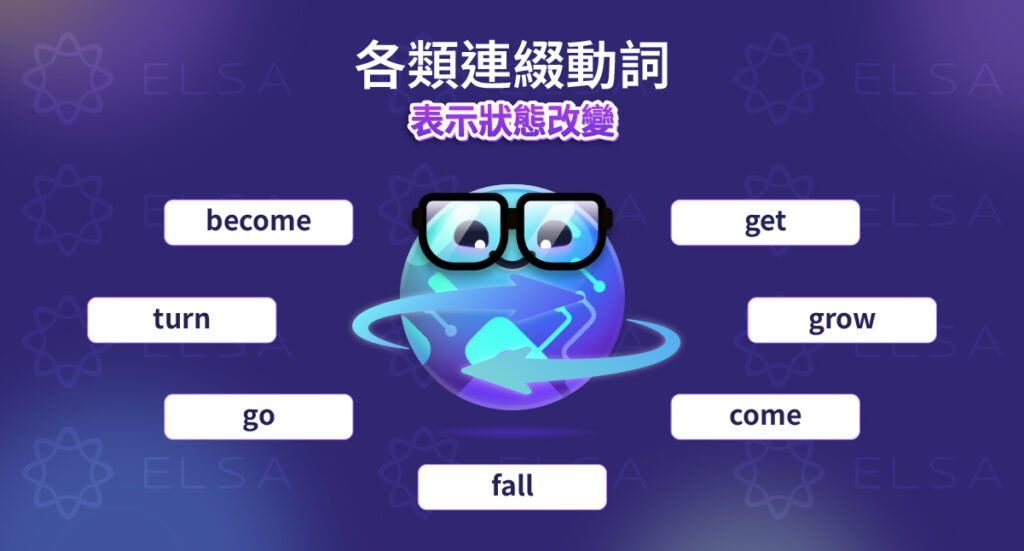
| 連綴動詞 | 中文釋義 | 例句 |
|---|---|---|
| become | 變得、成為 | She became famous. (她變得很有名。) |
| get | 變得 | It’s getting cold. (天氣正在變冷。) |
| grow | 逐漸變得 | He grew stronger. (他逐漸康復了。) |
| turn | 轉變為 | The leaves turn yellow in autumn. (葉子在秋天轉為黃色。) |
| go | 變得(通常帶有負面含義) | The milk went bad. (牛奶壞掉了。) |
| come | 變得、陷入某種狀態 | My dream came true. (我的夢想成真了。) |
| fall | 陷入某種狀態 | He fell asleep quickly. (他很快就入睡了。) |
表示持續狀態的連綴動詞
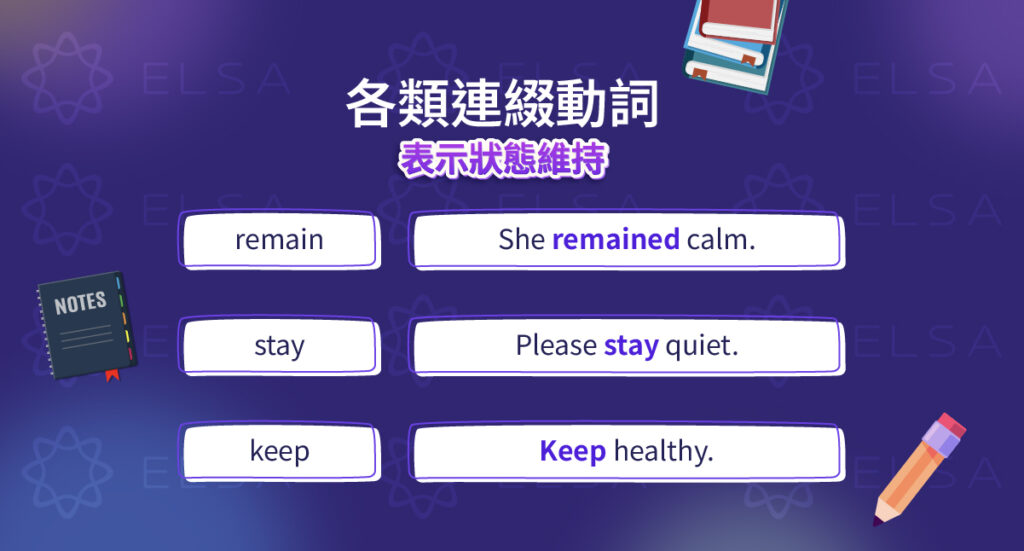
| 連綴動詞 | 中文釋義 | 例句 |
|---|---|---|
| remain | 仍然、依然 | She remained calm. (她保持冷靜。) |
| stay | 維持、保持 | Please stay quiet. (請保持安靜。) |
| keep | 持續維持 | Keep healthy. (請保持健康。) |
表示感覺的連綴動詞
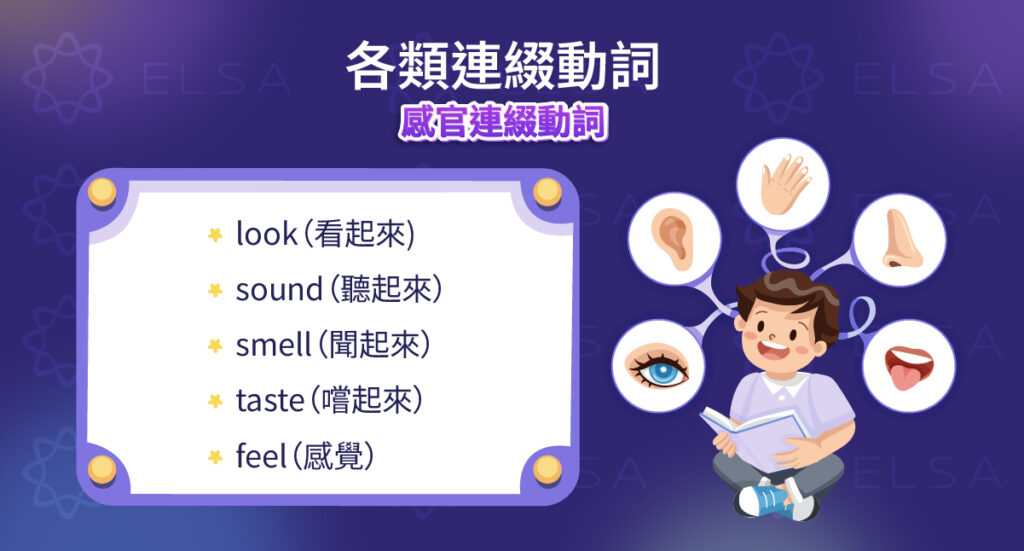
| 連綴動詞 | 中文釋義 | 例句 |
|---|---|---|
| look | 看起來 | You look happy today. (你今天看起來很開心 。) |
| sound | 聽起來 | That sounds interesting. (那聽起來很有趣。) |
| smell | 聞起來 | The flowers smell wonderful. (那些花聞起來很香。) |
| taste | 嚐起來 | The soup tastes delicious. (湯嚐起來很美味。) |
| feel | 感覺 | I feel much better now. (我現在感覺好多了。) |
連綴動詞感官動詞差別
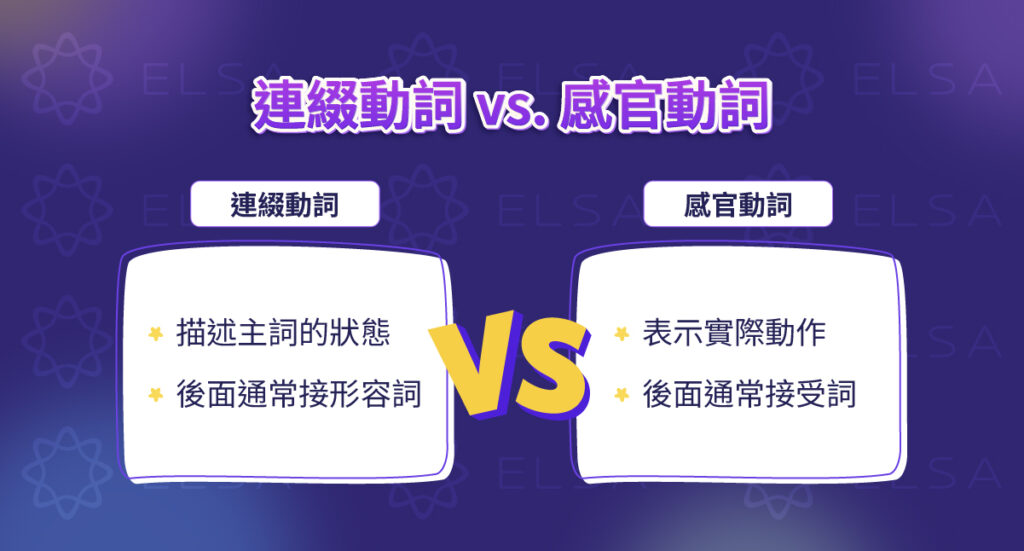
你是否已清楚了感官動詞連綴動詞差別?look、sound、smell、taste、feel 等動詞,既可作為連綴動詞(linking verbs),也可作為感官動詞(sense verbs)。兩者的差別在於語意與句子結構。
| 連綴動詞 (Linking Verb) | 感官動詞 (Sense Verb) | |
|---|---|---|
| 功能 | 連結主詞與補語,描述主詞的狀態或特徵 | 表達觀看、聆聽、嗅聞、品嚐或觸摸的動作 |
| 語意 | 不表達動作 | 表達主詞的動作 |
| 句型結構 | S + Verb + Adj. / S + Verb + like + N | S + Verb + O |
| 例句 | She looks tired. (她看起來很累。) | She looked at me. (她看著我。) |
連綴動詞練習題附解答
練習題
練習題:在空格中填入連綴動詞(linking verb),並將動詞變化為適當形式。
- The flowers _________ lovely.
- My brother _________ a great cook.
- You _________ more relaxed now.
- If you practice, you may _________ a champion.
- Mr. Le _________ so handsome in this suit.
- That coffee pot _________ my grandmother’s.
- Minh _________ very excited when she heard the news.
- My mother _________ a high school teacher at 22.
- These jeans _________ too tight for her.
- She _________ only sixteen years old.
解答
| 題號 | 1 | 2 | 3 | 4 | 5 |
| 答案 | look | is | seem | become | looks |
| 題號 | 6 | 7 | 8 | 9 | 10 |
| 答案 | was | got | became | feel | is |
常見問題
連綴動詞被動是什麼?
→ 連綴動詞沒有被動式,因為它們不表達作用於受詞的動作,而只用於連結主詞與補語(形容詞、名詞或修飾詞組)。
連綴動詞後面加什麼?
→ 連綴動詞後面通常接主詞補語,用以描述或補充說明主詞的資訊。此補語通常為形容詞、名詞/名詞組或介系詞組。
例句:
- She looks happy. (她看起來很開心。)
- He became a doctor. (他成為了一位醫生。)
- The keys are on the table. (鑰匙在桌上。)
清楚理解連綴動詞,將幫助你更自然地表達想法,並避免英文中許多常見的文法錯誤。別忘了經常透過連綴動詞例句進行練習,將知識內化為直覺反應,讓你更自信地使用英文。歡迎在 ELSA Speak 英語文法專區探索更多實用文章!
反身代名詞(Reflexive Pronouns)是英語語法中的一個重要主題。透過這篇文章,ELSA Speak會幫助你理解反身代名詞意思、反身代名詞用法、反身代名詞位置、如何與人稱代名詞區分開來,並透過例句與練習題加深理解。
反身代名詞是什麼?
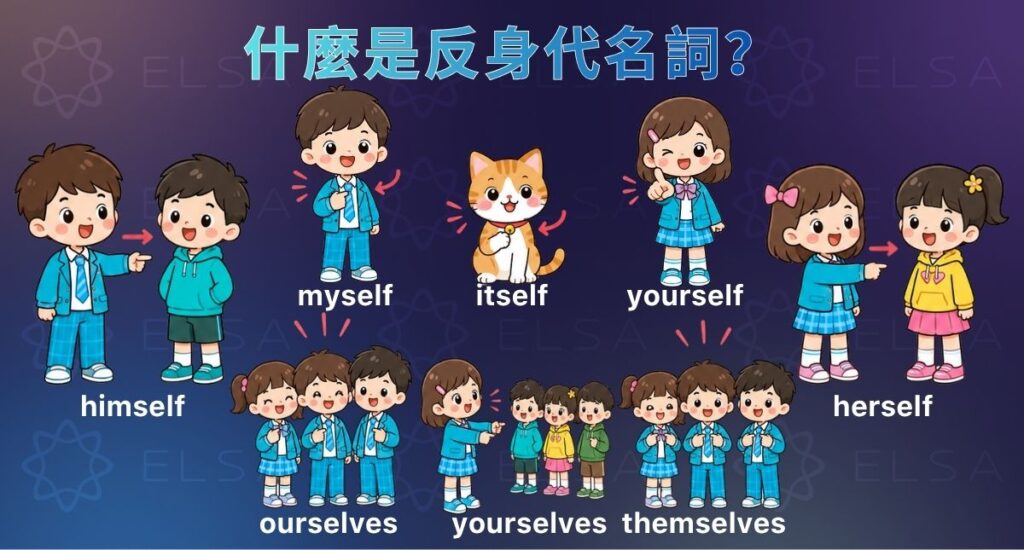
反身代名詞的意思
反身代名詞 英文 (Reflexive Pronouns) 是指句子中的主詞和受詞指涉同一個人或事物時,用來指稱執行動作的人或物的代名詞。此外,反身代名詞也用於強調主詞或表示由自己完成某個動作。
例子:
- She hurt herself. (她傷害了自己。)
- I made this cake myself. (這個蛋糕是我自己做的。)
反身代名詞英文構成規則
反身代名詞是透過在所有格形容詞或受格代名詞後面加上 -self 或 -selves 構成的。
| 規則 | 構成規則 | 例子 |
|---|---|---|
| 加上 -self | 用於單數主詞。 | myself, yourself, himself, herself, itself |
| 加上 -selves | 與複數主詞一起使用。 | ourselves, yourselves, themselves |
反身代名詞表格
以下是一個英語反身代名詞的完整表格,還可以回答有關 i的反身代名詞、we反身代名詞、it反身代名詞、我們 反身代名詞等的問題。
| 人稱代名詞 | 反身代名詞 | 意思 |
|---|---|---|
| I | myself | 我自己 |
| You (單數) | yourself | 你自己 |
| He | himself | 他自己 |
| She | herself | 她自己 |
| It | itself | 它自己 |
| We | ourselves | 我們自己 |
| You (複數) | yourselves | 你們自己 |
| They | themselves | 他們自己 |
英文反身代名詞用法
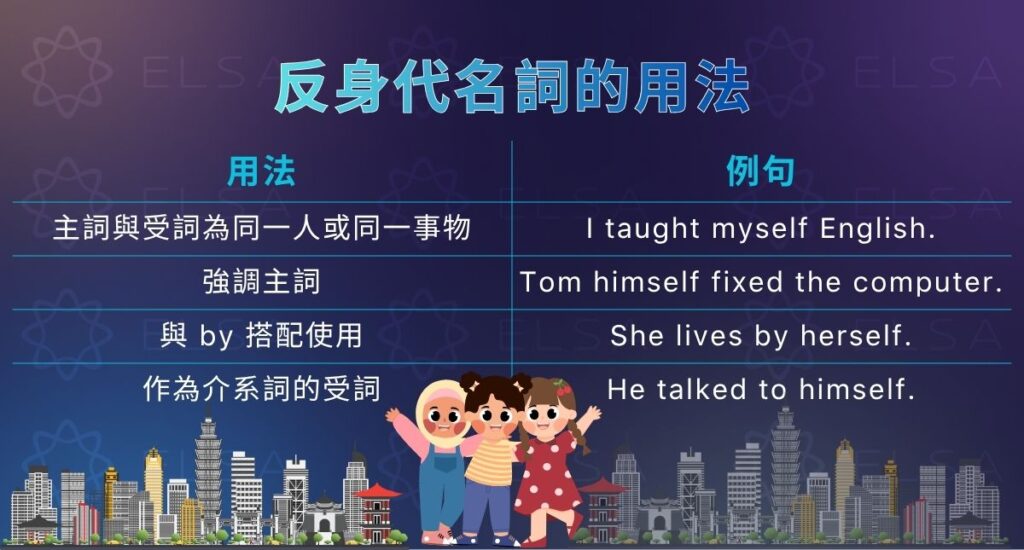
主詞和受詞指的是同一個人或事物
當主詞和受詞指涉同一人或事物時,使用反身代名詞。在這種情況下,反身代名詞充當動詞的受詞。
結構:
| S + V + Reflexive Pronoun |
例子:
- She hurt herself. (她傷害了自己。)
- I taught myself English. (我自學了英文。)
用於強調主詞
反身代名詞也用來強調主詞是執行動作的人,意思是 “自己”
結構:
| S + Reflexive Pronoun + V |
或者
| S + V + … + Reflexive Pronoun |
例子:
- Tom himself fixed the computer. (湯姆自己修好電腦了。)
- I finished the report myself. (我自己完成了報告。)
by 反身代名詞
反身代名詞by表示「自己」、「獨自」或「沒有他人協助」。
結構:
| by + Reflexive Pronoun |
例子:
- She lives by herself. (她單獨居住。)
- The child dressed by himself. (孩子自己穿好了衣服。)
反身代名詞作介詞的受詞
反身代名詞可以跟在某些介詞後面,表示指向主詞自身的動作。
| 短語 | 意思 | 例子 |
|---|---|---|
| about oneself | 自己 | She rarely talks about herself. (她很少談論自己。) |
| for oneself | 給自己 | You should decide for yourself. (你應該自己決定。) |
| to oneself | 跟自己 | He was talking to himself. (他在跟自己説話。) |
| with oneself | 對自己 | She is happy with herself. (她對自己很滿意。) |
在句子中反身代名詞位置
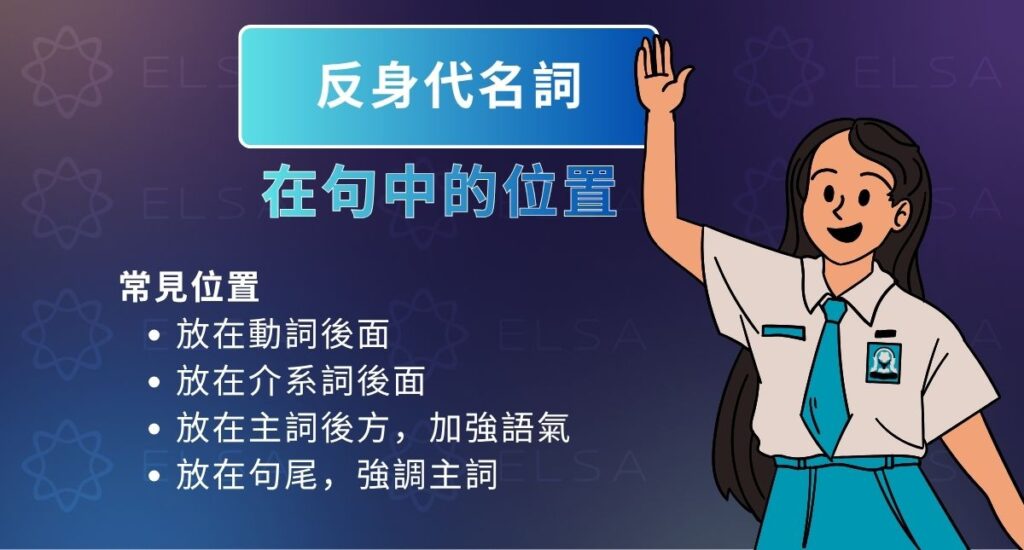
反身代名詞可以根據其用途出現在句子中的不同位置,例如作受詞或強調主詞。
| 位置 | 結構 | 例子 |
|---|---|---|
| 在動詞之後 | V + Reflexive Pronoun | She blamed herself. (她責怪自己。) |
| 介詞之後 | Prep + Reflexive Pronoun | He talked to himself. (他在和自己說話。) |
| 在主詞之後以强調 | S + Reflexive Pronoun + V | Tom himself solved it. (湯姆自己解決了這個問題。) |
| 在句尾加強語氣 | … + Reflexive Pronoun | I built the table myself. (這張桌子是我自己做的。) |
區分反身代名詞和其他代名詞
區分反身代名詞和強調代名詞
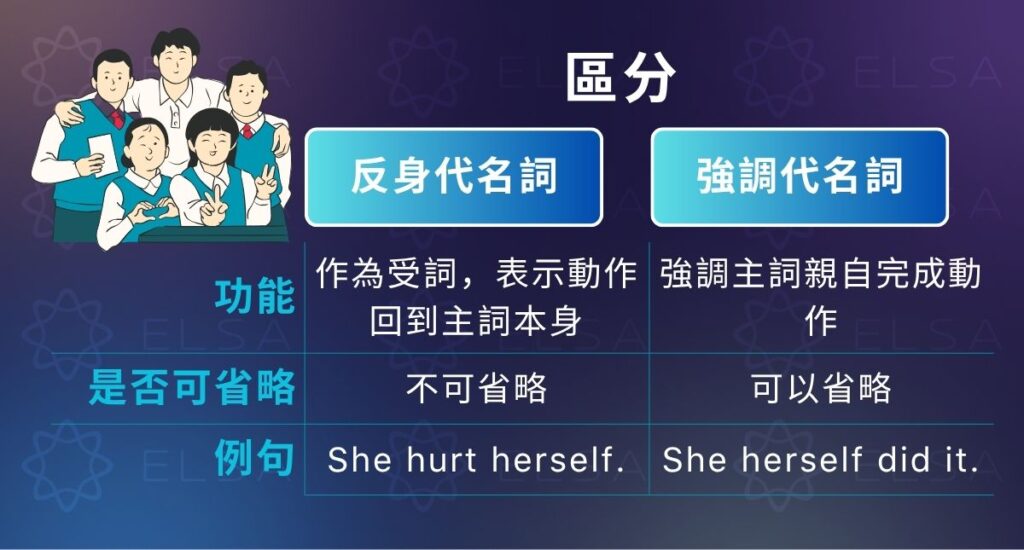
雖然它們形式相同(myself、yourself、himself…),但反身代名詞和強調代名詞在句子中具有不同的功能。
| 反身代名詞 | 強調代名詞 | |
|---|---|---|
| 功能 | 作為受詞,指主詞本身影響到他自己 | 強調主詞是直接執行動作的人。 |
| 可以省略 | 不可以 | 可以 |
| 例子 | She hurt herself. (她傷害了自己。) | She herself did it. (她自己做的。) |
區分人稱代名詞 反身代名詞
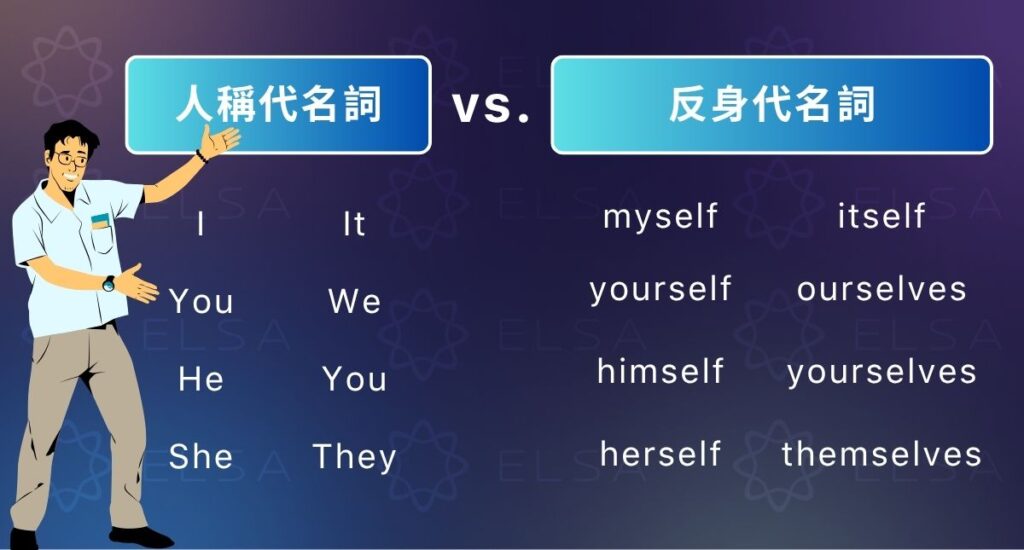
| 人稱代名詞 | 反身代名詞 | |
|---|---|---|
| 功能 | 將主詞或受詞替換為人或物。 | 表示動作回到主詞本身,或用來強調主詞。 |
| 位置 | 在句子中充當主詞或受詞 | 通常放在動詞之後、介詞之後,或用來強調主詞。 |
| 常用詞 | I, me, you, he, him, she, her, it, we, us, they, them | myself, yourself, himself, herself, itself, ourselves, yourselves, themselves |
| 例子 | She called him. (她打了電話給他。) | She hurt herself. (她傷害了自己。) |
| 注意事項 | 主詞和受詞是兩個不同的對象。 | 主詞和受詞是同一個人或事物,或用來強調主詞。 |
反身代名詞 練習及答案
練習
反身代名詞題目:選出正確的答案完成句子。
1. She looked at ________ in the mirror.
A. her
B. herself
C. hers
D. she
2. We enjoyed ________ during the holiday.
A. us
B. ourselves
C. our
D. ours
3. Tom fixed the bike by ________.
A. himself
B. him
C. his
D. he
4. I introduced ________ to the new teacher.
A. me
B. mine
C. myself
D. my
5. The children behaved ________ at school.
A. them
B. themselves
C. their
D. they
6. Please help ________ to some fruit.
A. yourself
B. your
C. yours
D. you
7. She blamed ________ for the mistake.
A. her
B. herself
C. hers
D. she
8. My father repaired the car ________.
A. himself
B. him
C. his
D. he
9. They kept the secret to ________.
A. themselves
B. them
C. their
D. theirs
10. I taught ________ how to cook.
A. myself
B. me
C. mine
D. my
練習 2:用適當的反身代名詞填空。
- I taught ________ to play the guitar.
- She looked at ________ in the mirror.
- They enjoyed ________ at the concert.
- We prepared the meal by ________.
- The cat cleaned ________ after eating.
- Please make ________ at home.
- Tom introduced ________ to the audience.
- You should believe in ________.
- The children dressed ________ before school.
- He often talks to ________ while working.
答案
練習1:
| 句子 | 1 | 2 | 3 | 4 | 5 |
| 答案 | B | B | A | C | B |
| 句子 | 6 | 7 | 8 | 9 | 10 |
| 答案 | A | B | A | A | A |
練習 2:
| 句子 | 1 | 2 | 3 | 4 | 5 |
| 答案 | myself | herself | themselves | ourselves | itself |
| 句子 | 6 | 7 | 8 | 9 | 10 |
| 答案 | yourself | himself | yourself | themselves | himself |
掌握反身代名詞的用法、意思與位置以及在句子中的位置,能讓你更自然、更準確地使用英語。別忘了複習反身代名詞表格,多做反身代名詞練習,以便長期記住這些知識。歡迎前往 ELSA Speak 閱讀更多英語文法相關文章。
代名詞 (Pronouns) 是用來代替名詞或名詞片語的詞,以避免重複。 ELSA Speak 將幫助你理解代名詞是什麼、代名詞 意思,掌握常見的代名詞類型,以及詳細的代名詞用法以便在英語中準確使用它們。
英文的代名詞是什麼?
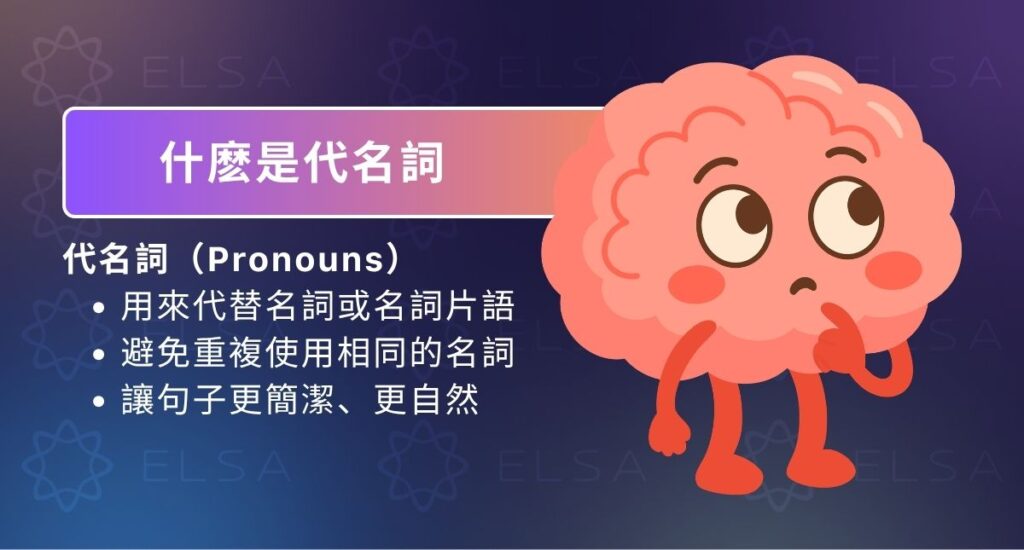
代名詞 英文 (Pronouns) 是用來代替已經提及的名詞或名詞片語的詞,可以避免重複,使句子更簡潔自然。被代名詞取代的名詞稱為先行詞或前綴。
例子:
- Linda is my friend. She is very kind. (Linda 是我的朋友,她人很好。)
- The twins went home because they were tired. (那對雙胞胎因為累了,所以回家了。)
了解更多英文詞性:所有關於八種英文詞性:用法、例子及在句子中的位置
代名詞有哪些?
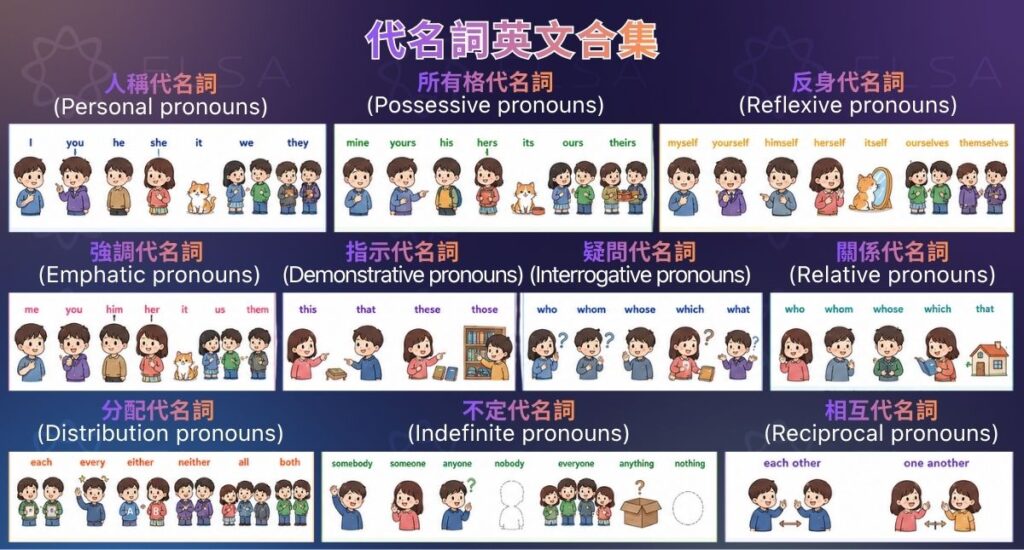
| 代名詞的類型 | 功能 | 例子 |
|---|---|---|
| 人稱代名詞 (Personal Pronouns) | 用來代替人、事物或概念 | I, you, he, she, it, we, they |
| 所有格代名詞 (Possessive Pronouns) | 指所有權 | mine, yours, his, hers, ours, theirs |
| 反身代名詞 (Reflexive Pronouns) | 表示動作回到主詞本身 | myself, yourself, himself, herself |
| 指示代名詞 (Demonstrative Pronouns) | 指具體的人或事物 | this, that, these, those |
| 疑問代名詞 (Interrogative Pronouns) | 用於提問 | who, whom, what, which, whose |
| 關係代名詞 (Relative Pronouns) | 連接從句並為名詞添加訊息 | who, whom, whose, which, that |
| 不定代名詞 (Indefinite Pronouns) | 指不明確的人或物 | someone, anyone, everyone, nothing |
| 相互代名詞 (Reciprocal Pronouns) | 表示兩個或多個人(或事物)彼此之間的互動 | each other, one another |
英文人稱代名詞
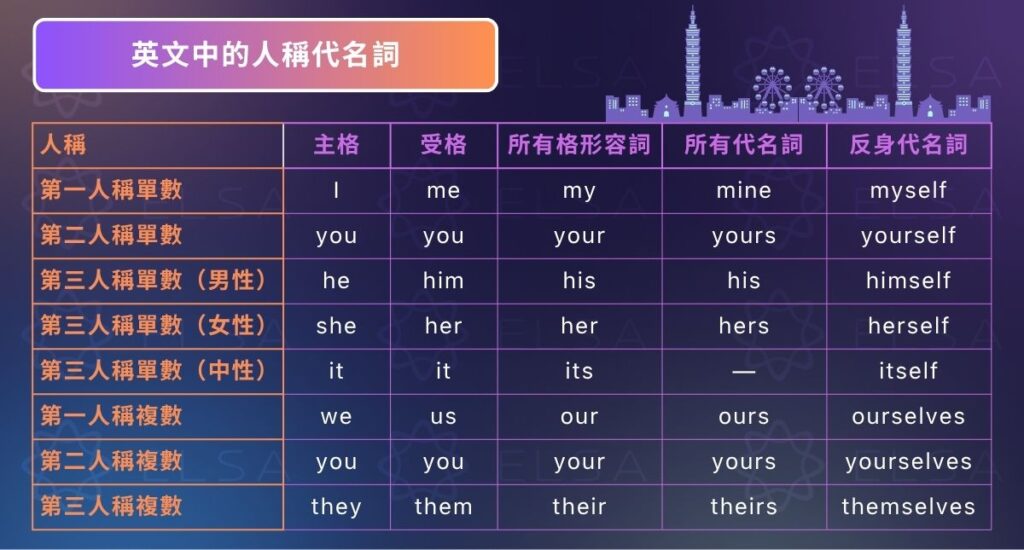
完整的人稱代名詞表
| 類別 | 主格代名詞 | 代名詞受格 | 所有格形容詞 | 所有格代名詞 | 反身代名詞 |
|---|---|---|---|---|---|
| 第一人稱單數 | I | me | my | mine | myself |
| 第二人稱單數 | you | you | your | yours | yourself |
| 第三人稱單數男性 | he | him | his | his | himself |
| 第三人稱單數女性 | she | her | her | hers | herself |
| 第三人稱單數中性 | it | it | its | — | itself |
| 第一人稱複數 | we | us | our | ours | ourselves |
| 第二人稱複數 | you | you | your | yours | yourselves |
| 第三人稱複數 | they | them | their | theirs | themselves |
主格代名詞 (Subject Pronouns)
主格代名詞用作句子的主語,指稱執行動作的人或物。這類代名詞通常位於動詞之前。
主格代名詞包括: I, you, he, she, it, we, they.
例子:
- She speaks English well. (她英語說得很好。)
- They are my classmates. (他們是我的同學。)
受格代名詞 (Object Pronouns)
受格代名詞用作動詞或介詞的受詞,指涉受該動作影響的人或物。這類代名詞通常位於動詞或介詞之後。
受格代名詞包括: me, you, him, her, it, us, them.
例子:
- The teacher called me. (老師打電話給我了。)
- Please talk to him. (請和他聊聊。)
區分主格代名詞和受格代名詞
| 主格代名詞 | 受格代名詞 | |
|---|---|---|
| 位置 | 通常位於動詞之前 | 通常位於動詞或介詞之後 |
| 功能 | 作主語 | 作受詞 |
| 代詞 | I, you, he, she, it, we, they | me, you, him, her, it, us, them |
| 例子 | She likes Tom. (她喜歡湯姆。) | Tom likes her. (湯姆喜歡她。) |
遇到複合關係代名詞的注意事項
複合關係代名詞 (Compound Relative Pronouns) 如 whoever, whomever, whichever, whatever 用來指任何人、物或事件,也可以用來連接從句,而無需在其前面加上名詞。
| 複合關係代名詞 | 意思 | 例子 |
|---|---|---|
| whoever | 任何人 | Whoever arrives first can choose a seat. |
| whomever | 任何人 (受詞) | You can invite whomever you like. |
| whatever | 任何 | Take whatever you need. |
| whichever | 任何哪個 | Choose whichever you prefer. |
句中的 prefer 用來表達個人的選擇與偏好,想進一步了解 prefer 的句型與用法,可以參考 prefer 用法。
注意: 與 who、which 和 that 不同,複合關係代名詞不需要前面有名詞(先行詞),而可以單獨作子句的主詞或受詞。因此,它們常用於表達 “任何…“或“無論…“的意思。
閲讀更多:從屬連接詞 (Subordinating Conjunctions): 常見從屬連接詞與用法
所有格代名詞和所有格形容詞
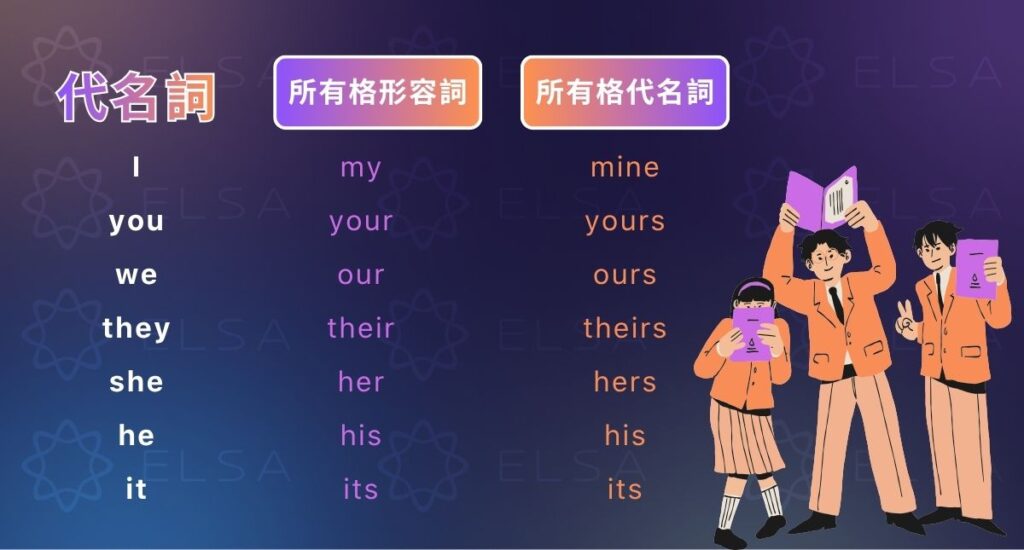
所有格形容詞和所有格代名詞都用來表示所有權,但它們在句子中的用法完全不同。
所有格代名詞(Possessive Pronouns)是什麽?
所有格代名詞 用來表示所有格,可以取代所有格形容詞和名詞,有助於避免句子中的重複。
所有格代名詞 包括: mine, yours, his, hers, ours, theirs.
例子:
- This book is mine. (這本書是我的。)
- That car is theirs. (那輛車是他們的。)
所有格形容詞(Possessive Adjectives)是什麽?
所有格形容詞 用於表示所有權,並且總是位於它所修飾的名詞之前。
所有格形容詞包括: my, your, his, her, its, our, their.
例子:
- This is my book. (這是我的書。)
- Their house is large. (他們的房子很大。)
區分所有格形容詞和所有格代名詞
| 所有格形容詞 | 所有格代名詞 | |
|---|---|---|
| 功能 | 修飾名詞以表示所有權。 | 替換整個所有格名詞片語。 |
| 結構 | 所有格形容詞 + 名詞 | 單獨存在,不與名詞連用。 |
| 例子 | This is my bag. | This bag is mine. |
反身代名詞和強調代名詞
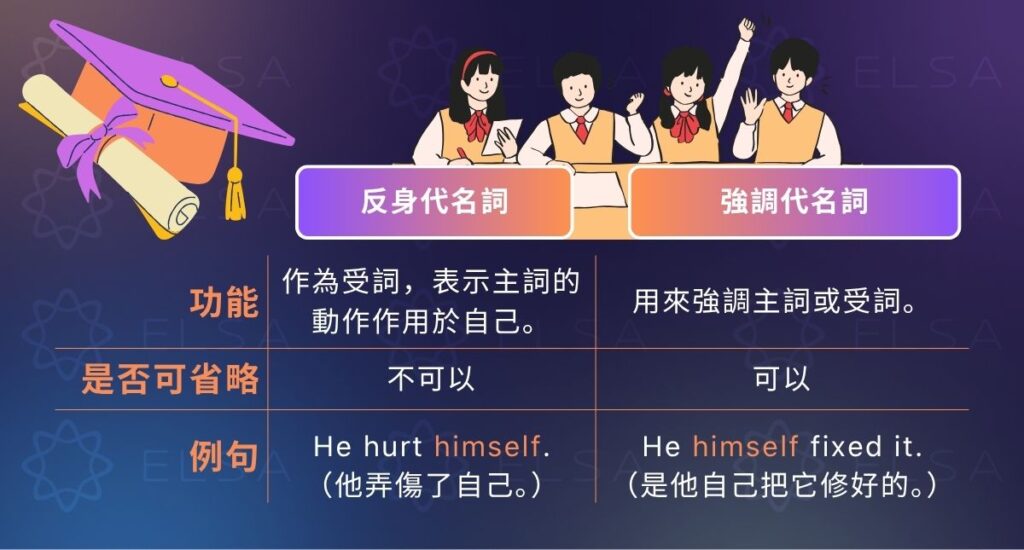
反身代名詞和強調代名詞形式相似(myself、yourself、himself…),但它們在句子中的功能不同。因此,你需要清楚地區分它們,才能在適當的脈絡中正確使用。
反身代名詞 (Reflexive Pronouns)
反身代名詞 用於當主詞和受詞指涉同一人或事物時。它通常作受詞,如果句子需要受詞,則不能省略。
反身代名詞包括: myself, yourself, himself, herself, itself, ourselves, yourselves, themselves.
例子:
- She hurt herself. (她傷害了自己。)
- I taught myself English. (我自學了英文。)
強調代名詞 (Intensive Pronouns)
強調代名詞用於強調句子中的主詞或受詞。與反身代名詞不同,強調代名詞可以省略,而不會影響語法正確性。
例子:
- I made this cake myself. (這個蛋糕是我自己做的。)
- The manager himself called me. (經理親自打電話給我。)

不要錯過具有大量功能的英語學習包
ELSA Premium 終身 – 十月優惠
原價:7,150元 現在 4,215 元
ELSA Premium 還有另外以下的學習包:
ELSA Premium 一年:原價:5,250元 現在 2,199 元
ELSA Premium 三個月:原價:2,100元 現在 1,140 元
區分反身代名詞和強調代名詞
| 反身代名詞 | 強調代名詞 | |
|---|---|---|
| 功能 | 作為受詞,表示主體正在作用於自身。 | 強調主詞或受詞。 |
| 可以省略 | 不可以 | 可以 |
| 例子 | He hurt himself. (他傷害了自己。) | He himself fixed it. (他自己把它修好了。) |
指示代名詞 (Demonstrative Pronouns)
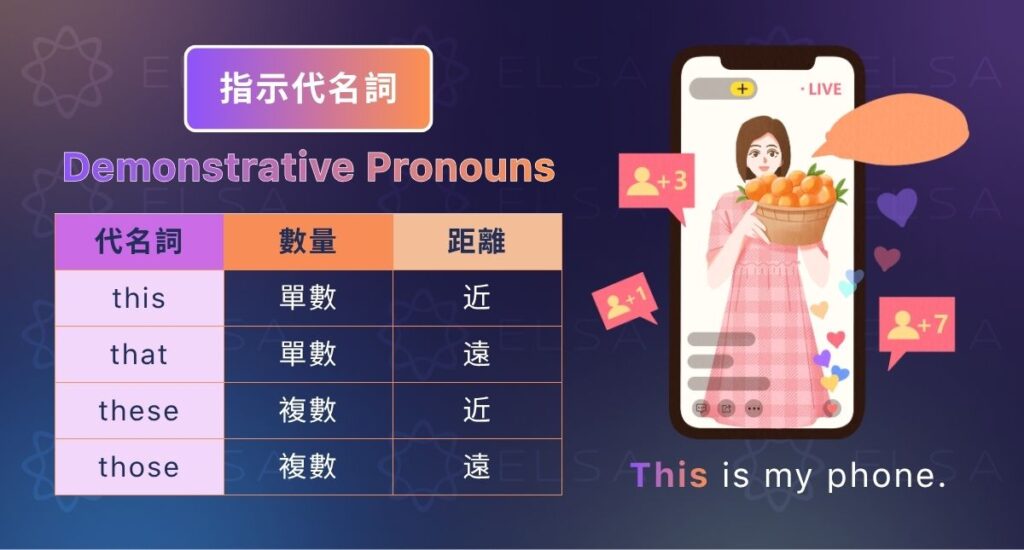
指示代名詞用於根據數量(單數或複數)和與說話者的距離(近或遠)來指具體的人或事物。
指示代名詞包括: this, that, these, those.
| 代名詞 | 數量 | 距離 |
|---|---|---|
| this | 單數 | 近 |
| that | 單數 | 遠 |
| these | 複數 | 近 |
| those | 複數 | 遠 |
例子:
- This is my phone. (這是我的手機。)
- Those are my shoes. (那些是我的鞋子。)
疑問代名詞 (Interrogative Pronouns)
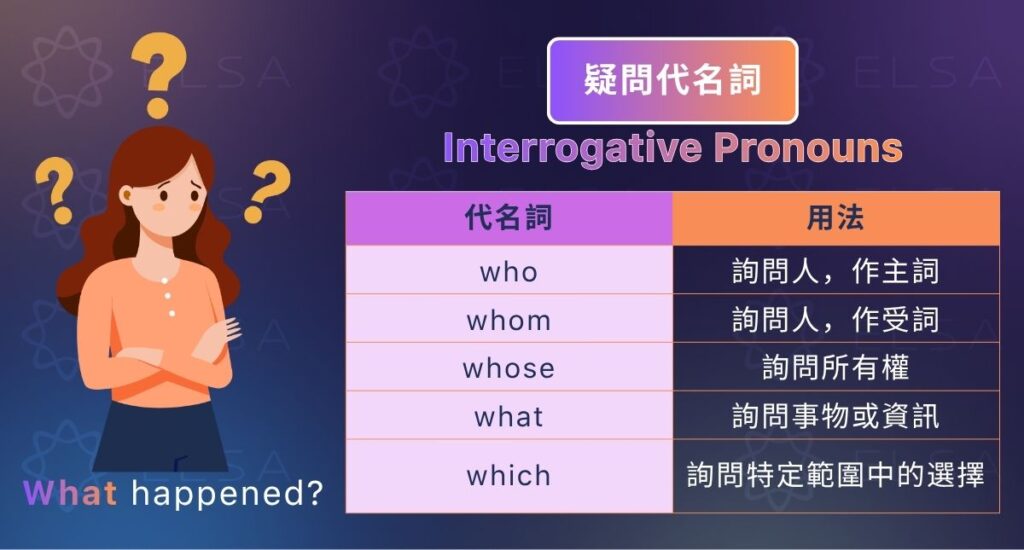
疑問代名詞用於提問有關人、事物、選擇或所有權。常見的疑問代名詞包括:who、whom、whose、what 和 which。
| 代名詞 | 用法 | 例子 |
|---|---|---|
| who | 詢問有關人,作主語 | Who called you? (誰打電話給你?) |
| whom | 詢問有關人,作受詞 | Whom did you meet? (你遇到了誰?) |
| whose | 詢問所有權 | Whose bag is this? (這是誰的包包?) |
| what | 詢問有關事物或訊息 | What happened? (發生了什麼事?) |
| which | 詢問具體群體內的選擇。 | Which do you prefer? (你比較喜歡哪一個?) |
關係代名詞 (Relative Pronouns)
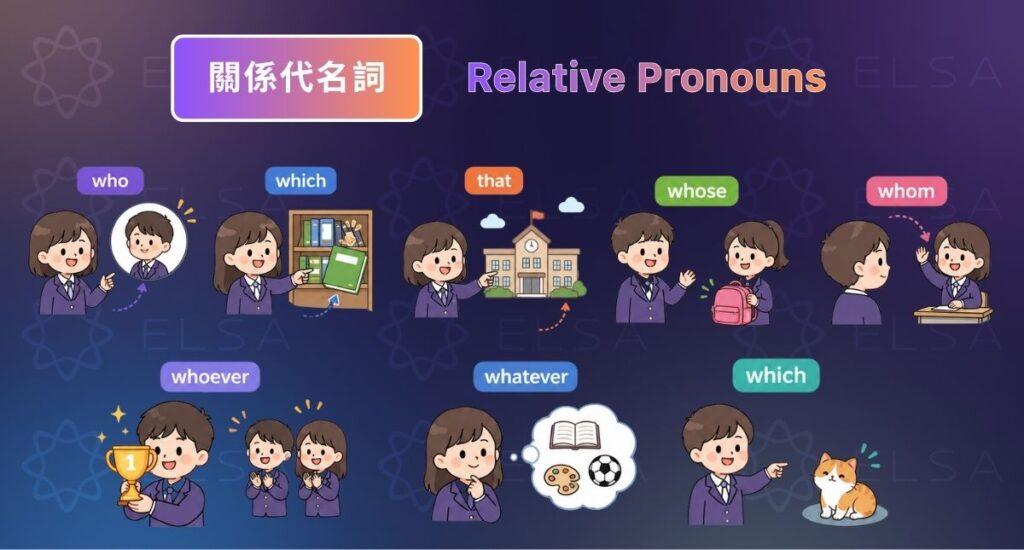
關係代名詞用於將關係子句與前面的名詞連接起來,幫助補充或澄清有關人、事物或事件的資訊。
常用關係代名詞包括: who, whom, whose, which 和 that.
| 代名詞 | 替代為 | 用法 |
|---|---|---|
| who | 人 | 作主語 |
| whom | 人 | 作受詞 |
| whose | 人或物 | 指所有格 |
| which | 事物 | 作主語或者受詞 |
| that | 人或物 | 作主語或者受詞 |
例子:
- The woman who called me is my teacher. (打電話給我的女士是我的老師。)
- This is the book that I bought. (這是我買的那本書。)
更多連接詞:連接詞(Conjunction): 意思、例句與在寫作與溝通中的用法
不定代名詞 (Indefinite Pronouns)
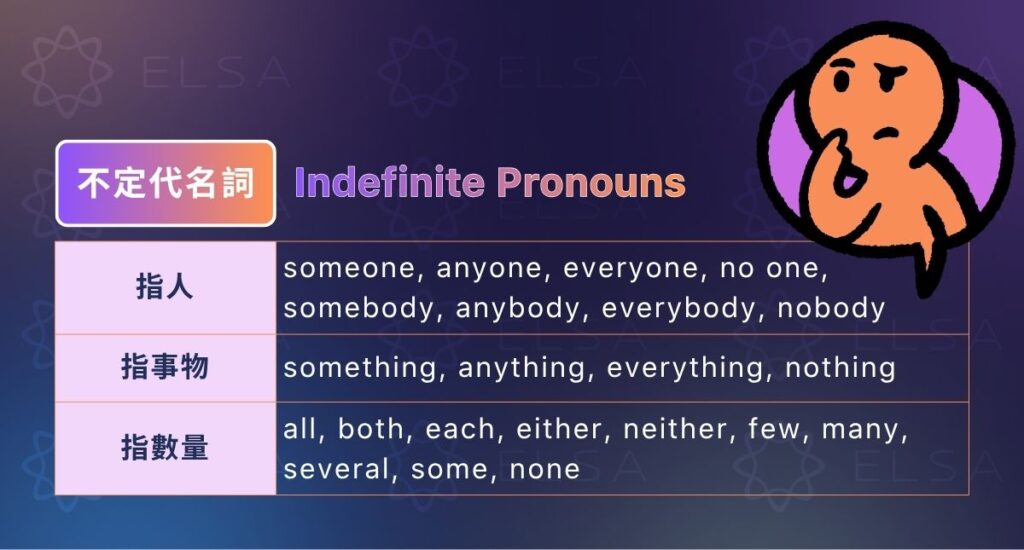
不定代名詞用於指稱未確定的人、物或數量。當無需或不可能精確指明所指物件時,通常使用這種表示方法。
| 不定代名詞分類 | 代名詞 |
|---|---|
| 指人的不定代名詞 | someone, anyone, everyone, no one, somebody, anybody, everybody, nobody |
| 指物的不定代名詞 | something, anything, everything, nothing |
| 指數量不定代名詞 | all, both, each, either, neither, few, many, several, some, none |
例子:
- Everyone is welcome. (歡迎所有人。)
- Nothing is impossible. (沒有什麼是不可能的。)
- Each has a different answer. (每個人都有不同的答案。)
相互代名詞 (Reciprocal Pronouns)
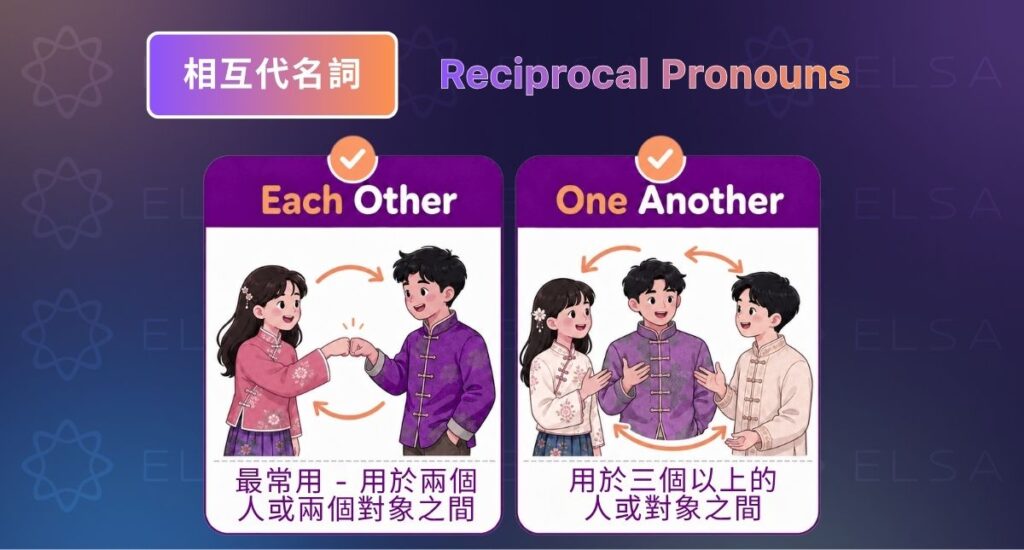
相互代名詞用來描述兩個或多個人或事物之間的相互行為。英文有兩個常用的相互代名詞:each other 和 one another。
| 代名詞 | 用法 |
|---|---|
| each other | 描述兩個人或兩個物體之間的互動(常用) |
| one another | 描述多人或多個對象之間的互動(目前經常與 each other 互換使用)。 |
例子:
- They help each other. (他們互相幫助。)
- The team members respect one another. (團隊成員互相尊重。)
英文代名詞總整理
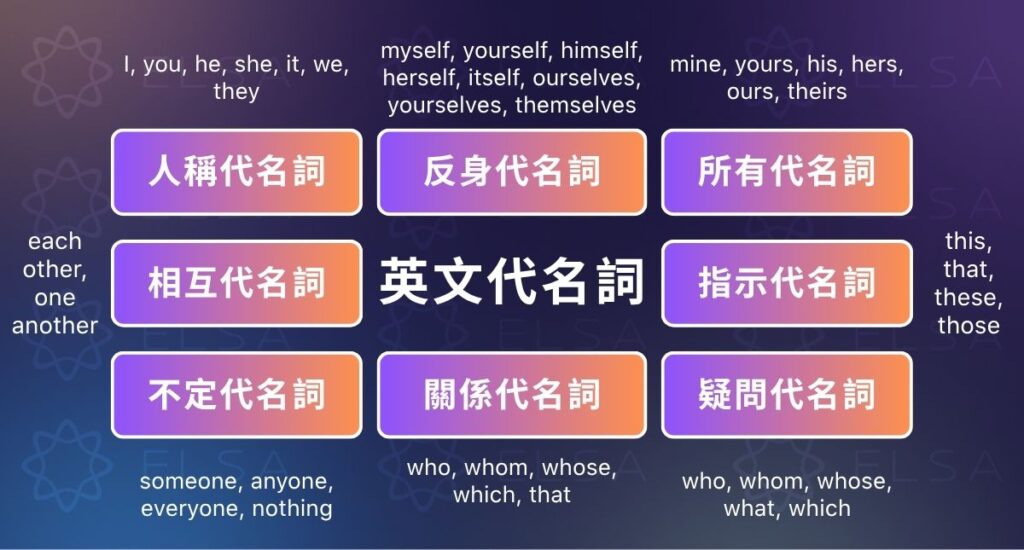
| 代名詞的類型 | 常用詞 |
|---|---|
| 人稱代名詞 | I, you, he, she, it, we, they |
| 所有格代名詞 | mine, yours, his, hers, ours, theirs |
| 反身代名詞 | myself, yourself, himself, herself, itself, ourselves, yourselves, themselves |
| 指示代名詞 | this, that, these, those |
| 疑問代名詞 | who, whom, whose, what, which |
| 關係代名詞 | who, whom, whose, which, that |
| 不定代名詞 | someone, anyone, everyone, nothing |
| 相互代名詞 | each other, one another |
句子中代名詞的位置
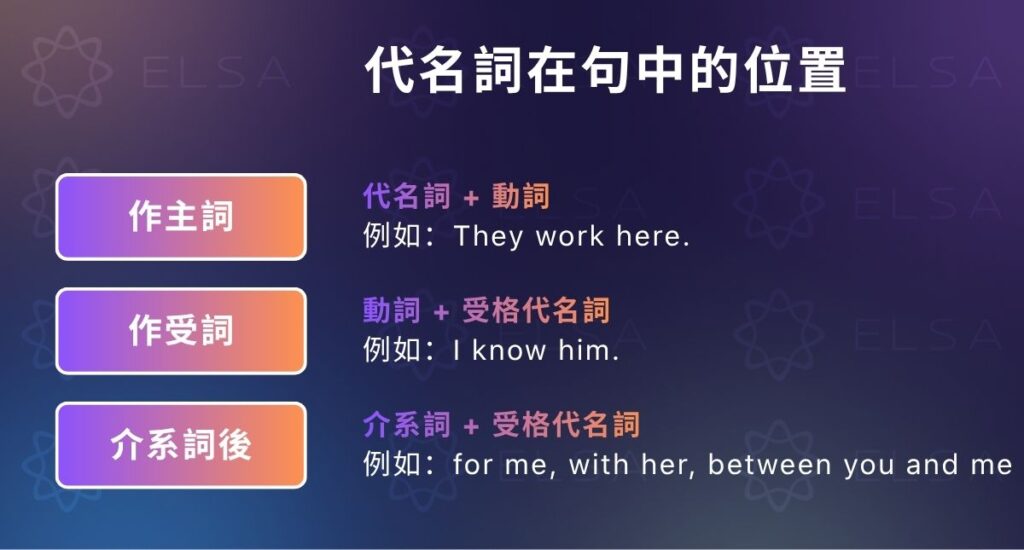
代名詞在句子中可以出現在許多不同的位置,這取決於它們的語法功能。以下是你應該記住的三種常見位置。
| 位置 | 結構 | 例子 |
|---|---|---|
| 代名詞作為主詞 | 代名詞 + 動詞 | They work here. |
| 代名詞作為受詞 | 動詞 + 受詞代名詞 | I know him. |
| 在介詞後 | 介詞 + 受詞代名詞 | for me, with her, between you and me |
代名詞練習及答案
練習
選出正確答案完成句子。
1. ________ is my best friend.
A. Him
B. He
C. Her
D. Me
2. The teacher asked ________ to answer the question.
A. I
B. She
C. Me
D. They
3. This pencil isn’t mine. It is ________.
A. her
B. hers
C. she
D. herself
4. Tom and Jack helped ________ finish the project.
A. themselves
B. ourselves
C. yourselves
D. himself
5. ________ book is this?
A. Who
B. Which
C. Whose
D. Whom
6. The woman ________ lives next door is a doctor.
A. whom
B. which
C. who
D. whose
7. ________ left the lights on before leaving the office.
A. Someone
B. Anyone
C. None
D. Everything
8. These shoes are old, but ________ are still comfortable.
A. it
B. they
C. them
D. their
9. Sarah and Emma always help ________.
A. one another
B. herself
C. himself
D. itself
10. I don’t have a blue pen. Can I borrow ________?
A. it
B. one
C. mine
D. myself
答案
| 句子 | 1 | 2 | 3 | 4 | 5 |
| 答案 | B | C | B | A | C |
| 句子 | 6 | 7 | 8 | 9 | 10 |
| 答案 | C | A | B | A | B |
10月特別優惠 —— ELSA 大促銷
ELSA PREMIUM 1 年
原價: 5,250
2,199
ELSA PREMIUM 終身
原價: 7,150
4,215
ELSA PRO 1 年
原價: 2,450
1,715
ELSA PRO 終身
原價: 6,150
2,568
常見問題
代名詞 “it” 和 “one” 是如何使用的?
- It 用來指稱先前已提及的人、物或事件,也可以指天氣、時間或距離。
- One 用來替代單數可數名詞,以避免重複。
例子:
- I bought a new phone. It is very fast. (我買了一部新手機,它非常快。)
- I need a pen. Do you have one? (我需要一支筆。你有一支嗎?)
性別認同代名詞有哪些?
在現代英語中,除了傳統的男性/女性代名詞(如 he/him 和 she/her)之外,許多人還會使用性別認同代名詞,例如 they/them (中性)、ze/zir 或 xe/xem。其中,they/them 是最常使用的中性代名詞。
例子: Alex said they will join us later. (Alex 表示自己稍後會加入我們。)
代名詞英文縮寫是什麽?
→ 在英語文法中,代名詞 (pronoun) 通常縮寫為 pron。
代名詞是英語中不可或缺的一部分,它能讓句子更簡潔、連貫、自然。掌握各類代名詞英文如人稱代名詞、所有格代名詞、反身代名詞、關係代名詞、不定代名詞和指示代名詞的特點和用法,將有效提升你的溝通技巧以及閱讀和寫作能力。進入 ELSA Speak 網站的英語文法專欄,閱讀更多實用文章吧!
未來簡單式是小學到中學階段必學的12 英文時態之一。掌握未來簡單式公式、理解 will 和 be going to 的用法,並了解未來簡單式 未來進行式的差別,將幫助你在英文考試與日常溝通中更有自信。現在就跟著 ELSA Speak 一起閱讀以下完整教學,快速掌握未來簡單式的核心概念吧!
未來簡單式(Simple Future Tense)是什麼?
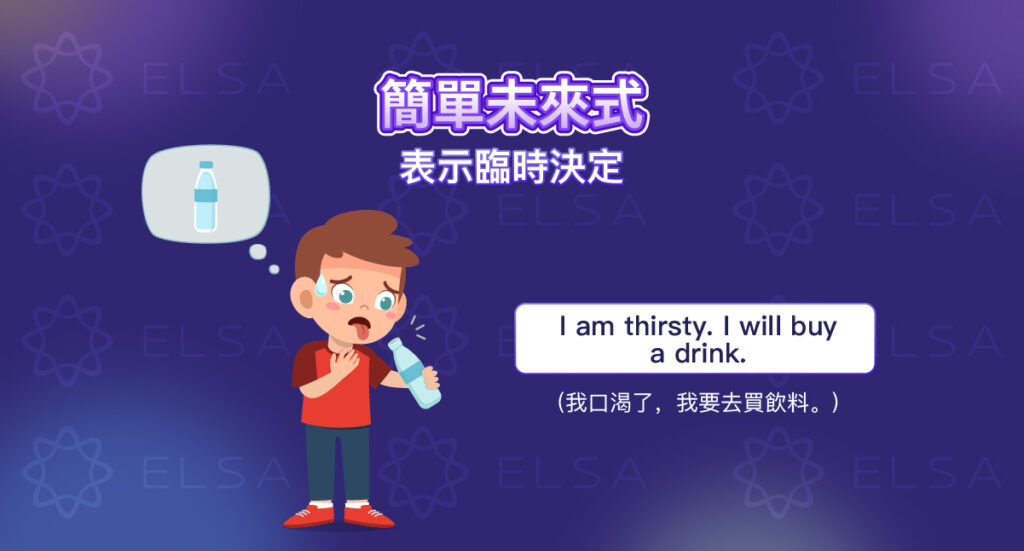
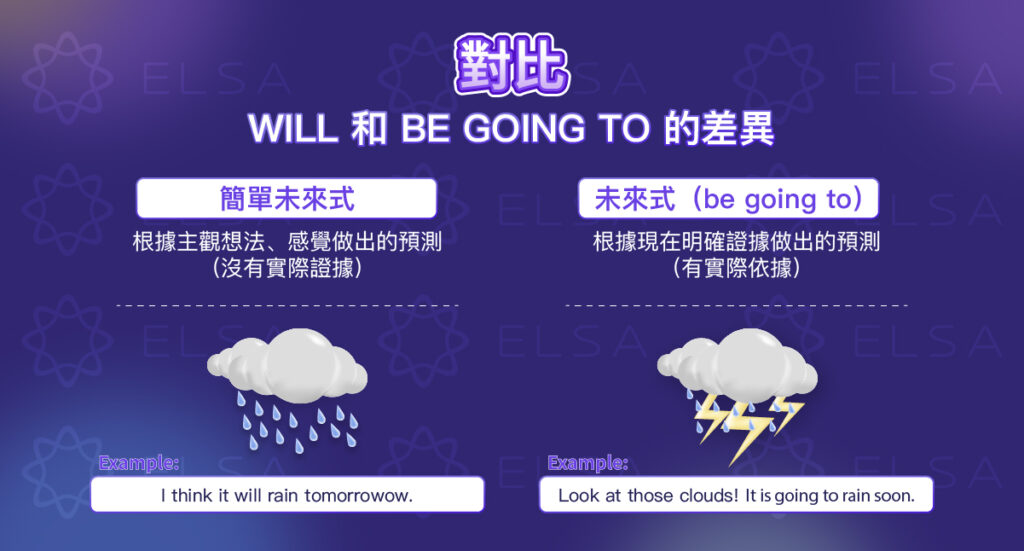
未來簡單式(Simple Future Tense)用來描述將來會發生的行動或事件,但這個決定是在說話的那一刻做出的,沒有事先計劃。
例子:I am thirsty. I will buy a drink.(我渴了,我會去買杯飲料。)
→ 因為口渴而當下做出的決定,並非事先打算購買
另外,這種時態也用於做出承諾、禮貌的請求或毫無根據的預測。
例子:I think it will rain tomorrow.(我想明天會下雨。)
→ 沒有任何實際證據支持這項推測。
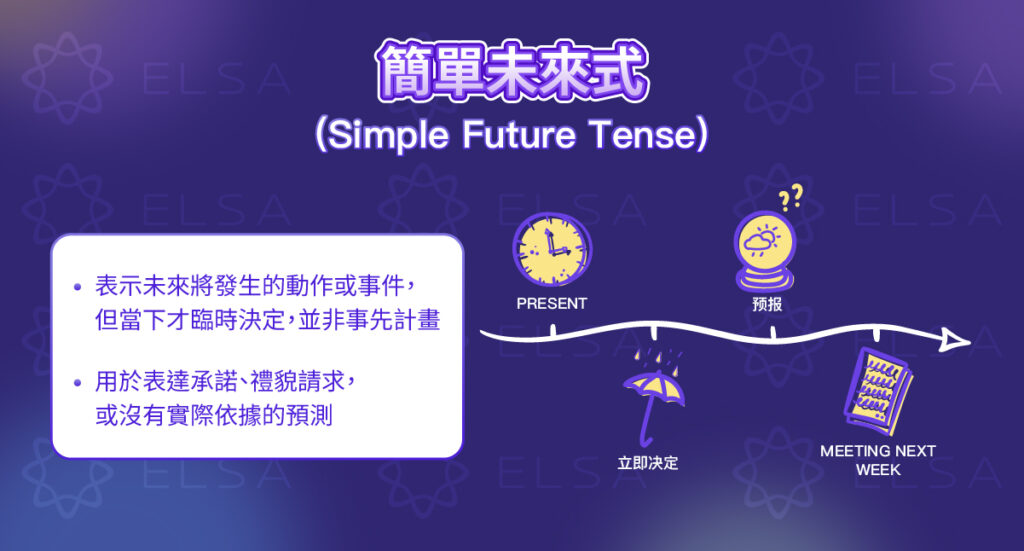
未來簡單式公式
未來簡單式公式根據你使用的是動詞to be還是一般動詞,它們可以分為兩大類:
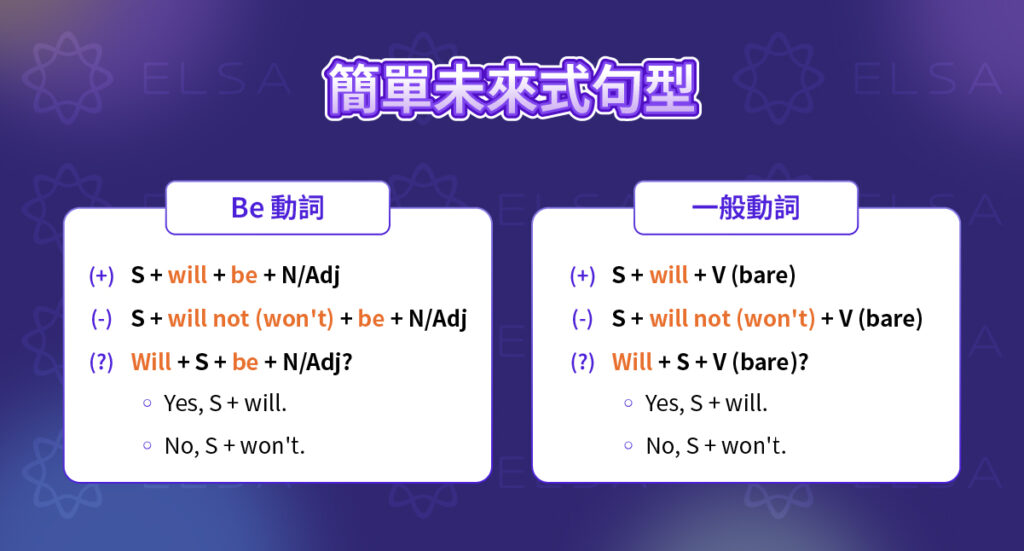
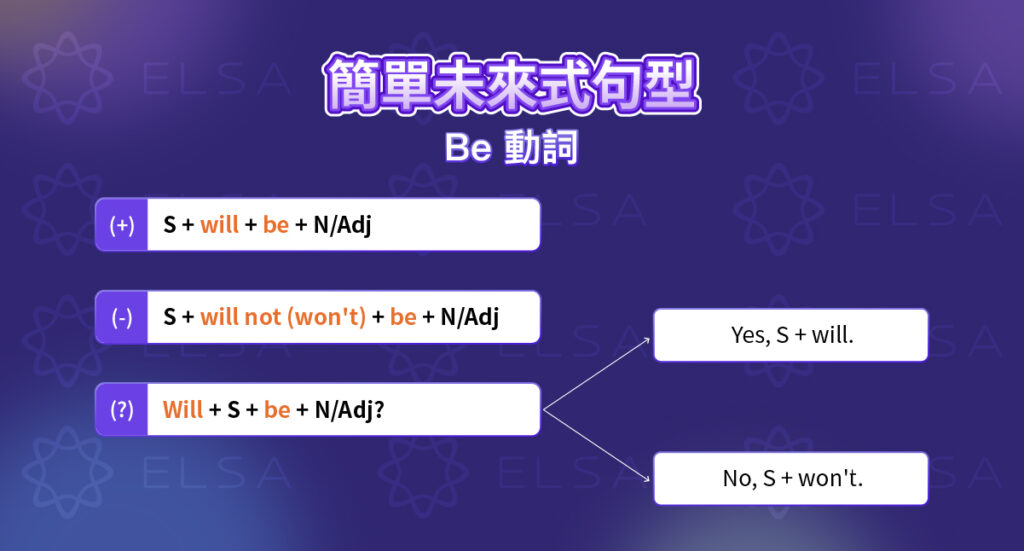
動詞to be的未來簡單式結構
用法:用來描述事物在未來的狀態、性質或位置。
肯定結構:
| S + will + be + N/Adj |
例子:I will be at home tomorrow.(我明天會在家。)
否定結構:Will not = Won’t
| S + will not (won’t) + be + N/Adj |
例子:She won’t be late.(她不會遲到的。)
疑問句結構:
| 疑問句: Will + S + be + N/Adj? | 回答: Yes, S + will. No, S + won’t. |
例子:Will it be cold tomorrow?(明天會冷嗎?)
一般動詞的未來簡單式公式
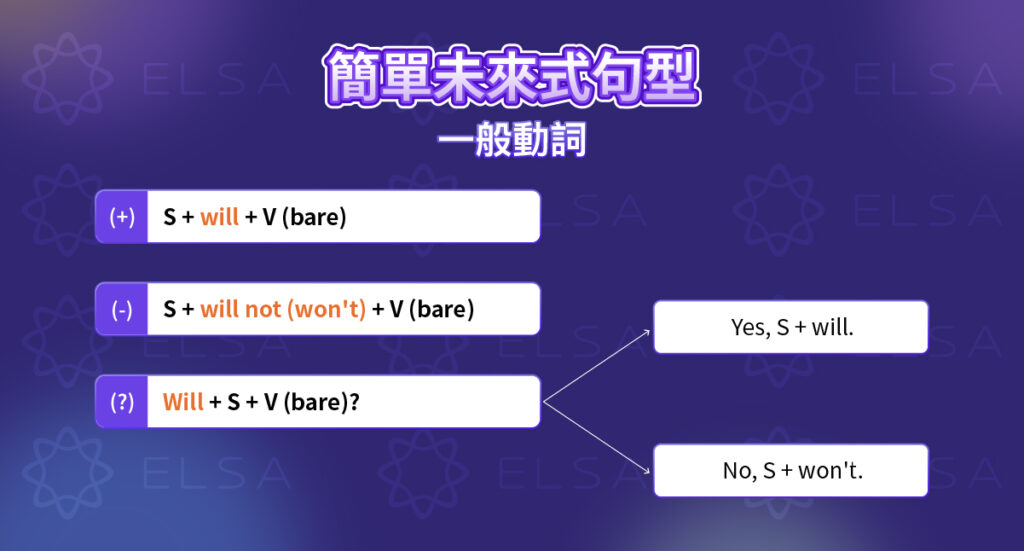
用法:用來表示將來會發生的具體動作。
肯定結構:
| S + will + V (bare) |
例子:They will buy a new car.(他們會買一輛新車。)
否定結構:
| S + will not (won’t) + V (bare) |
例子:They won’t buy a new car.(他們不會買一輛新車。)
疑問句結構:
| 疑問句: Will + S + V (bare)? | 回答: Yes, S + will. No, S + won’t. |
例子:Will you come over tomorrow?(你明天會過來嗎?)
未來簡單式的常見用法
未來簡單式在日常溝通中非常實用,這主要歸功於以下四個你需要掌握的核心用法:
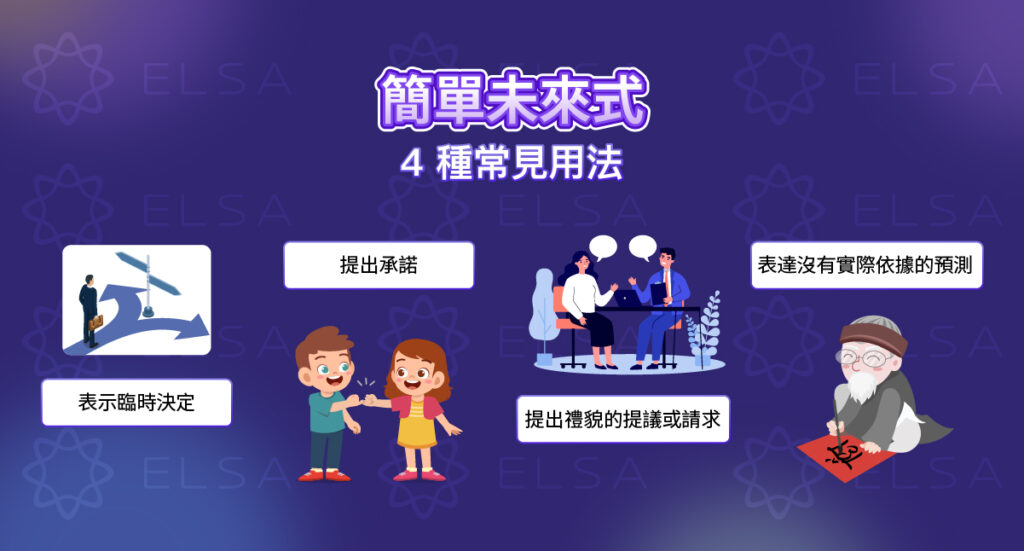
表示立即做出決定
這個決定是當場做出的,事先沒有任何計劃或意圖。
例子:It is freezing. I will turn on the heater.(太冷了。我會去開暖氣。)
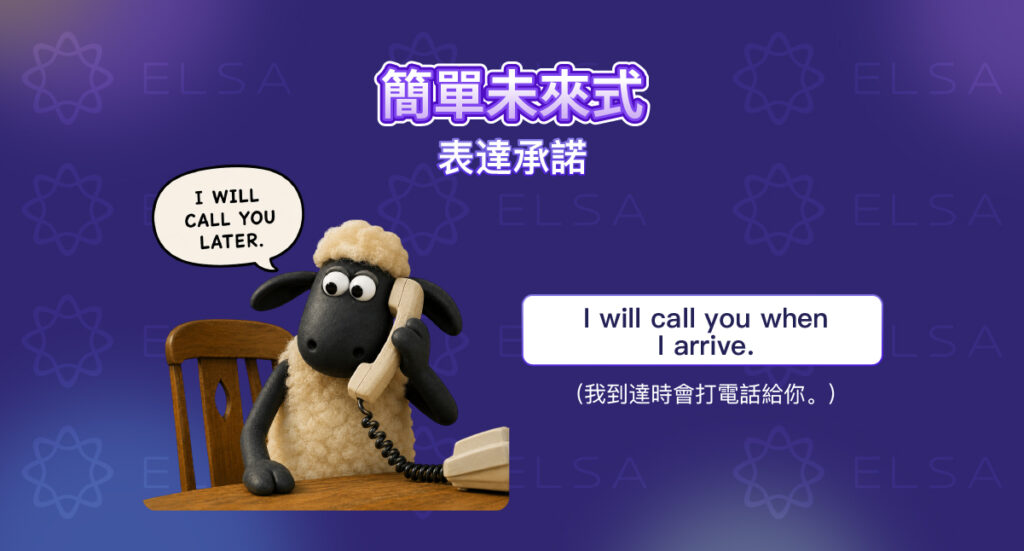
做出承諾 (Promise)
承諾在未來與某人採取某種行動。
例子:I will call you when I arrive.(我到達後會打電話給你。)
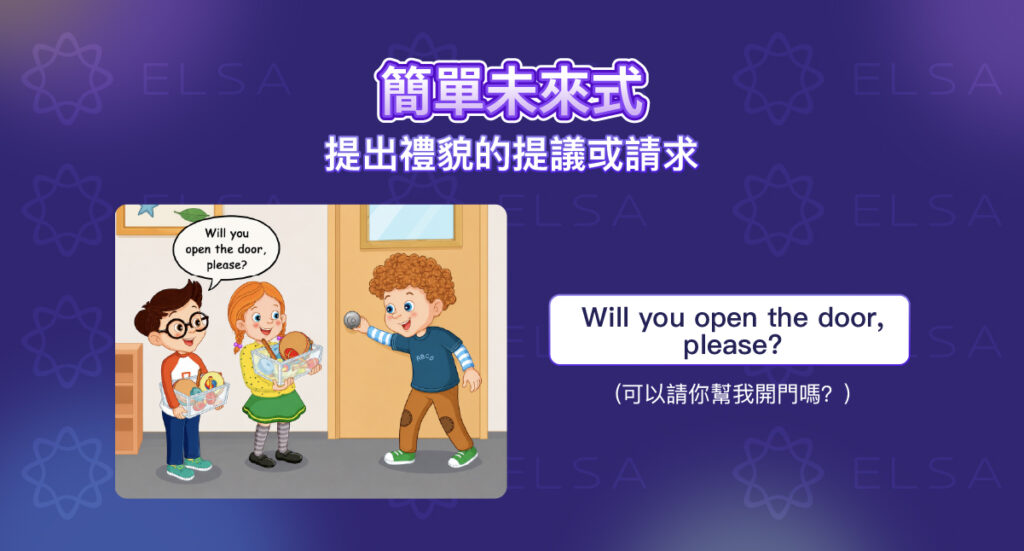
禮貌地提出提議或請求
禮貌而溫和地請某人做某事。
例子:Will you open the door, please?(請你開門好嗎?)
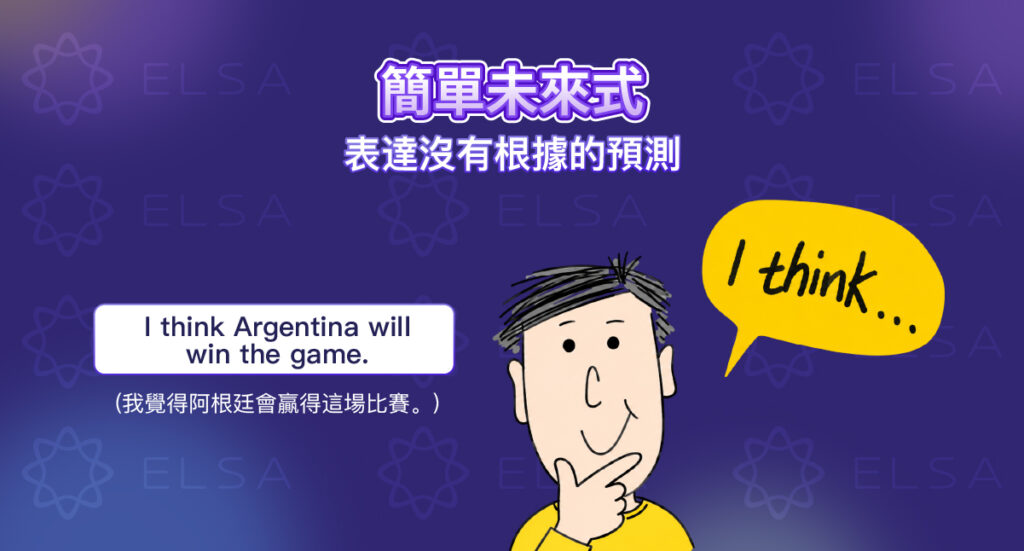
沒有現實依據的預測
預測是基於感覺或主觀個人意見(通常伴隨諸如think, believe, suppose)之類的詞語)。
例子:I think Argentina will win the game.(我認為阿根廷會贏得這場比賽。)
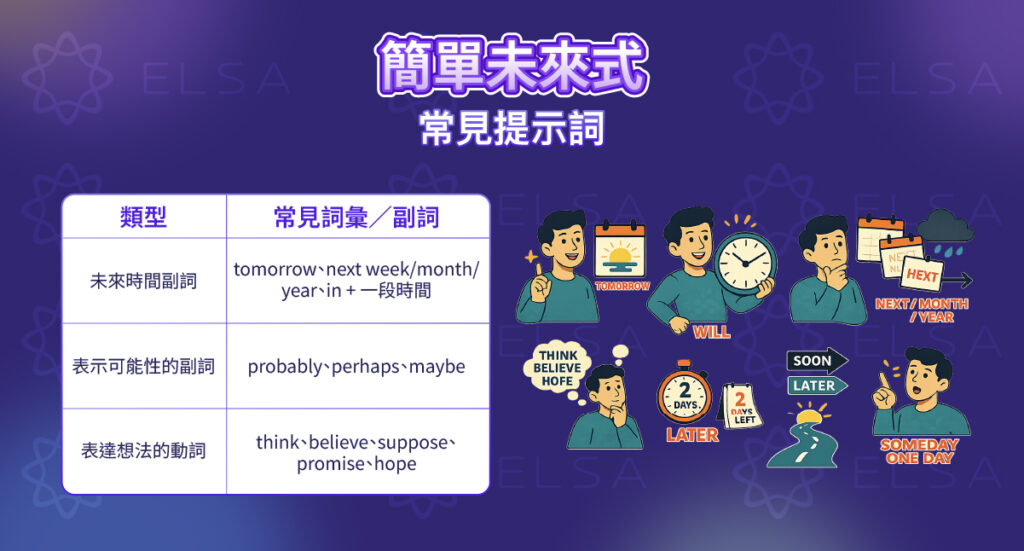
近未來式的訊號詞
在參加英文考試時,你可以根據句子中出現的表示未來式的字詞或意見副詞輕鬆辨識未來簡單式:
| 訊號詞 | 常用詞彙/副詞 | 例子 |
|---|---|---|
| 表示未來式的副詞 | tomorrow, next week/month/year, in + 時間段 | I will go shopping tomorrow. (我明天會去購物。) |
| 可能性副詞 | probably, perhaps, maybe | Perhaps he will come. (或許他會來。) |
| 表示意見的動詞 | think, believe, suppose, promise, hope | I think it will rain. (我覺得會下雨。) |
除了在未來簡單式中使用 think、believe 等動詞表達意見,也可以參考 認為 英文,進一步學習「認為」的其他實用英文表達方式。
閲讀更多:使役動詞 (Causative Verb): 定義、用法、結構和避免用錯的應用練
未來簡單式 未來進行式的差別
未來簡單式(Simple Future)和未來進行式(Future Continuous)都用來描述未來的事情,但兩者的用法有所不同。掌握兩種時態的差異,不僅能幫助你在英文寫作和口說中更精準地表達,也能提升考試作答的正確率。以下整理兩者的重點比較:
| 未來簡單式 (Simple Future Tense) | 未來進行式 (Future Continuous Tense) | |
|---|---|---|
| 句型 | S + will + V (bare) | S + will + be + V-ing |
| 用法 | 表示未來將發生的動作、臨時決定、承諾或主觀預測。 | 表示未來某個時間點正在進行中的動作。 |
| 時間概念 | 著重未來會發生的事件或結果。 | 著重未來某一時刻持續進行中的動作。 |
| 例句 | I will call you tonight.(我今晚會打電話給你。) → 表示未來將會發生的動作。 | This time tomorrow, I will be studying for my exam.(明天這個時候,我將正在準備考試。) → 強調未來某個時間正在進行的動作。 |
閲讀更多:現在完成式 (Present Perfect Tense): 公式、用法和應用練習
未來簡單式練習題(附答案)
以下是未來簡單式的練習題,旨在緊密貼合課程大綱和實際考試內容,幫助你有效鞏固知識:
練習1:使用括號中動詞的正確形式
題目:請將括號中的動詞改為未來簡單式(will),完成下列句子。
- I ________ (help) you with your homework tonight.
- She ________ (call) her parents after work.
- We ________ (visit) Taipei next month.
- They ________ (finish) the project on time.
- He ________ (not/forget) your birthday.
- ________ you ________ (join) us for dinner tomorrow?
- I think it ________ (be) sunny this weekend.
- My brother ________ (study) abroad next year.
- The teacher ________ (give) us a quiz next Monday.
- We ________ (have) a great time at the party.
練習1的詳細答案:
| 句子 | 答案 | 簡要說明 |
|---|---|---|
| 1 | will help | 未來簡單式肯定句:will + 原形動詞。 |
| 2 | will call | 表示未來將發生的動作。 |
| 3 | will visit | 描述未來的計畫或安排。 |
| 4 | will finish | 表示未來預期完成的動作。 |
| 5 | won’t forget | 未來簡單式否定句:will not (won’t) + 原形動詞。 |
| 6 | Will / join | 未來簡單式疑問句:Will + S + 原形動詞。 |
| 7 | will be | think 後常搭配未來簡單式表示主觀預測。 |
| 8 | will study | 描述未來將進行的事情。 |
| 9 | will give | 表示未來即將發生的動作。 |
| 10 | will have | 描述未來的事件或情況。 |
練習2:選出最佳答案
題目: 請選擇最準確的選項(A、B、C 或 D)完成以下句子:
- Are you busy tonight? Yes, I ________ a movie with my friend. I’ve already booked the tickets.
A. will watch
B. am going to watch
C. watched
D. watch - I am sure you ________ the exam easily.
A. will pass
B. are going to pass
C. pass
D. passes - We don’t have any milk left. Oh, really? I ________ some now.
A. am going to buy
B. will buy
C. bought
D. buy - Look! That tree ________.
A. will fall
B. is going to fall
C. falls
D. fell - I promise I ________ late again.
A. won’t be
B. am not going to be
C. wouldn’t be
D. am not - They ________ a new factory in this area next month.
A. will build
B. are going to build
C. build
D. built - I think it ________ sunny tomorrow.
A. will be
B. is going to be
C. is
D. was - Why is she learning Spanish? She ________ to Spain next summer.
A. will travel
B. is going to travel
C. travels
D. traveled - Perhaps they ________ the game tonight.
A. will win
B. are going to win
C. win
D. won - Watch out! You ________ yourself.
A. will hurt
B. are going to hurt
C. hurt
D. hurts
練習2的詳細答案:
| 句子 | 答案 | 簡要說明 |
|---|---|---|
| 1 | B | 事先計劃好,並且預訂了電影票。 |
| 2 | A | 主觀預測,通常在表示觀點的詞語 am sure後面 |
| 3 | B | 得知牛奶用完後,立即做出了這個決定。 |
| 4 | B | 基於直接可見證據的預測。(Look!). |
| 5 | A | 對未來的一份榮譽承諾(I promise). |
| 6 | B | 具體方案將於下個月實施。 |
| 7 | A | 預測是主觀的,在 think後面。 |
| 8 | B | 有目的、預先計劃好的行動。 (next summer). |
| 9 | A | 預測結果並不確定, 伴隨著副詞 perhaps. |
| 10 | B | 預測是根據説話時的實際情況做出的。 |
常見問題 (FAQ)
未來簡單式何時使用?
回答: 未來簡單式用於表達說話時衝動做出的決定、承諾、禮貌的請求或缺乏事實依據的情緒預測。
will 後面該用什麼動詞形式?
回答: will後面,對於句子的三種形式(肯定句、否定句和疑問句),我們都必須使用不含to的不定式(VR)。
Will 和 Shall 有什麼不同?
回答: Will 可以與所有主詞連用。 Shall 主要用於第一人稱單數/複數(I/We),用於禮貌的請求或徵求聽者的意見。
掌握未來簡單式,是學會表達未來計畫、承諾與預測的重要一步。想進一步熟悉 will 和 be Ving 的用法,並了解未來簡單式 未來進行式的差別,請每天在 ELSA Speak 智能應用程式上進行練習。此外,別忘了查看基礎英語文法主題中的其他實用文章,以快速提高你的英語水平!
現在完成進行式(Present Perfect Continuous Tense)是 12 英文時態中的一種,經常出現在實用考試和國際學術考試中。與 ELSA Speak 一起學習現在完成進行式用法,以及如何區分現在完成式和一般現在完成時,掌握如何表達動作的持續性!
現在完成進行式是什麼?
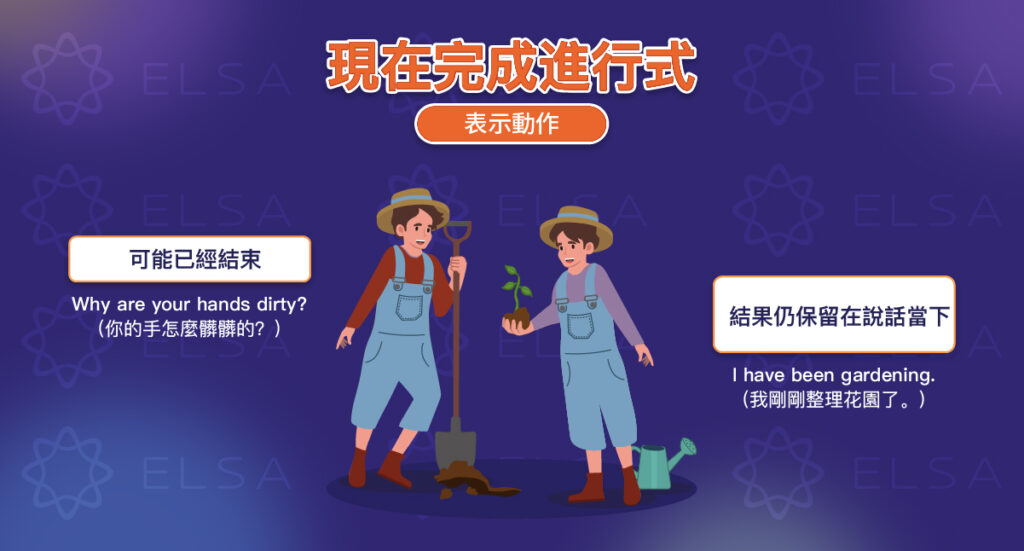
現在完成進行式(Present Perfect Continuous Tense)用來描述過去開始、持續至今的動作。這種時態強調動作的過程和連續性,而非最終結果。
現在完成進行式例句:
- I have been studying English for 3 years.(我學習英語已經三年了。)
- It has been raining all morning.(整個上午都在下雨。)
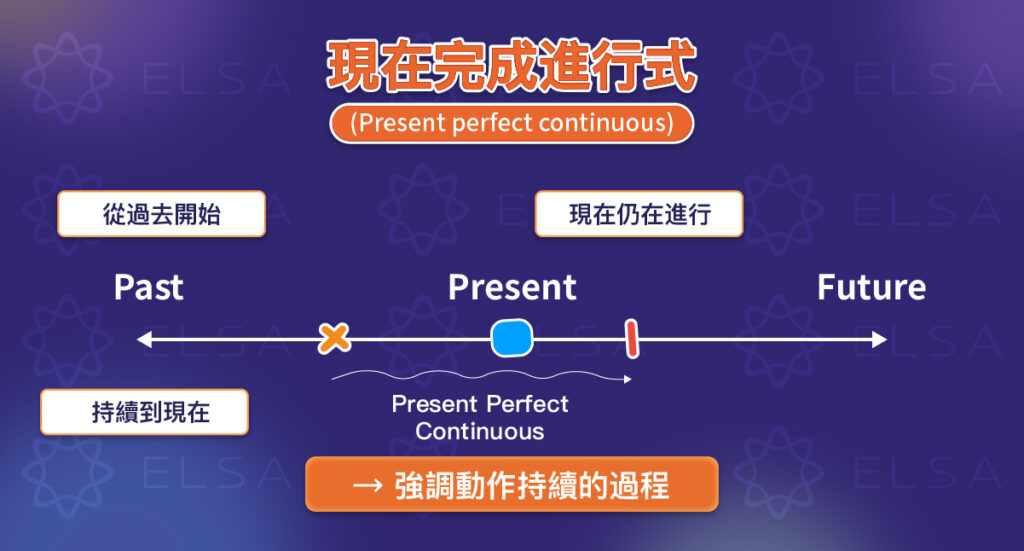
現在完成進行式結構
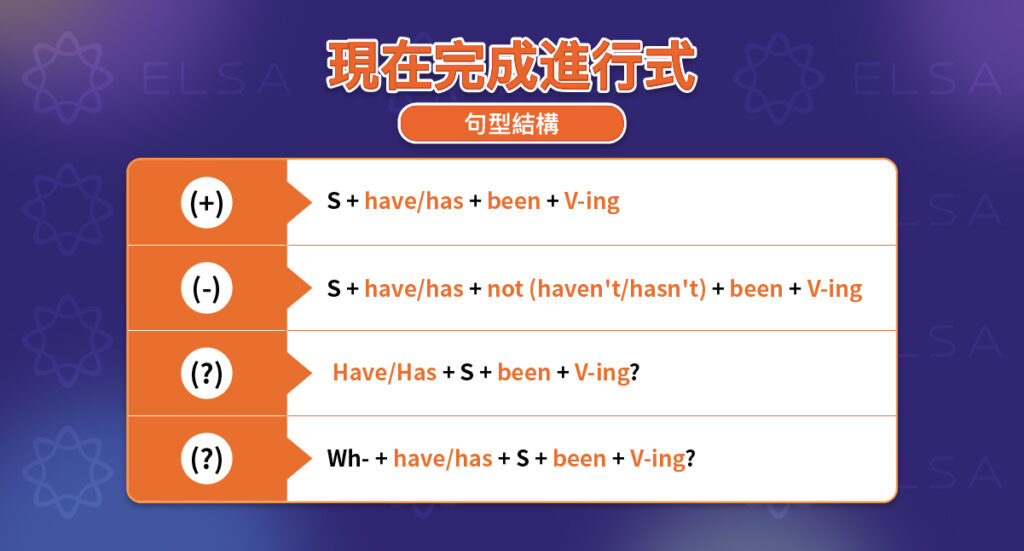
現在完成進行式的結構是由助動詞和現在分詞(V-ing)組合而成:
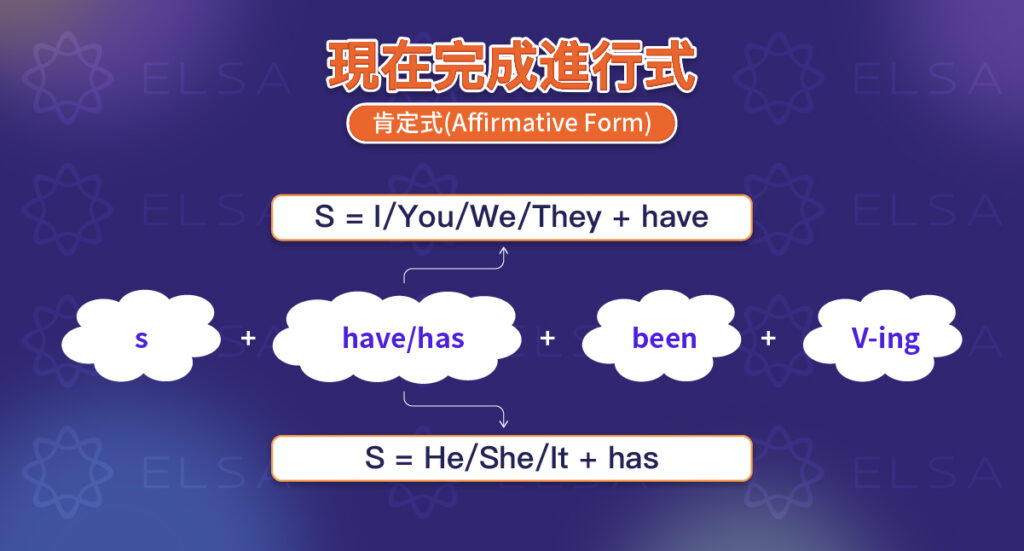
肯定式 (Affirmative Form)
用法:將助動詞 have 或 has 與 been 和以 -ing 結尾的動詞一起使用
結構:
| S + have/has + been + V-ing |
請注意主題:
- S = I/You/We/They + have.
- S = He/She/It + has.
例子:
- She has been working here since Monday. (她從星期一開始就在這裡工作了。)
- We have been waiting for an hour. (我們已經等了一個小時了。)
否定式 (Negative Form)
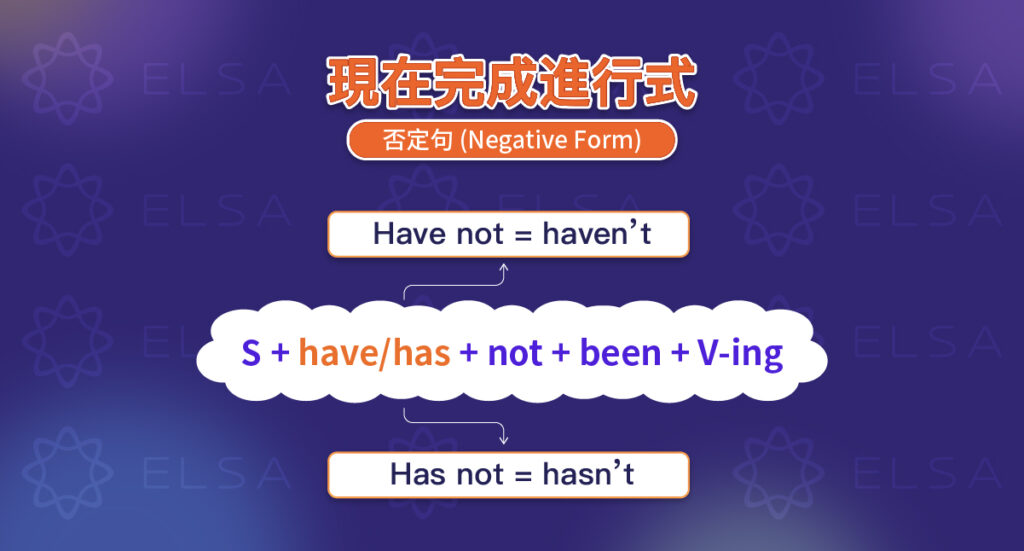
用法:在助動詞“have”或“has”之後立即加上“not”
結構:
| 現在完成進行式(Present Perfect Continuous Tense) |
例子:
- He hasn’t been sleeping well recently.(他最近沒睡好。)
- They haven’t been playing football lately.(他們最近沒踢足球。)
如果你也想學習更多與例句中「playing football」相關的實用英文表達,可以參考 足球英文,掌握更多足球情境下常見的英文說法。
疑問式 (Interrogative Form)
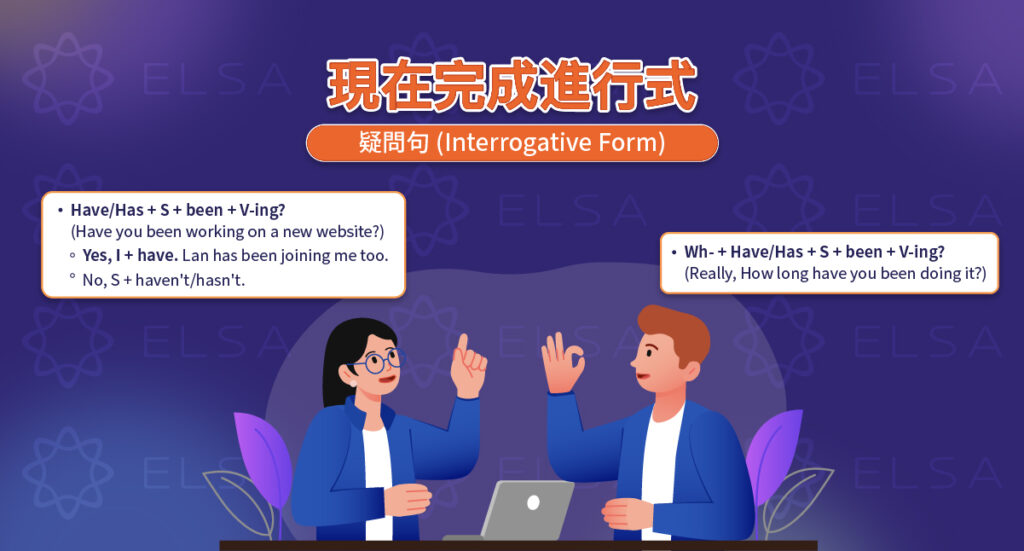
用法:將助動詞“have”或“has”移到主詞前面
結構:
| 是非題 Have/Has + S + been + V-ing? | 回覆 Yes, S + have/has. No, S + haven’t/hasn’t. |
| Wh- 疑問句 | Wh- + Have/Has + S + been + V-ing? |
例子:
- Have you been crying?(你哭過嗎?)
- Has it been snowing in the mountains?(山區下雪了嗎?)
- Where have you been?(你去哪裡了?)
現在完成進行式的用法
現在完成進行式在日常交流中靈活運用,主要體現在以下兩個方面:
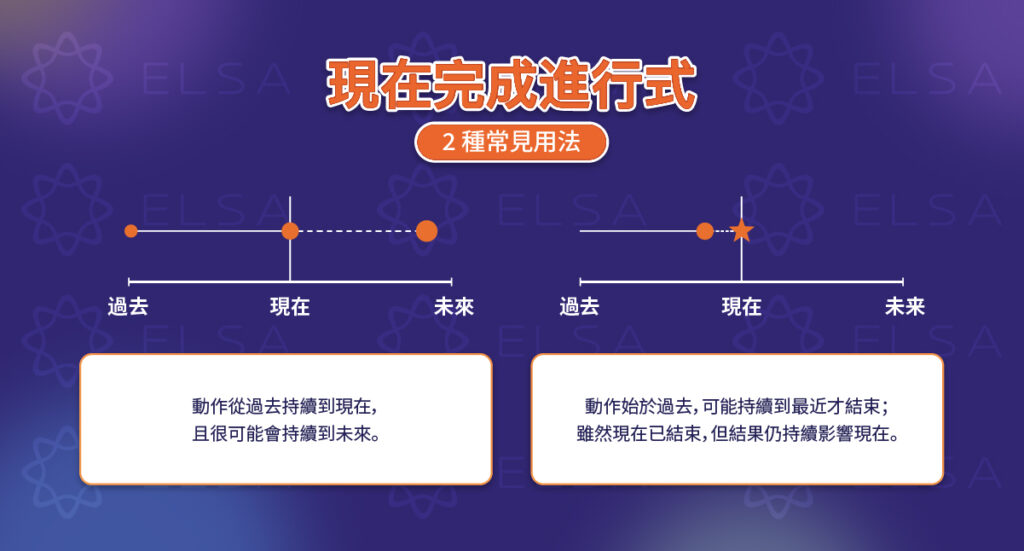
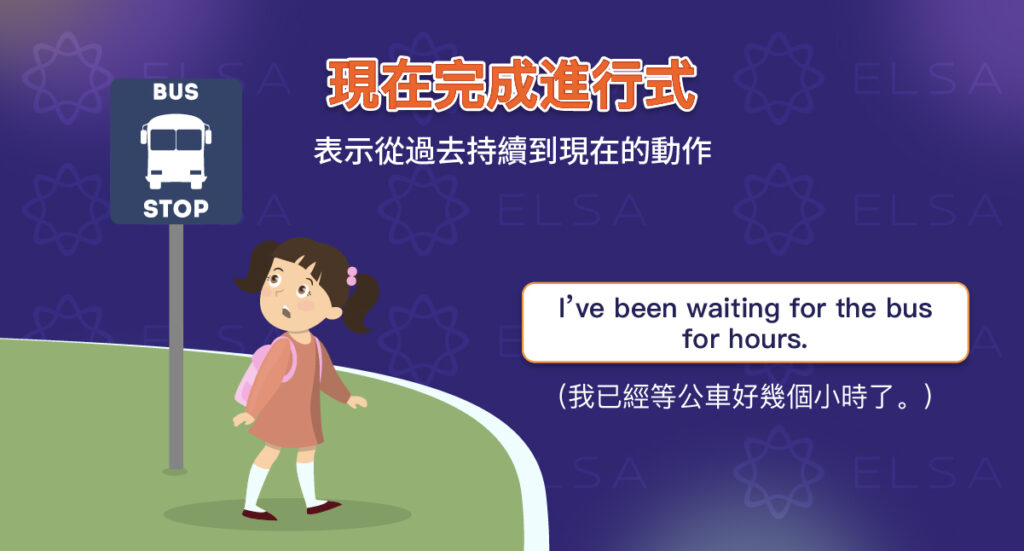
描述從過去一直持續到現在的行為。
強調持續不斷的、不間斷的過程或行動時期
例子:
- They have been renovating the house for weeks.(他們已經翻修房子好幾個星期了。)
- I have been working on this project all day.(我今天一整天都在做這個專案。)
描述的是一個剛完成但已在當下留下明確結果的行為
行動可能已經停止,但其物理後果或狀態在說話的這一刻仍然直接存在。
例子:
- Why are your hands dirty? – I have been gardening.(你的手怎麼髒了?—我一直在花園裡工作。)
- She is out of breath because she has been running.(她氣喘吁籲,因為她一直在跑步。)
現在完成進行式的訊號詞
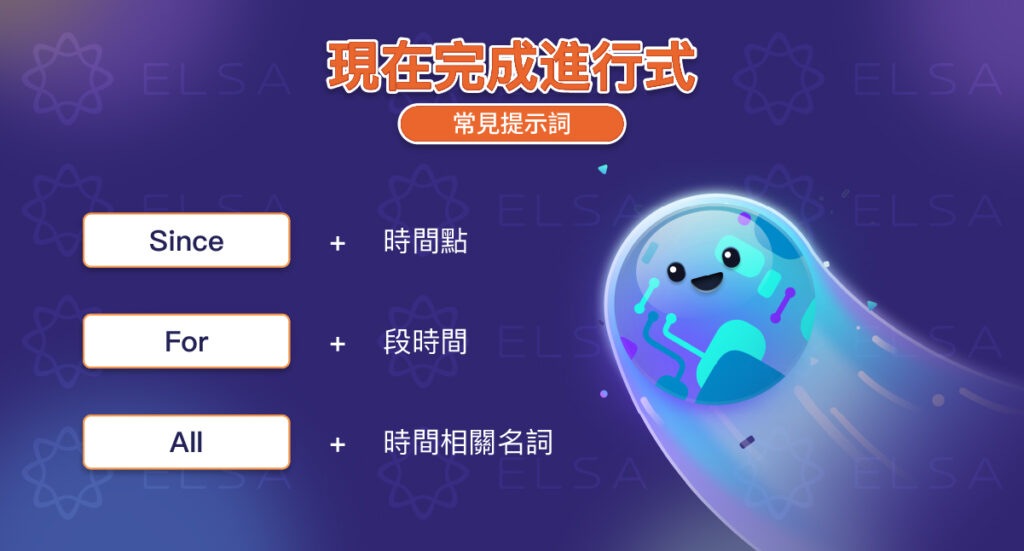
你可以根據句子中出現的時間狀語輕鬆識別並正確變位現在完成進行式:
| 時間標記類型 | 意思 | 例子 |
|---|---|---|
| Since + 時間軸 | 請具體說明行動開始的確切時間 | since 2010 (從2010年) since yesterday(從昨天) |
| For + 時間段 | 僅表示持續動作的持續時間 | for 3 hours(持續3小時) for a long time(很長時間了) |
| All + 表示時間的名詞 | 強調一天/一週中持續發生的行動 | all afternoon(整個下午) all month(整個月) |
Since 也是英文中常見的 從屬連接詞 (subordinating conjunction),如果想進一步了解這類連接詞的用法,可以參考相關內容。
閲讀相關:since 用法:意義、規範用法、區分方法及記憶技巧
區分現在完成進行式和現在完成式
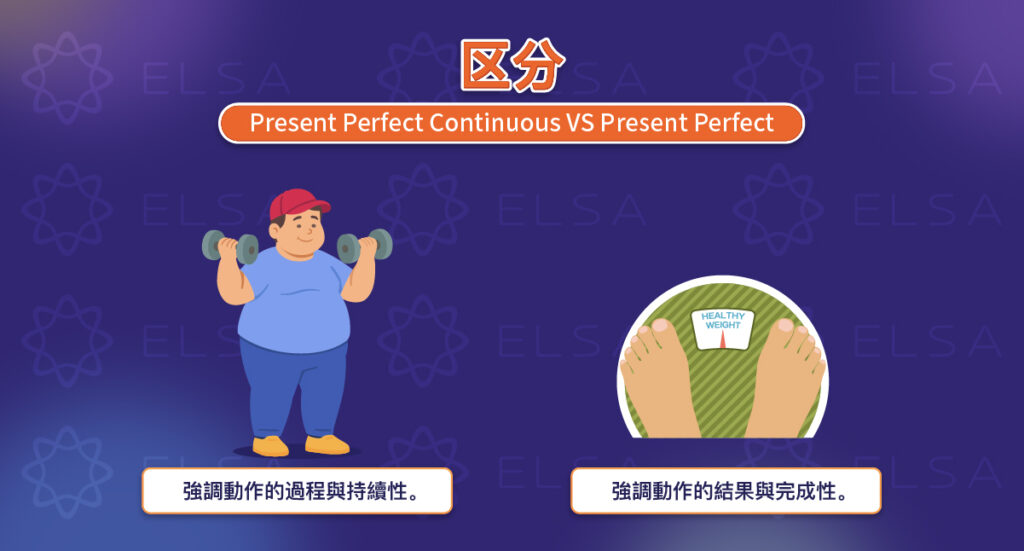
這是一個容易讓許多學習者感到困惑的語法點,因為這兩種時態都表示從過去到現在的時間。在釐清兩者差異之前,建議先掌握核心的 have been 用法 結構。 為了避免在練習現在完成進行式和現在完成式時混淆,請比較以下標準:
| 現在完成進行式 (Present Perfect Continuous) | 現在完成式 (Present Perfect) | |
|---|---|---|
| 公式 | S + have/has + been + V-ing | S + have/has + V3/ed |
| 重點強調 | 強調過程和持續行動的重要性。 | 強調結果和行動的完成情形。 |
| 狀態動詞(Stative Verbs) | 不使用進行式狀態動詞。(例如:不使用 have been knowing.) | 通常與表示狀態的動詞連用,表示長期狀況。 |
| 例子 | I have been writing this report for 2 hours. (我寫這份報告已經兩個小時了。) → 強調寫作時間。 | I have written three reports today. (我今天寫了三份報告。) → 強調所取得的成果。 |
>> 閱讀更多:過去完成式
現在完成進行式練習題(有答案)
以下是現在完成進行式練習,詳細彙編,旨在幫助你最有效地鞏固剛剛學到的理論知識:
練習1:使用括號中動詞的正確形式。
题目:請用現在完成式或現在完成進行式填入括號內動詞的正確形式,完成下列句子:
- I ________ (write) emails all morning and my fingers are tired.
- She ________ (write) ten emails so far today.
- They ________ (live) in this city since 2015.
- He ________ (wait) for the bus for thirty minutes.
- I ________ (read) that book you lent me, but I haven’t finished it yet.
- We ________ (clean) the house all afternoon.
- He ________ (lose) his car keys again.
- How long ________ you ________ (learn) Spanish?
- She ________ (know) her best friend for ten years.
- It ________ (snow) since we woke up this morning.
練習1的詳細答案:
| 句子 | 答案 | 簡要說明 |
|---|---|---|
| 1 | have been writing | 強調整個上午持續不斷的電子郵件寫作過程導致了目前的疲勞。 |
| 2 | has written | 強調所取得的数量結果(已完成 10 封信)。 |
| 3 | have been living / have lived | 對於 live/work 這兩個詞,在指長期情況時,兩種時態都有相似的意思。 |
| 4 | has been waiting | 強調,等公車的時間持續了整整 30 分鐘。 |
| 5 | have been reading | 看书行為是一個進行中的過程,尚未完成。 |
| 6 | have been cleaning | 強調打掃房子的工作是整個下午持續進行的 (all afternoon.)。 |
| 7 | has lost | 丟失鑰匙這一行為本身就是一個已完成的事件,它強調的是結果。 |
| 8 | have / been learning | 詢問語言學習過程需要多長時間。 |
| 9 | has known | Know 是狀態動詞,不能用進行時態。 |
| 10 | has been snowing | 描述了從早晨到現在持續不斷的降雪。 |
練習2:選出最佳答案。
题目: 請選擇最精確的選項(A、B、C 或 D)完成以下選擇題:
- Why are your hands dirty? – I ________ in the garden.
A. have worked
B. have been working
C. worked
D. am working - They ________ each other since they were children.
A. have known
B. have been knowing
C. know
D. knew - I ________ this movie three times already.
A. have been watching
B. have watched
C. watch
D. watched - It ________ all week, so the ground is very wet.
A. has rained
B. has been raining
C. rains
D. rained - How long ________ she ________ English?
A. has/learned
B. has/been learning
C. did/learn
D. does/learn - I ________ my homework, so now I can play games.
A. have been finishing
B. have finished
C. finish
D. finished - He ________ on this project since 8 AM.
A. worked
B. has been working
C. works
D. is working - We ________ in Hanoi for ten years.
A. have been living
B. live
C. lived
D. are living - She ________ her purse. She can’t find it anywhere.
A. has been losing
B. has lost
C. loses
D. lost - My eyes are sore because I ________ at the screen all day.
A. stared
B. have been staring
C. stare
D. am staring
練習2的詳細答案:
| 句子 | 答案 | 簡要說明 |
|---|---|---|
| 1 | B | 描述剛完成並留下明顯結果(髒手)的動作。 |
| 2 | A | Know 是一個表示狀態的動詞;它絕對不能用于進行時態。 |
| 3 | B | 強調所取得的成果數量(觀看影片3次)。 |
| 4 | B | 強調本週持續降雨過程。(all week) |
| 5 | B | 問題結構與學習活動的持續時間有關。 |
| 6 | B | 已完成的行動已達到目前的結果。 |
| 7 | B | 強調從早上8點開始的持續工作流程。 |
| 8 | A | 描述了從過去到現在持續不斷的在河內生活。 |
| 9 | B | 錢包遺失事件已經完成, 不用進行式 |
| 10 | B | 強調觀看螢幕的行為在一天中持續發生(整天)(all day.) |
常見問題
在這個時態中 Since 和 For 是如何被使用的?
回答: Since 用來表示過去某個特定時間點開始的某個動作(例如,since 2012,since Monday)。 For用來表示某個動作持續的特定時間(例如,for 3 hours,for 2 years)。
現在完成進行式的被動語態何時使用?
回答: 現在完成進行式被動語態的結構是S + have/has + been + being + p.p,但由於結構過於繁復,在書面語和口語中都很少使用。通常情況下,為了讓句子更簡潔,會使用現在完成式被動語態。
現在完成進行式可以與狀態動詞(stative verbs) 連用嗎?
回答: 絕對不行。表示所有格、情感或感知的動詞,例如:know, believe, understand, love, belong… 不能用現在完成進行式;它們必須用現在完成式。
掌握現在完成進行式有助於你描述事件從過去到現在的完整自然進程。別忘了查看 ELSA Speak 基礎英語文法主題下的其他實用文章,快速提升你的英語基礎!
過去簡單式(Past Simple Tense) 是英文中最基礎也最重要的文法概念之一。熟練掌握一般動詞、To Be 動詞的變化規則以及辨識信號詞,將有助於你在實際測驗中自信取得高分。跟著 ELSA Speak 一起深入探索以下詳細說明吧。
過去簡單式是什麼?
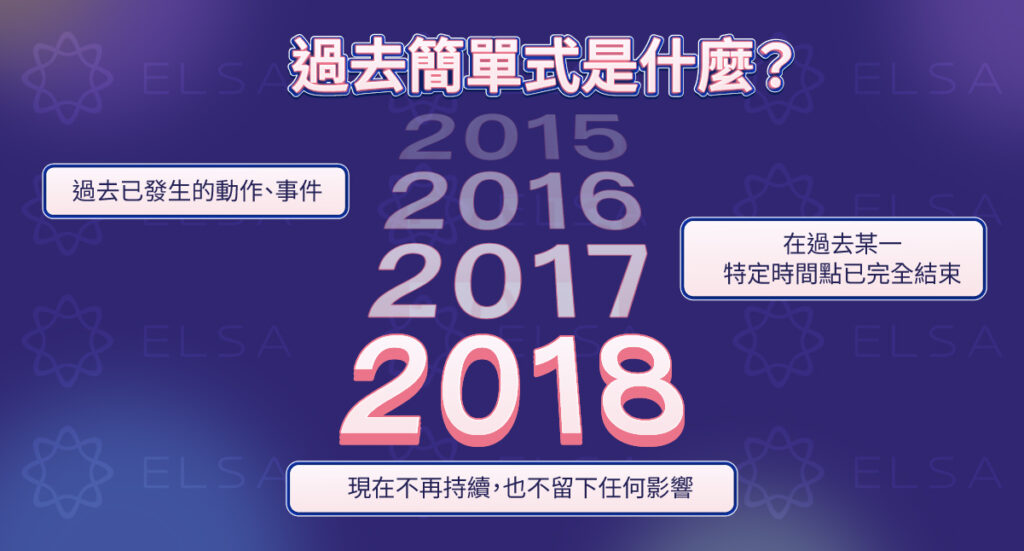
在英文時態,過去簡單式(Past Simple Tense)用於描述在過去某一特定時間點已發生並完全結束的動作或事件。該動作在現在不再持續,也不留下任何影響。
過去簡單式例句:
- I was at home yesterday.(昨天我待在家裡。)
- We watched a movie last night.(昨晚我們看了一部電影。)
過去簡單式結構
過去簡單式的結構依句子使用 To Be 動詞或一般動詞而分為兩大類:
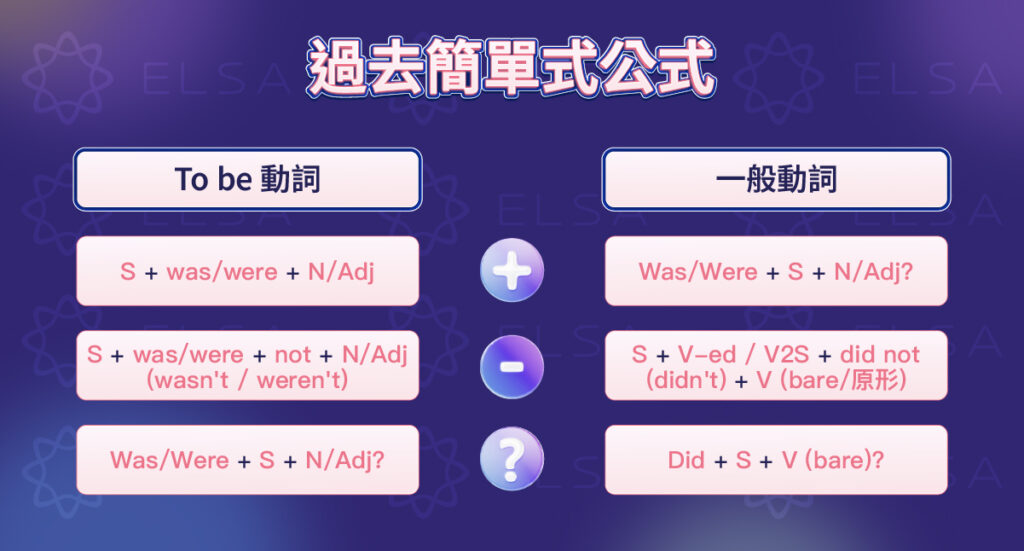
過去簡單式搭配 To Be 動詞
用法:用於描述主詞在過去的位置、狀態或性質
肯定句結構:
| S + was/were + N/Adj |
例句:I was at home yesterday.(昨天我待在家裡。)
否定句結構:
| S + was/were + not + N/Adj (wasn’t / weren’t) |
例句:She was not (wasn’t) at the park.(她不在公園裡。)
疑問句結構:
| 是非問句:Was/Were + S + N/Adj? | 回答: Yes, S + was/were. No, S + wasn’t/weren’t. |
| WH-疑問句 | WH- + Was/Were + S + (not) + N/Adj? |
例句:Were you tired yesterday?(昨天你累嗎?)
注意:
- Was 搭配主詞:I, he, she, it 及單數名詞。
- Were 搭配主詞:we, you, they 及複數名詞。
此外,初學者在掌握 was/were 的變化時,也經常將其與 have been 用法 混淆,建議透過釐清動作是否持續至現在來正確區分兩者的使用時機。
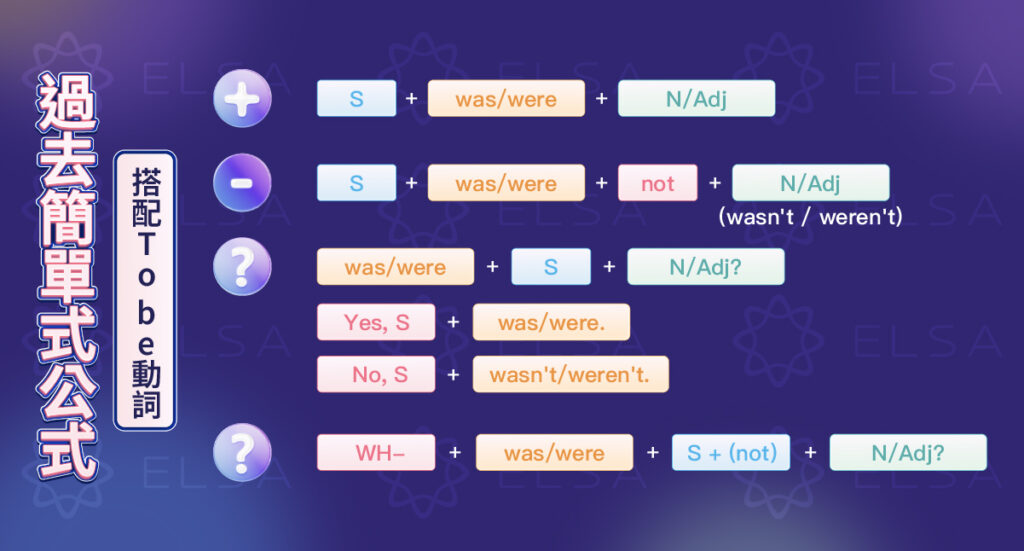
過去簡單式搭配一般動詞
用法:用於描述主詞所進行的具體動作
肯定句結構:
| S + V-ed / V2 |
例句:We watched a movie last night.(昨晚我們看了一部電影。)
否定句結構:
| S + did not (didn’t) + V (bare) |
例句:They didn’t go to school yesterday.(昨天他們沒有去上學。)
疑問句結構:
| 問句: Did + S + V (bare)? | 回答: Yes, S + did. No, S + didn’t. |
例句:Did you have breakfast?(你吃早餐了嗎?)
除了 breakfast 這個單字,也可以參考 「早餐英文」,學習更多與早餐相關的實用英文單字與句型。
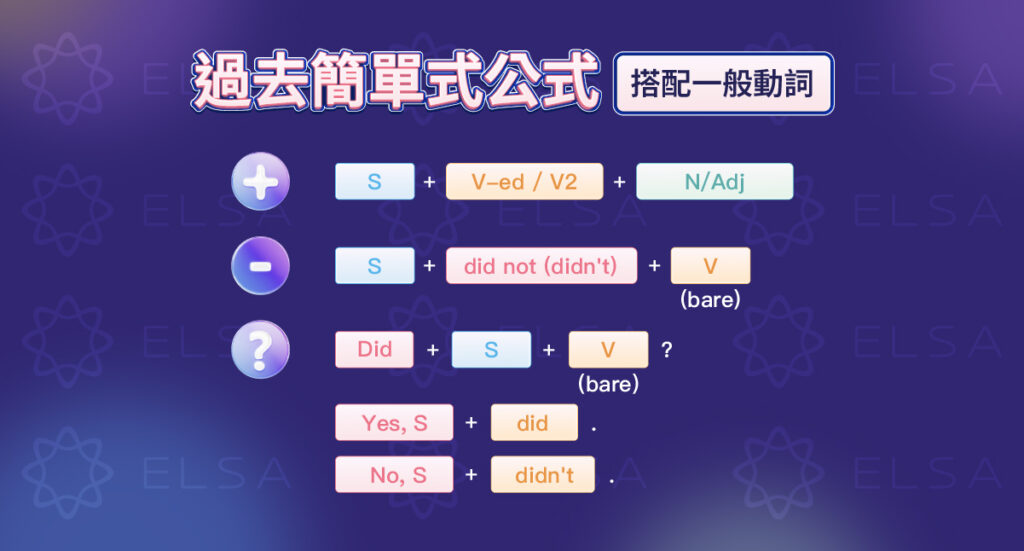
過去簡單式的動詞變化規則
要在 Simple Past Tense 中正確變化一般動詞,需清楚區分規則動詞(Regular Verbs)與不規則動詞(Irregular Verbs):
規則動詞(Regular Verbs)的 -ed 變化規則
為幫助你輕鬆記憶並正確運用過去簡單式中規則動詞如何加 ed,以下為各種變化情形的彙整表格,並附詳細例句:
| 情形 | 變化方式 | 動詞例子 |
|---|---|---|
| 一般動詞 | 直接加 -ed | watch → watched(看) cook → cooked(烹飪) |
| 動詞尾為 -e | 只加 -d | live → lived(居住) like → liked(喜歡) |
| 動詞尾為子音 + y | 將y改為i再加 -ed | study → studied(學習) cry → cried(哭泣) |
| 單音節動詞結構:子音-母音-子音 | 雙寫字尾子音再加 -ed | stop → stopped(停止) plan → planned(計劃) |
watch 不僅是常見的規則動詞,也可以用來表達「觀看」這類感知動作;想進一步了解這類動詞的用法,可以參考 感官動詞。
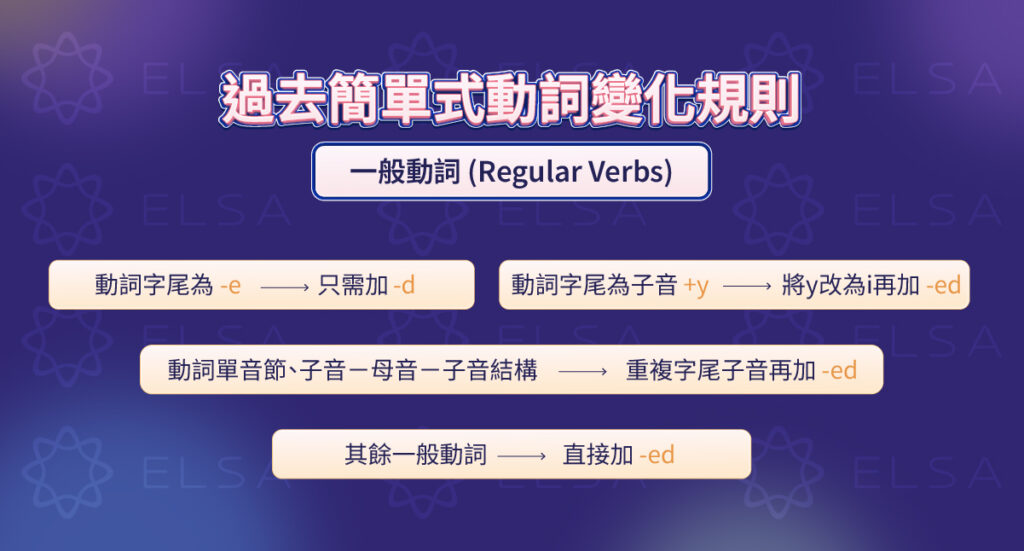
不規則動詞(Irregular Verbs)
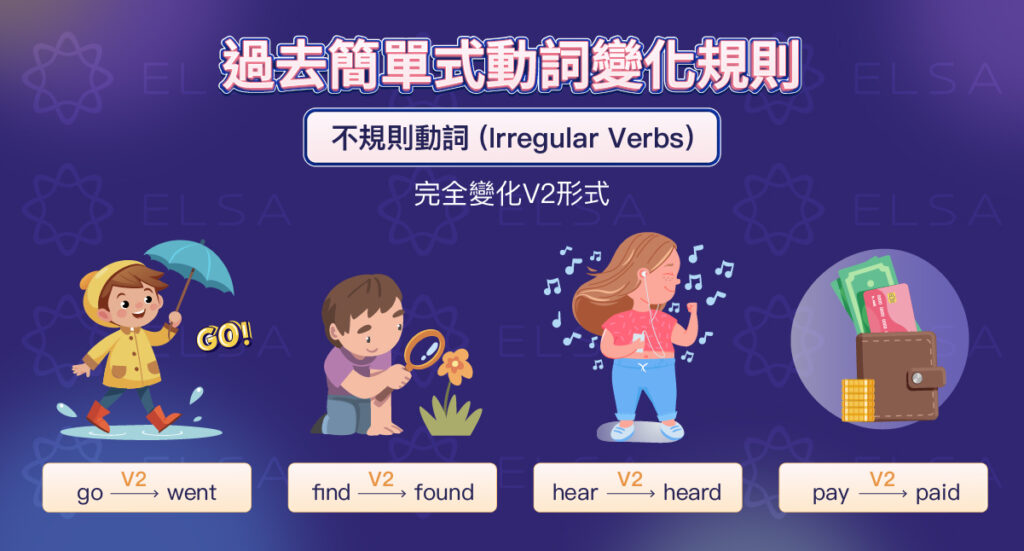
許多不規則過去式動詞並不遵循加 -ed的規則,而是完全變化為另一種形式。考生必須查閱不規則動詞表的V2。
例子:
- go → went, do → did, see → saw, take → took, write → wrote.
- He went to Paris last year.(他去年去了巴黎。)
過去簡單式的訊號詞
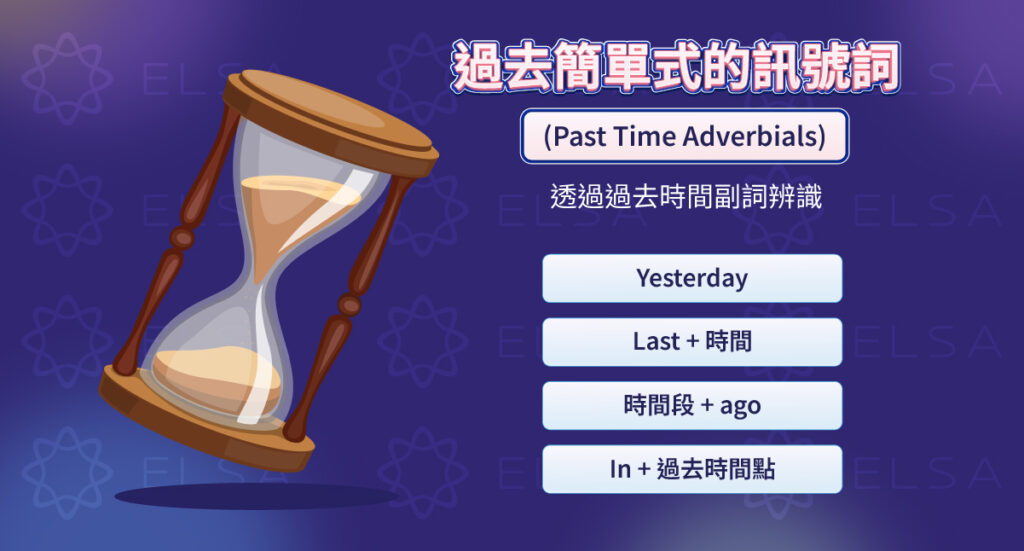
辨識過去簡單式最簡單的正确 Simple Past 動詞變化方法,是找出句中具代表性的過去時間副詞(Past Time Adverbials):
| 時間訊號詞 | 意義 | 例句 |
|---|---|---|
| Yesterday | 昨天 | Yesterday, I saw him.(昨天我看見他了。) |
| Last + 時間 | 昨晚、上週、去年 | last night(昨晚) last week(上週) |
| 時間段 + ago | 距今⋯⋯之前 | 2 days ago(兩天前) 5 years ago(五年前) |
| In + 過去時間點 | 在過去某年 | in 1999(在1999年) in the 1800s(在1800年代) |
如果句子沒有明確的過去時間,而是強調和現在的關係,就要改用現在完成式。
時間介詞:in on at 用法:時間與地點的區別及應用練習
區分時態過去進行式 過去簡單式
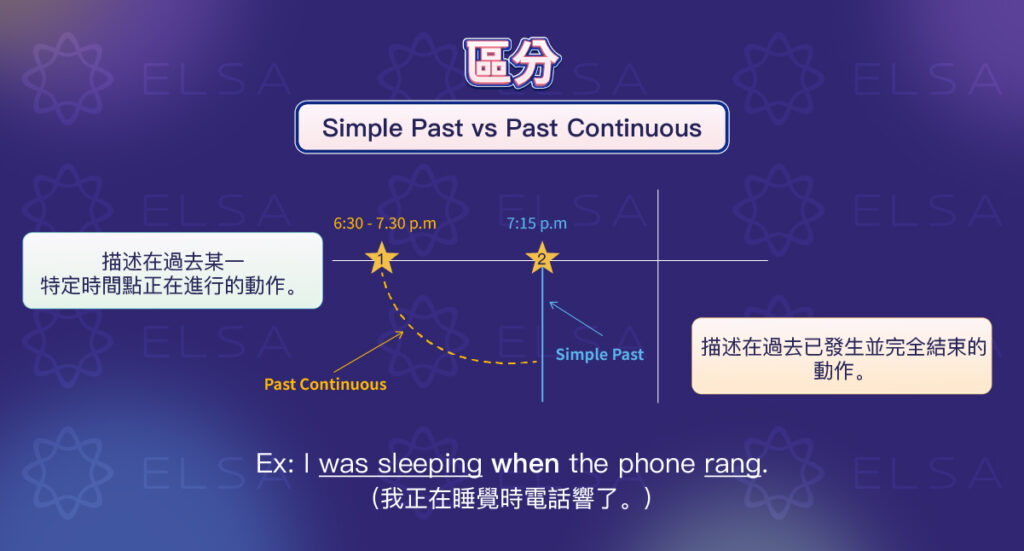
這兩種時態經常一起出現在句子中,尤其會搭配 when、while 等連接詞,以及 ago 等時間副詞。那麼,When用什麼式?Ago用什麼式?請參考以下比較表格:
| 過去簡單式 (Past Simple) | 過去進行式 (Past Continuous) | |
|---|---|---|
| 公式 | S + V-ed / V2 | S + was/were + V-ing |
| 動作性質 | 描述在過去已發生並完全結束的動作。 | 描述在過去某一特定時間點正在進行的動作。 |
| 句中搭配 | 描述插入正在進行之動作的另一動作(通常接在when之後) | 描述正在進行中被另一動作插入的動作(通常接在while之後) |
例句:I was sleeping when the phone rang.(我正在睡覺時電話響了。)
- I was sleeping → 正在進行的動作
- The phone rang → 插入的動作
過去簡單式練習題(附解答)
以下為精心編製的過去簡單式練習題,幫助你有效鞏固所學理論:
練習題一:將括號內的動詞變化為正確形式
請將括號內的動詞填入過去簡單式的正確形式,完成以下各句:
- We ________ (watch) an interesting movie last night.
- My family ________ (go) to Taipei last summer.
- Yesterday, I ________ (not/see) him at school.
- ________ you ________ (eat) dinner? – Yes, I did.
- She ________ (be) at the park yesterday morning.
- They ________ (buy) a new house two years ago.
- I ________ (study) hard for the exam last semester.
- We ________ (not/be) late for the class yesterday.
- Where ________ you ________ (go) last weekend?
- It ________ (rain) heavily last night.
練習題一詳細解答:
| 題號 | 答案 | 簡要說明 |
|---|---|---|
| 1 | watched | 規則動詞 watch 直接加 -ed(regular verb) |
| 2 | went | Go 的過去簡單式不規則變化為went(V2) |
| 3 | didn’t see | 一般動詞否定句結構:did not (didn’t) + V-bare |
| 4 | Did / eat | 一般動詞疑問句結構:Did + S + V-bare |
| 5 | was | To be 動詞搭配單數主詞 she,過去式為 was |
| 6 | bought | Buy 的過去簡單式不規則變化為 bought(V2) |
| 7 | studied | 動詞 study 字尾 y 改為 i 再加 -ed |
| 8 | weren’t | To be 動詞搭配複數主詞 we,否定形式為 were not(weren’t) |
| 9 | did / go | 一般動詞 WH 疑問句結構:Wh- + did + S + V-bare |
| 10 | rained | 規則動詞 rain 直接加 -ed (regular verb) |
H3: 練習題二: 選出最正確的答案
題目: 請選出最正確的選項(A, B, C 或 D)完成以下各選擇題:
- I ________ a famous actor yesterday morning.
A. see
B. saw
C. seen
D. am seeing - They ________ to school last Sunday.
A. didn’t go
B. don’t go
C. won’t go
D. haven’t gone - She ________ late for work yesterday.
A. was
B. were
C. is
D. been - ________ you at the party last night? Yes, I was.
A. Was
B. Were
C. Did
D. Are - We ________ a new song on the radio two hours ago.
A. hear
B. heard
C. hearing
D. hears - He ________ his homework before going to bed.
A. did
B. do
C. does
D. doing - If I ________ you, I would take that offer.
A. am
B. was
C. were
D. been - My father ________ the car last week.
A. washed
B. wash
C. washes
D. washing - Did you finish the report? No, I ________.
A. didn’t
B. don’t
C. wasn’t
D. haven’t - Yesterday, the weather ________ very cold.
A. was
B. were
C. is
D. been
練習題二詳細解答:
| 題號 | 答案 | 簡要說明 |
|---|---|---|
| 1 | B | See 的過去簡單式不規則變化為saw(V2) |
| 2 | A | 一般動詞過去式否定句結構為 didn’t go |
| 3 | A | To Be 動詞搭配單數主詞she,過去式為 was |
| 4 | B | To Be 動詞搭配複數主詞 you,疑問句形式為 Were |
| 5 | B | Hear 的過去簡單式不規則變化為heard(V2) |
| 6 | A | Do 的過去簡單式不規則變化為did(V2) |
| 7 | C | 假設語氣第二條件句中,所有人稱主詞一律使用 |
| 8 | A | 規則動詞 wash 直接加 -ed |
| 9 | A | 一般動詞過去式疑問句的否定回答 |
| 10 | A | To Be 動詞搭配不可數名詞主詞weather,過去式為 was |
常見問題(FAQ)
什麼時候用was,什麼時候用were?
回答: Was用於單數主詞,包括:I、He、She、It及單數名詞。Were用於複數主詞,包括:We、You、They及複數名詞。
不規則動詞是什麼?
回答: 不規則動詞是指在過去簡單式中不遵循加-ed規則,而是變化為完全不同形式的動詞,考生必須查閱不規則動詞表的第二欄。
過去簡單式最具代表性的訊號詞是什麼?
回答: 最具代表性的時間訊號詞為:yesterday、ago(距今⋯⋯之前)、last(上一個)以及in + 過去某一具體年份。
熟練掌握過去簡單式(Past Simple Tense),有助於你完整表達過去已發生並結束的事件,提升學術與日常溝通的精準度。同時,別忘了參考 ELSA Speak 英語文法專區中的更多實用文章,快速突破你的英文基礎!
足球英文是 football 還是 soccer?如果你是足球迷,或想透過體育主題學習英文,這是你不能錯過的內容。跟著 ELSA Speak 探索兩種說法的差異,學習足球英文單字與足球英文術語,讓你自信追蹤國際賽事,像真正的球迷一樣用英文交流。
足球英文是 Football 還是 Soccer?
Football 是什麼意思?
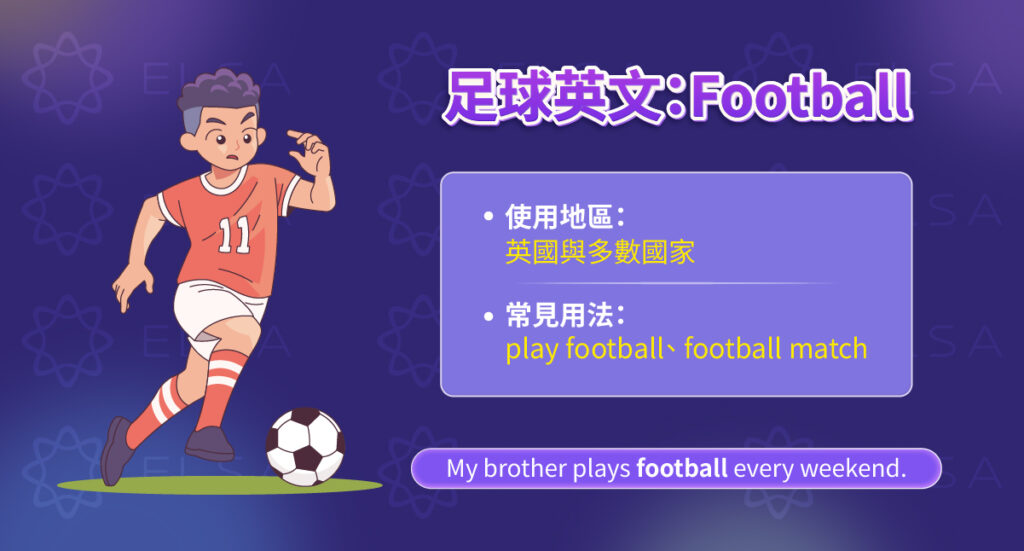
Football是英國及世界上大多數國家對足球的普遍稱呼,也是FIFA世界盃等國際賽事所使用的術語。若你收看英國或歐洲的體育媒體,會比 soccer 更常看到 football 這個字。比賽中,每隊由11名球員組成,目標是比對手攻入更多球。
- 字義: Football 由 foot(腳)與 ball(球)組成,指以腳進行的運動。
- 使用範圍: 英國、歐洲及世界上大多數國家普遍使用。
- 歷史備註: 此運動最初稱為 association football, 後來簡稱為 football。
例句:
- My brother plays football every weekend. (我哥哥每個週末都踢足球。)
- The football match starts at 8 p.m. (足球比賽將於晚上8點開始。)
Soccer 是什麼意思?
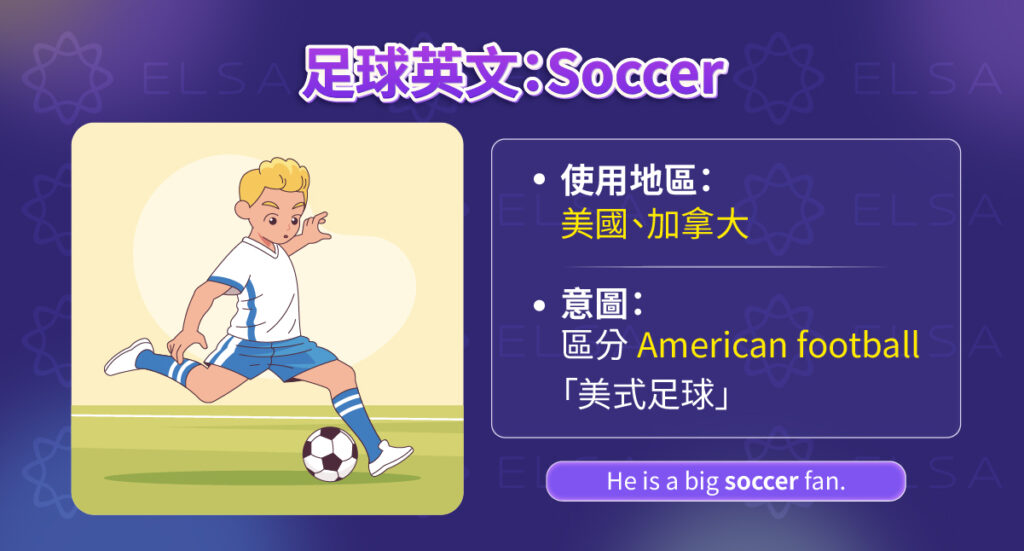
Soccer 英文 同樣指足球,但主要在美國、加拿大及其他部分國家使用。此詞的出現是為了與 American football(美式足球)做區別,因此若與美國人交流,你會更常聽到 soccer。
- 使用範圍: 主要在美國、加拿大及部分北美國家使用。
- 備註: 由於足球最初稱為 association football,為與 rugby football(橄欖球)區別,因此衍生出 soccer一詞。
例句:
- She is a big soccer fan. (她是一位狂熱的足球迷。)
- We watched a soccer game together last night. (昨晚我們一起看了一場足球賽。)
區分 soccer football rugby
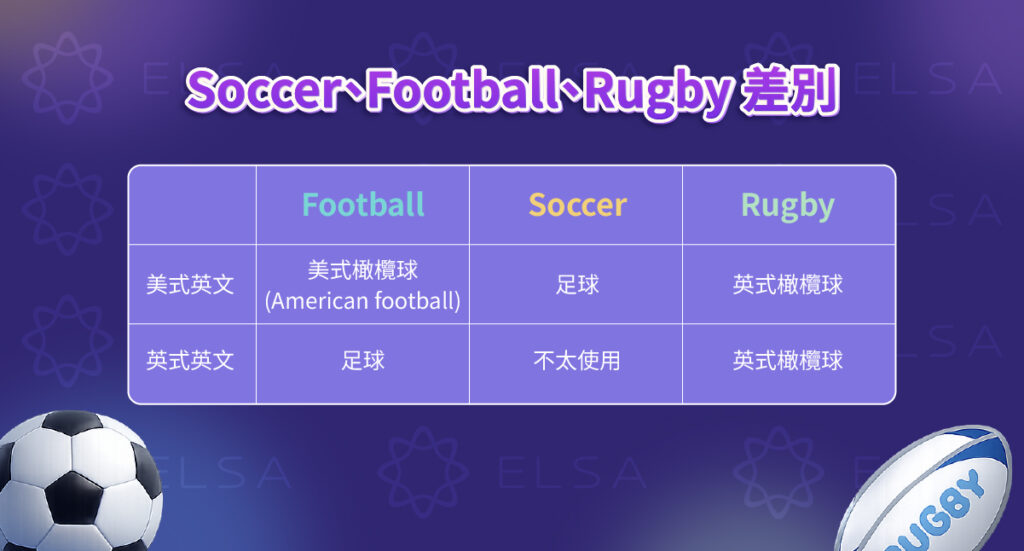
| 用法 | 美式英語 | 英式英語 |
|---|---|---|
| Football | 美式足球 (American football) | 足球 |
| Soccer | 足球 | 較少使用 |
| Rugby | 橄欖球 | 橄欖球 |
| Futsal | 五人制足球 | 五人制足球 |
足球英文單字大全
足球場英文 單字
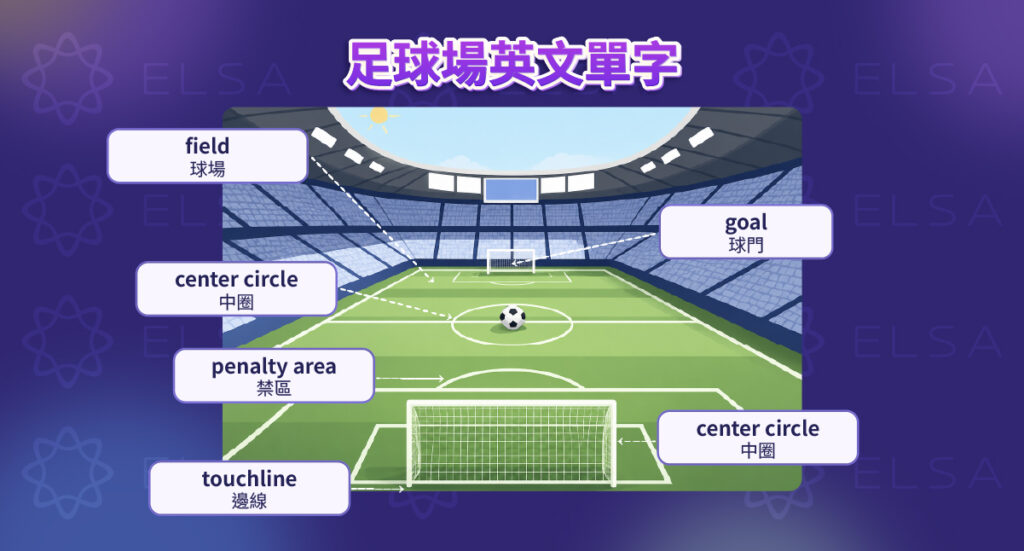
若你想收看國際賽事或閱讀英文體育新聞,千萬別錯過足球場相關單字。以下是足球場英文、足球門英文等常見區域與器材詞彙,每位足球迷都應該了解。
| 英文單字 | 音標(IPA) | 釋義 |
|---|---|---|
| Football field | /ˈfʊtbɔːl fiːld/ | 足球場英文 |
| Soccer field | /ˈsɑːkər fiːld/ | 足球場(美式說法) |
| Stadium | /ˈsteɪdiəm/ | 體育場 |
| Goal | /ɡoʊl/ | 足球門英文 |
| Goalpost | /ˈɡoʊlpoʊst/ | 門柱 |
| Goal net | /ɡoʊl net/ | 球門網 |
| Penalty area | /ˈpenəlti ˈeriə/ | 禁區 |
| Penalty box | /ˈpenəlti bɑːks/ | 小禁區 |
| Penalty spot | /ˈpenəlti spɑːt/ | 罰球點 |
| Center circle | /ˈsentər ˈsɜːrkl/ | 中圈 |
| Halfway line | /ˌhæfˈweɪ laɪn/ | 中線 |
| Touchline | /ˈtʌtʃlaɪn/ | 邊線 |
| Goal line | /ˈɡoʊl laɪn/ | 底線 (球門線 ) |
| Corner | /ˈkɔːrnər/ | 角球區 |
| Corner flag | /ˈkɔːrnər flæɡ/ | 角旗 |
| Technical area | /ˈteknɪkl ˈeriə/ | 技術區 |
| Bench | /bentʃ/ | 替補席 |
| Football boots (UK) / Soccer cleats (US) | /ˈfʊtbɔːl buːts/ | /ˈsɑːkər kliːts/ | 足球鞋英文 |
| Stands | /stændz/ | 看台 |
| Football/Soccer ball | /ˈfʊtbɔːl/ | /ˈsɑːkər bɔːl/ | 足球 |
| Referee | /ˌrefəˈriː/ | 主裁判 |
| Assistant referee | /əˈsɪstənt ˌrefəˈriː/ | 助理裁判 |
| Whistle | /ˈwɪsl/ | 哨子 |
| Football player/Soccer player | /ˈfʊtbɔːl ˈpleɪər/ | /ˈsɑːkər ˈpleɪər/ | 足球員英文 |
| Football team/Soccer team | /ˈfʊtbɔːl tiːm/ | /ˈsɑːkər tiːm/ | 足球隊英文 |
| Football match/Soccer match | /ˈfʊtbɔːl mætʃ/ | /ˈsɑːkər mætʃ/ | 足球比賽英文 |
| Scoreboard | /ˈskɔːrbɔːrd/ | 計分板 |
| Score | /skɔːr/ | 比分 /足球得分英文 |
| Locker room | /ˈlɑːkər ruːm/ | 更衣室 |
| Players’ tunnel | /ˈpleɪərz ˈtʌnl/ | 球員通道 |
| Grandstand | /ˈɡrændstænd/ | 主看台 |
足球位置英文單字
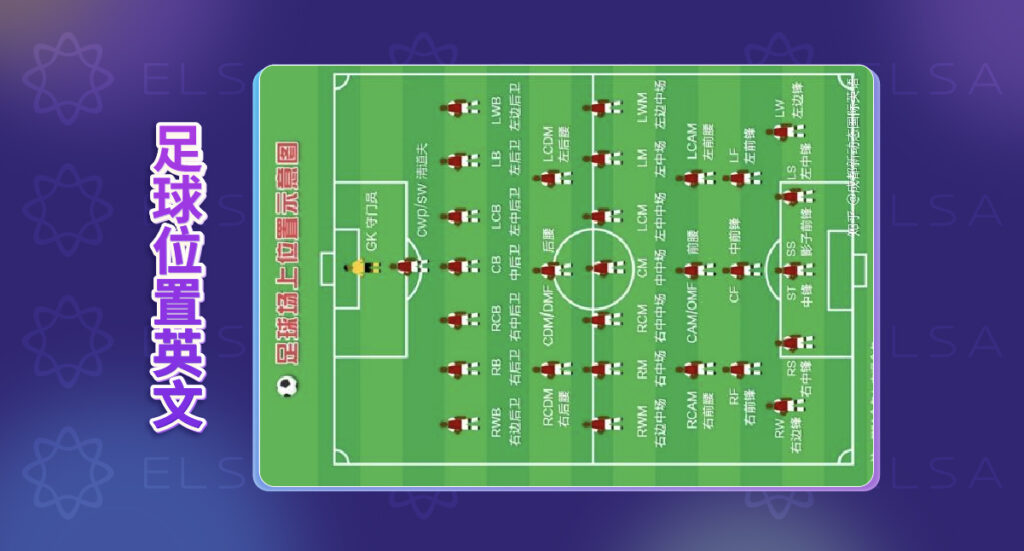
若你是足球迷,掌握足球 位置 英文、足球後衛英文、足球守門員英文、足球中場英文、足球前鋒英文等及足球位置英文縮寫,將有助於你理解戰術圖、足球比賽解說,並更自信地與同好交流。
| 位置 | 英文 | 縮寫 |
|---|---|---|
| 守門員 | Goalkeeper | GK |
| 左後衛 | Left Back | LB |
| 右後衛 | Right Back | RB |
| 中後衛 | Center Back | CB |
| 清道夫 | Sweeper | SW |
| 翼衛 | Wing Back | LWB/RWB |
| 防守型中場 | Defensive Midfielder | CDM |
| 中央中場 | Central Midfielder | CM |
| 攻擊型中場 | Attacking Midfielder | CAM |
| 左翼中場 | Left Midfielder | LM |
| 右翼中場 | Right Midfielder | RM |
| 邊鋒 | Winger | LW/RW |
| 影子前鋒 | Striker | ST |
| 中鋒 | Center Forward | CF |
| 第二前鋒 | Second Striker | SS |
| 左翼前鋒 | Left Forward | LF |
| 右翼前鋒 | Right Forward | RF |
在學習足球相關詞彙時,除了熟悉球場上的位置與動作之外,數字也是常見且實用的英文表達。例如,球員的球衣號碼、比賽比分以及場上人數,都會經常用到英文數字。如果想進一步了解英文數字的讀法與用法,可以參考這篇【1–100 的英文數字】文章。
足球比賽與成績相關單字
| 英文單字 | 釋義 |
|---|---|
| World Cup | World Cup |
| FIFA | 國際足球總會 |
| UEFA Champions League | UEFA Champions League |
| Premier League | 英格蘭超級聯賽 |
| La Liga | La Liga |
| Serie A | Serie A |
| Bundesliga | Bundesliga |
| champion | 冠軍 |
| runner-up | 亞軍 |
| trophy | 冠軍獎盃 |
| champion title | 冠軍頭銜 |
| group stage | 小組賽 |
| knockout stage | 淘汰賽 |
| final | 決賽 |
| semi-final | 準決賽 |
| quarter-final | 八強賽 |
常見足球英文術語
足球動作英文
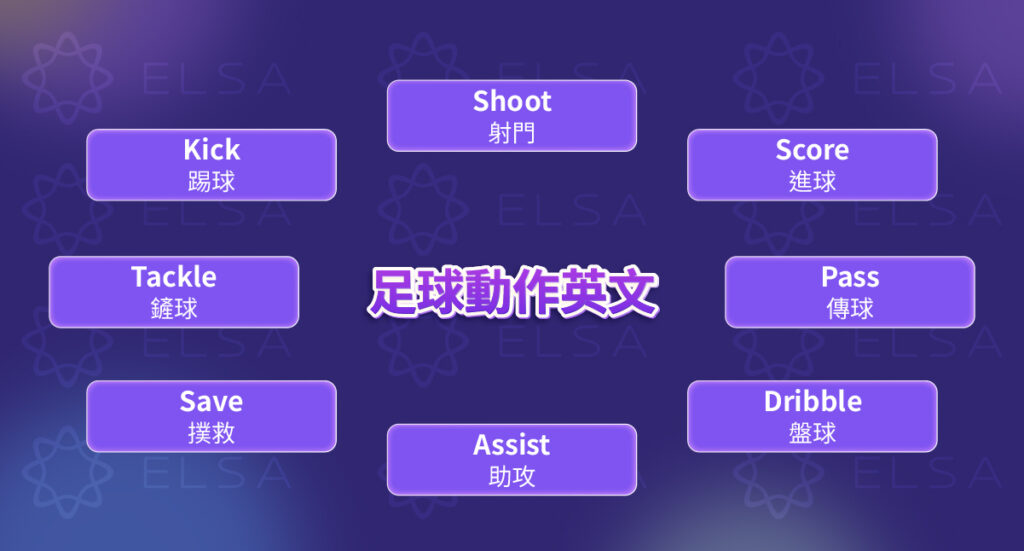
觀看或踢足球時,你會經常遇到踢足球英文、足球射門英文、足球進球英文或傳球等動作。跟著ELSA Speak一起來認識這些英文術語吧!
| 英文術語 | 釋義 |
|---|---|
| kick | 踢足球英文 |
| shoot | 射門/足球射門 |
| score | 足球進球英文 |
| score a goal | 攻入一球 |
| pass | 傳球 |
| cross | 傳中 |
| dribble | 盤球 |
| head the ball | 頭球 |
| tackle | 搶球 |
| intercept | 截球 |
| assist | 助攻 |
| save | 撲救(守門員) |
| catch the ball | 接球 |
| block | 擋球 |
| clear the ball | 解圍 |
| control the ball | 控球 |
| volley | 凌空射門 |
| celebrate | 慶祝進球 |
足球規則與情境英文
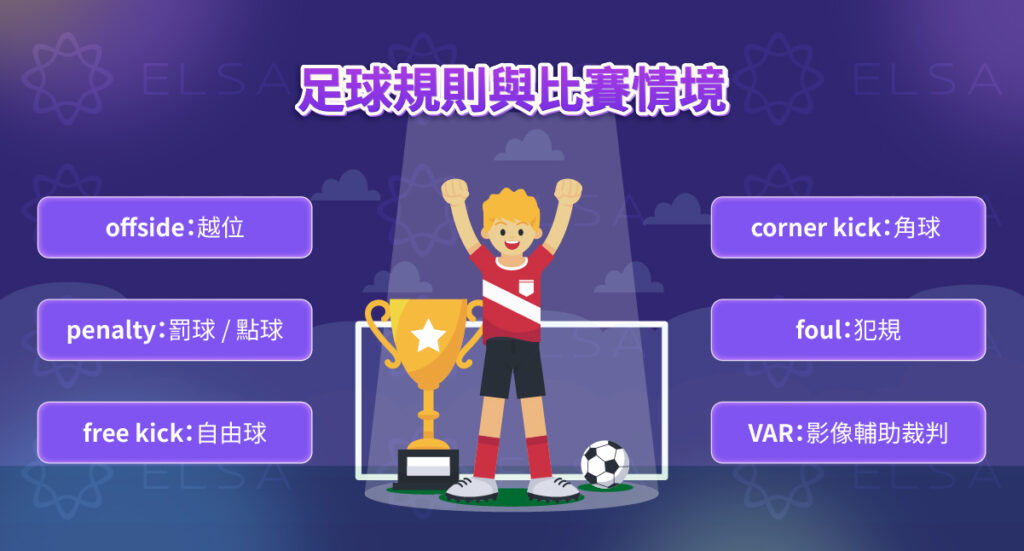
| 英文術語 | 釋義 |
|---|---|
| offside | 足球越位英文 |
| penalty kick (penalty) | 十二碼罰球 |
| free kick | 任意球 |
| direct free kick | 直接任意球 |
| indirect free kick | 間接任意球 |
| corner kick | 角球 |
| goal kick | 球門球 |
| throw-in | 擲界外球 |
| yellow card | 黃牌 |
| red card | 紅牌 |
| foul | 犯規 |
| handball | 手球 |
| own goal | 烏龍球 |
| injury time | 補時 |
| extra time | 延長賽 |
| penalty shootout | 互射十二碼 |
| half-time | 中場休息 |
| full-time | 終場 |
| referee | 主裁判 |
| assistant referee | 邊線裁判 |
| VAR (Video Assistant Referee) | VAR視頻助理裁判 |
常見問題
美式足球英文是什麼?
美式足球英文為 American football,是美國的熱門運動。而足球在美國通常稱為 soccer;英式足球英文則通常稱為 football。
足球的英文怎麼唸?
足球英文有兩種常見發音 :
- Football: /ˈfʊtbɔːl/ (英式英語 )
- Soccer: /ˈsɑːkər/ (美式英語 )
五人制足球英文是什麼 ?
五人制足球英文通常稱為 futsal,或 five-a-side football(英式)/five-a-side soccer(美式)。其中,futsal是國際賽事中最廣泛使用的術語。
透過本文,你已了解足球英文是 football 還是 soccer,並學習了更多足球英文單字與術語。請跟著 ELSA Speak 持續練習,改善發音、擴充詞彙,讓你在英文溝通上更加自信。別忘了在 ELSA Speak 探索更多溝通交流英語文章,每天持續精進你的英文技能。
許多人在需要使用英文名字時,常對如何正確將英文翻譯中文名字感到困惑。事實上,這不僅僅是翻譯,更牽涉到拼音規則以及在護照等證件上的使用方式。現在就跟著 ELSA Speak 一起了解符合國際標準的名字英文翻譯方法吧!
英文中的名字是什麼?
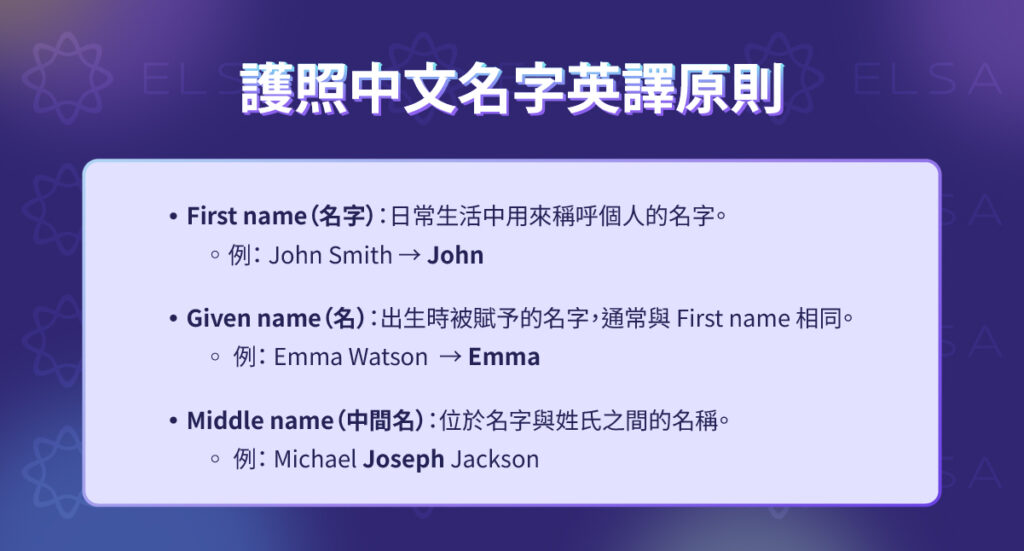
- First name:用於日常溝通中稱呼一個人的名字。
例如: John Smith → John 是 first name. - Given name:出生時所取的名字,意義通常與 first name 相近。
例如: Emma Watson → Emma 是 given name. - Middle name:位於 first name 與 last name(姓氏)之間的中間名。
例如: Michael Joseph Jackson → Joseph 是 middle name.
中文名字翻譯英文方法彙整
你正為護照上的英文翻譯名字方法感到困惑嗎?跟著 ELSA Speak 一起了解拼音規則與最易查詢、最精確的對照表吧!
護照英文翻譯名字規則
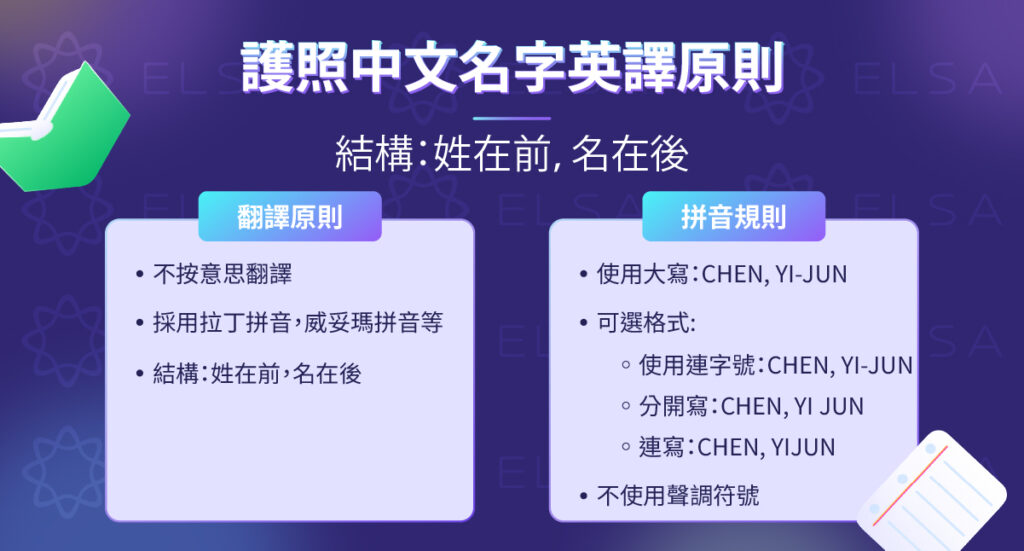
中文名字轉換為拉丁字母時,是依據英文羅馬拼音轉寫,而非按字義翻譯。此外,辦理護照時護照英文拼音可選擇使用漢語拼音、威妥瑪拼音(Wade-Giles)等不同拼音系統;若未特別選擇,系統將採用預設拼音方式。護照名字的結構為“姓氏(surname)在前-名字(given name)在後”。
例如: 陳怡君 → Chen, Yi-Jun
中文名字翻譯英文注意事項
- 護照上的姓名應與學歷證書、機票、簽證等文件保持一致,以避免出入境時產生困擾。
- 各音節之間可使用連字號(CHEN, YI-JUN)——這是最正統、最常見的寫法,也可以不使用連字號(CHEN, YI JUN)或連寫(CHEN, YIJUN),皆屬可行方式。
- 不使用中文拼音中的聲調符號。
- 某些情況下可額外加註其他英文名字 (alias),但主要姓名仍以中文名字的拼音為準。
外交部認證英文翻譯中文名字對照表
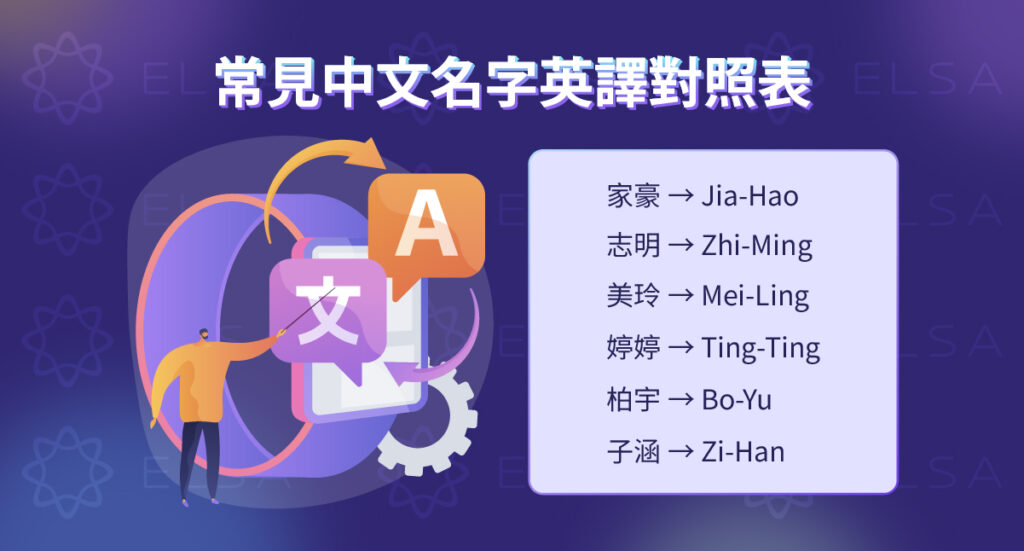
以下彙整台灣常見姓名對照表,協助你更準確地參考並中文名字翻譯為英文。
| 中文名字 | 威妥瑪拼音 | 漢語拼音 | 正確翻譯建議 |
|---|---|---|---|
| 家豪 | Chia-Hao | Jiā Háo | Jia-Hao |
| 志明 | Chih-Ming | Zhì Míng | Zhi-Ming |
| 建宏 | Chien-Hung | Jiàn Hóng | Jian-Hong |
| 淑芬 | Shu-Fen | Shū Fēn | Shu-Fen |
| 淑惠 | Shu-Hui | Shū Huì | Shu-Hui |
| 美玲 | Mei-Ling | Měi Líng | Mei-Ling |
| 承恩 | Cheng-En | Chéng Ēn | Cheng-En |
| 宥廷 | Yu-Ting | Yòu Tíng | You-Ting |
| 品睿 | Pin-Jui | Pǐn Ruì | Pin-Rui |
| 品妍 | Pin-Yen | Pǐn Yán | Pin-Yan |
| 子晴 | Tzu-Ching | Zǐ Qíng | Zi-Qing |
| 詠晴 | Yung-Ching | Yǒng Qíng | Yong-Qing |
| 恩碩 | En-Shuo | Ēn Shuò | En-Shuo |
| 子睿 | Tzu-Jui | Zǐ Ruì | Zi-Rui |
| 苡菲 | I-Fei | Yǐ Fēi | Yi-Fei |
| 雨霏 | Yu-Fei | Yǔ Fēi | Yu-Fei |
| 婷婷 | Ting-Ting | Tíng Tíng | Ting-Ting |
| 玲玲 | Ling-Ling | Líng Líng | Ling-Ling |
| 莉莉 | Li-Li | Lì Lì | Li-Li |
| 彬彬 | Pin-Pin | Bīn Bīn | Bin-Bin |
| 安安 | An-An | Ān Ān | An-An |
| 明明 | Ming-Ming | Míng Míng | Ming-Ming |
| 冠廷 | Kuan-Ting | Guān Tíng | Guan-Ting |
| 柏宇 | Po-Yu | Bó Yǔ | Bo-Yu |
| 宇軒 | Yu-Hsuan | Yǔ Xuān | Yu-Xuan |
| 子涵 | Tzu-Han | Zǐ Hán | Zi-Han |
| 家銘 | Chia-Ming | Jiā Míng | Jia-Ming |
| 志豪 | Chih-Hao | Zhì Háo | Zhi-Hao |
| 承翰 | Cheng-Han | Chéng Hàn | Cheng-Han |
| 宗翰 | Tsung-Han | Zōng Hàn | Zong-Han |
常見英文名字翻譯中文名字對照表
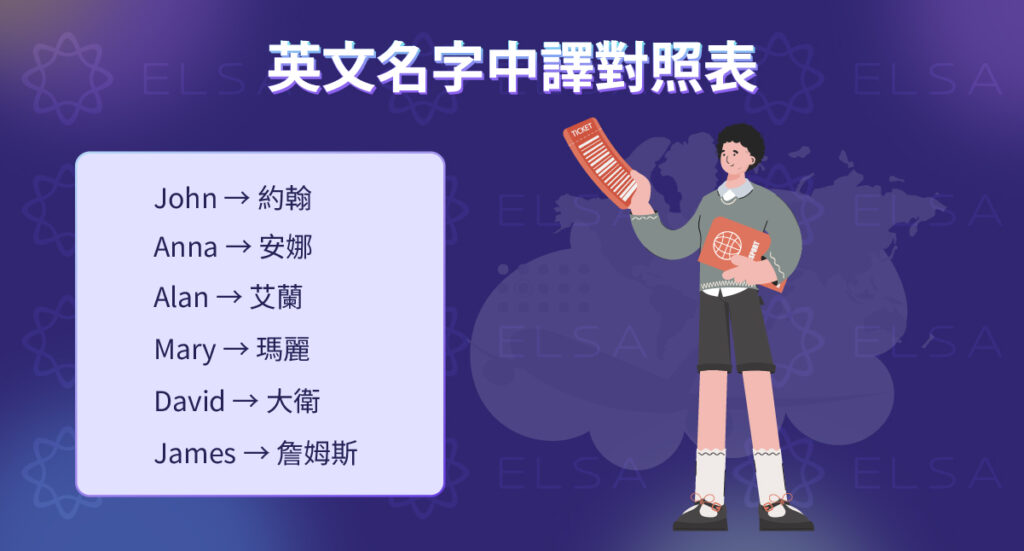
你正關心如何將中文翻譯英文名字嗎?特別是在涉及證件的情況下,將護照英文名字翻譯中文同樣十分重要。以下表格將幫助你快速對照英文名字翻譯成中文,並更準確地使用。
| 英文名字 | 翻譯成中文名字 |
|---|---|
| John | 約翰 |
| Anna | 安娜 |
| Alan | 艾蘭 |
| Mary | 瑪麗 |
| David | 大衛 |
| James | 詹姆斯 |
| Michael | 麥可 |
| Robert | 羅伯特 |
| William | 威廉 |
| Richard | 理查 |
| Joseph | 約瑟夫 |
| Thomas | 湯瑪斯 |
| Charles | 查爾斯 |
| Christopher | 克里斯多福 |
| Daniel | 丹尼爾 |
| Matthew | 馬修 |
| Anthony | 安東尼 |
| Mark | 馬克 |
| Steven | 史蒂文 |
| Andrew | 安德魯 |
| Joshua | 約書亞 |
| Kevin | 凱文 |
| Brian | 布萊恩 |
| George | 喬治 |
| Edward | 愛德華 |
| Ronald | 羅納德 |
| Jason | 傑森 |
| Justin | 賈斯汀 |
| Eric | 艾瑞克 |
| Ryan | 萊恩 |
| Adam | 亞當 |
| Sean | 尚恩 |
| Jack | 傑克 |
| Henry | 亨利 |
| Lucas | 盧卡斯 |
| Leo | 里奧 |
| Ethan | 伊森 |
| Noah | 諾亞 |
| Oliver | 奧利佛 |
| Liam | 連恩 |
| Emma | 艾瑪 |
| Olivia | 奧莉維亞 |
| Sophia | 蘇菲亞 |
| Isabella | 伊莎貝拉 |
| Mia | 米亞 |
| Charlotte | 夏洛特 |
| Amelia | 艾蜜莉亞 |
| Harper | 哈珀 |
| Evelyn | 伊芙琳 |
| Abigail | 艾比蓋兒 |
| Emily | 艾蜜莉 |
在找好聼的英文名字?查看這裏:
總而言之,英文翻譯中文名字並非單純的直接翻譯,而是需要依使用目的選擇適合的方式。針對正式證件,建議依護照英文拼音規則進行英文翻譯名字;而在日常生活中,則可較為靈活地選擇適合的名字。歡迎前往 ELSA Speak 探索更多實用的溝通交流英語文章。
元宵節英文 — Lantern Festival 是東亞文化中極具代表性的傳統節日之一,通常於農曆正月十五慶祝。跟著 ELSA Speak 一起學習元宵節英文,了解相關單字、英文介紹與實用表達方式。
元宵節 英文是什麽?
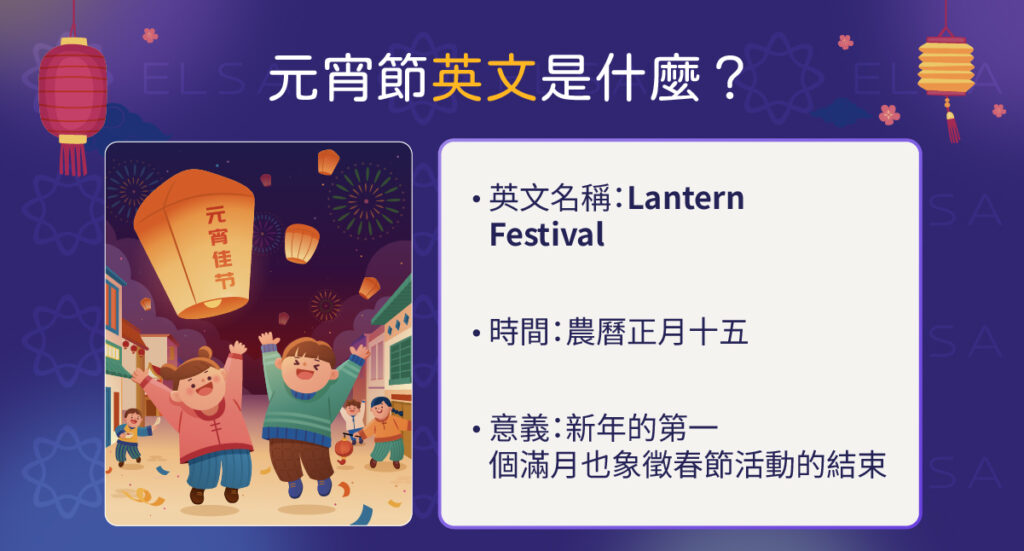
元宵節(英文:Lantern Festival)是農曆正月十五慶祝的傳統節日,標誌著新年第一個滿月的到來,也標誌著農曆新年的結束。
- 英文名: Lantern Festival
- 時間:農曆1月15日
- 由來:新年第一個滿月節
- 意義:為農曆新年系列活動畫下圓滿句點
除了常用名“Lantern Festival”之外,元宵節有時在英語中也被稱為:
- Festival of Lights
- Yuanxiao Festival
元宵節由來英文
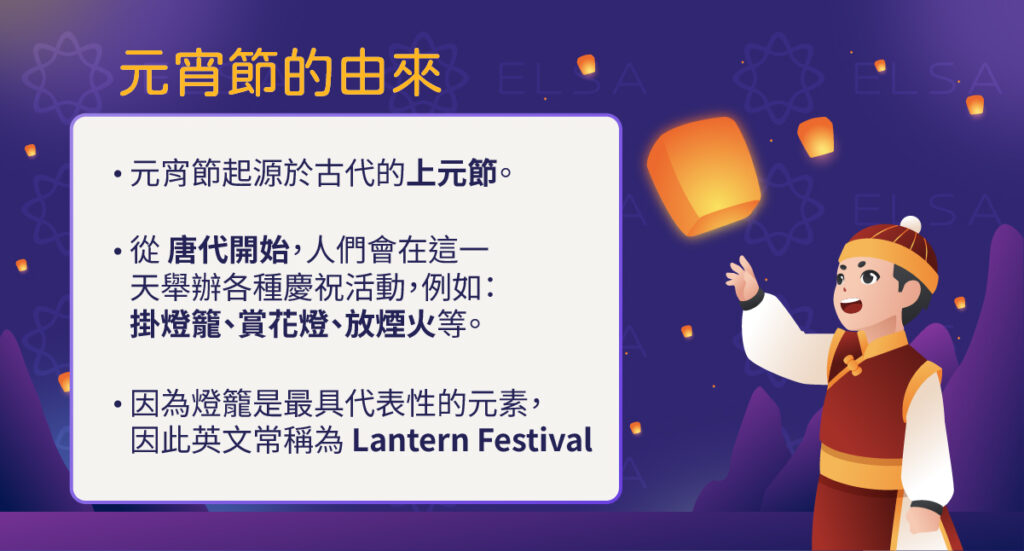
| The Lantern Festival marks the first full moon of the Lunar New Year and is celebrated on the fifteenth day of the first lunar month. Its origins can be traced back more than 2,000 years to the Han Dynasty in China. According to traditional beliefs, people would light lanterns to worship the gods, pray for peace and good fortune, and celebrate the arrival of spring. Over time, the festival evolved into a joyful occasion featuring lantern displays, riddle guessing, dragon and lion dances, and eating sweet rice balls known as tangyuan. Today, the Lantern Festival remains an important cultural celebration in many East Asian countries, including Taiwan, where colorful lantern festivals attract visitors from around the world. |
翻譯:
元宵節是農曆新年後的第一個月圓之夜,於農曆正月十五慶祝。它的起源可追溯至兩千多年前的中國漢朝。根據傳統習俗,人們會點燈祭神、祈求平安與好運,同時慶祝春天的到來。隨著時代演變,元宵節逐漸發展成充滿歡樂氣氛的節慶,包含賞花燈、猜燈謎、舞龍舞獅以及品嚐湯圓等活動。時至今日,元宵節仍是許多東亞國家重要的傳統節日,其中台灣的燈會活動更吸引來自世界各地的遊客前來參觀。
相關閱讀: 拜拜 英文: 在交流、宗教儀式與傳統節慶中的表達方式
元宵節的意義
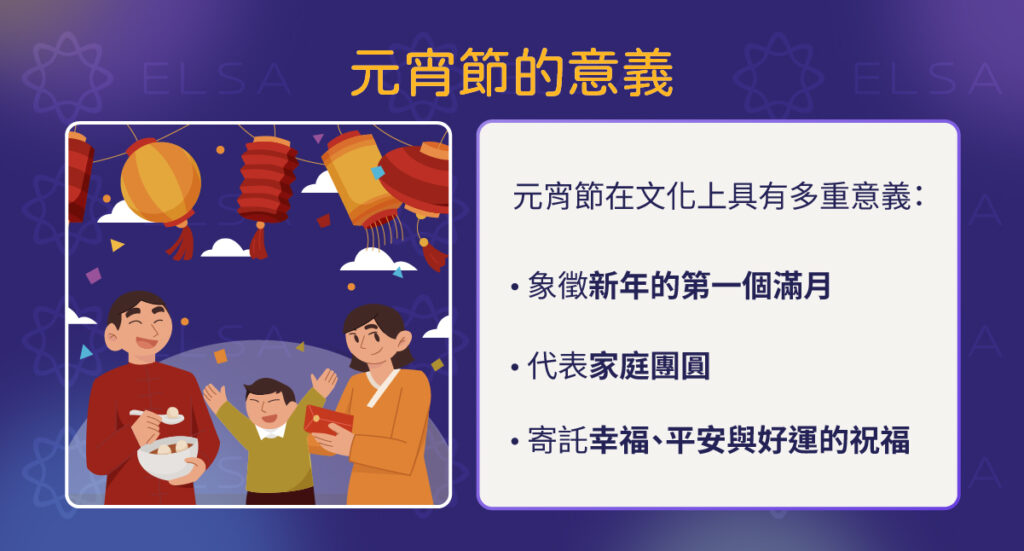
元宵節 (Lantern Festival) 是東亞人重要的傳統節日,在農曆新年第一個滿月之夜慶祝,象徵吉祥的開始和閔家團圓。人們通過掛燈籠、賞燈籠、猜謎等活動,表達對平安、幸福和繁榮的美好祝福。在國際上,元宵節也被稱為Chinese Lantern Festival, Spring Lantern Festival 或者 Yuan Xiao Festival,有助於推廣其獨特的文化價值。
元宵節英文單字
為了更好地理解英語中的元宵節,你可以從熟悉的英文單字入手,例如湯圓英文、燈籠英文以及燈會 元宵節 英文名稱。
元宵節活動與事件的詞彙
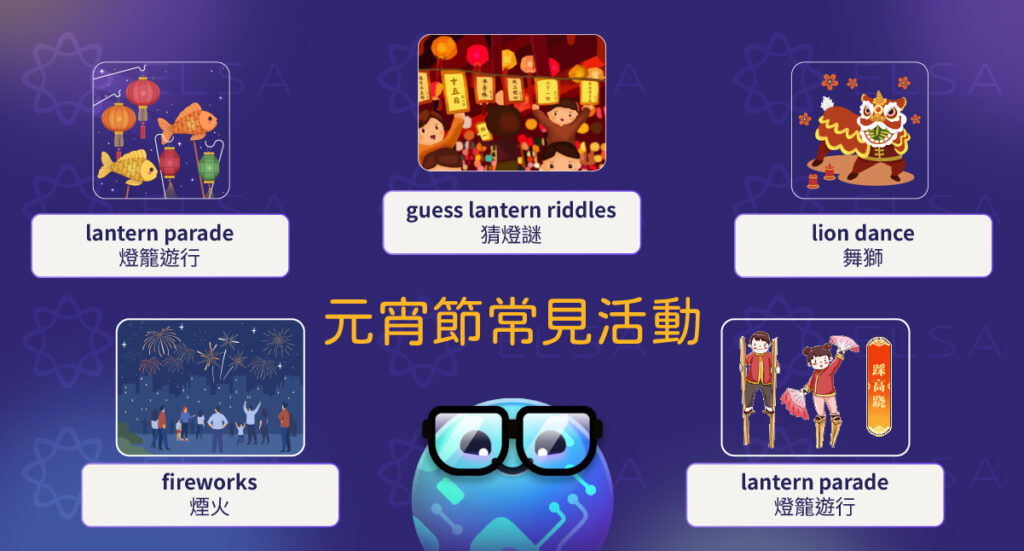
| 詞彙 | 發音 (IPA) | 意思 |
|---|---|---|
| Lantern Festival | /ˈlæntərn ˈfɛstəvəl/ | 元宵節 |
| lantern display | /ˈlæntərn dɪˈspleɪ/ | 燈籠展示 |
| lantern exhibition | /ˈlæntərn ˌeksɪˈbɪʃən/ | 花燈展覽 |
| lantern parade | /ˈlæntərn pəˈreɪd/ | 燈籠遊行 |
| hold a lantern | /hoʊld ə ˈlæntərn/ | 提著燈籠 |
| hang lanterns | /hæŋ ˈlæntərnz/ | 掛燈籠 |
| light lanterns | /laɪt ˈlæntərnz/ | 燈籠 |
| sky lantern | /skaɪ ˈlæntərn/ | 天燈 |
| release sky lanterns | /rɪˈliːs skaɪ ˈlæntərnz/ | 放飛天燈 |
| light sky lantern | /laɪt skaɪ ˈlæntərn/ | 放飛天燈 |
| lantern riddles | /ˈlæntərn ˈrɪdəlz/ | 燈謎 |
| guess lantern riddles | /ɡɛs ˈlæntərn ˈrɪdəlz/ | 猜燈籠謎語 |
| riddle game | /ˈrɪdəl ɡeɪm/ | 謎語遊戲 |
| watch lanterns | /wɑːtʃ ˈlæntərnz/ | 賞燈籠 |
| admire lanterns | /ədˈmaɪər ˈlæntərnz/ | 賞燈籠 |
| dragon dance | /ˈdræɡən dæns/ | 舞龍 |
| lion dance | /ˈlaɪən dæns/ | 舞獅 |
| fireworks | /ˈfaɪərwɜːrks/ | 烟花 |
| watch fireworks | /wɑːtʃ ˈfaɪərwɜːrks/ | 看烟花 |
| firecrackers | /ˈfaɪərˌkrækərz/ | 鞭炮 |
| beehive firecrackers | /ˈbiːhaɪv ˈfaɪərkrækərz/ | 蜂炮 |
| festive celebration | /ˈfɛstɪv ˌsɛləˈbreɪʃən/ | 節日慶祝活動 |
| cultural performance | /ˈkʌltʃərəl pərˈfɔːrməns/ | 文化表演 |
| folk performance | /foʊk pərˈfɔːrməns/ | 民間表演 |
| festival activities | /ˈfɛstəvəl ækˈtɪvətiz/ | 節慶活動 |
| street celebration | /striːt ˌsɛləˈbreɪʃən/ | 街頭慶祝活動 |
| family gathering | /ˈfæməli ˈɡæðərɪŋ/ | 家庭聚會 |
元宵節菜餚的詞彙
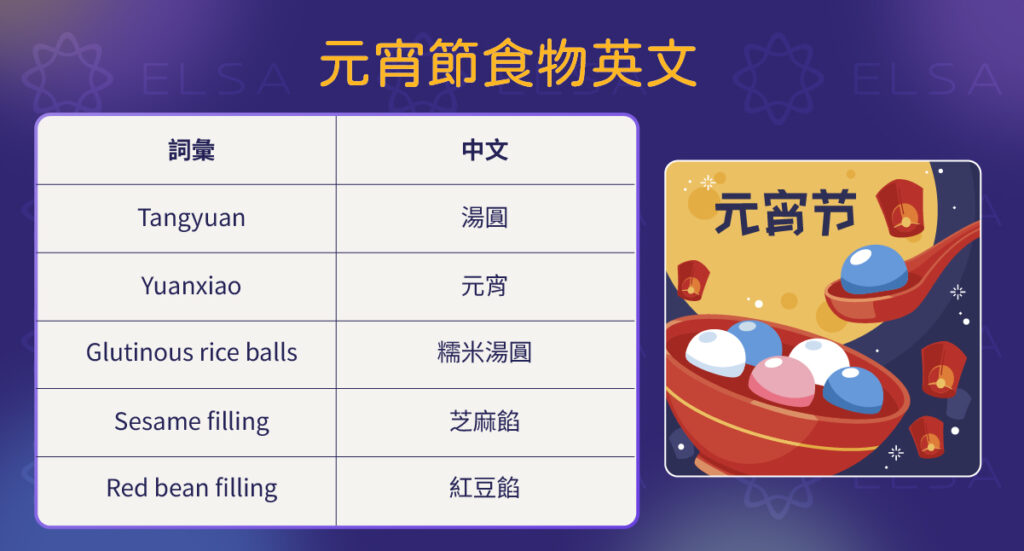
| 詞彙 | 發音 (IPA) | 意思 |
|---|---|---|
| tangyuan | /tæŋˈjuːɛn/ | 湯圓 |
| yuanxiao | /juːˈɛnʃaʊ/ | 元宵 |
| glutinous rice balls | /ˈɡluːtənəs raɪs bɔːlz/ | 糯米團 |
| glutinous rice flour | /ˈɡluːtənəs raɪs flaʊər/ | 糯米粉 |
| sweet dumpling | /swiːt ˈdʌmplɪŋ/ | 湯圓 |
| filling | /ˈfɪlɪŋ/ | 餡料 |
| sesame filling | /ˈsɛsəmi ˈfɪlɪŋ/ | 芝麻餡 |
| peanut filling | /ˈpiːnʌt ˈfɪlɪŋ/ | 花生餡 |
| red bean filling | /rɛd biːn ˈfɪlɪŋ/ | 紅豆餡 |
| black sesame paste | /blæk ˈsɛsəmi peɪst/ | 黑芝麻醬 |
| peanut paste | /ˈpiːnʌt peɪst/ | 花生碎 |
| red bean paste | /rɛd biːn peɪst/ | 紅豆沙 |
| traditional tangyuan | /trəˈdɪʃənl tæŋˈjuːɛn/ | 傳統湯圓 |
| sesame tangyuan | /ˈsɛsəmi tæŋˈjuːɛn/ | 芝麻湯圓 |
| peanut tangyuan | /ˈpiːnʌt tæŋˈjuːɛn/ | 花生湯圓 |
| red bean tangyuan | /rɛd biːn tæŋˈjuːɛn/ | 紅豆湯圓 |
| savory tangyuan | /ˈseɪvəri tæŋˈjuːɛn/ | 鹹湯圓 |
| fried tangyuan | /fraɪd tæŋˈjuːɛn/ | 炸湯圓 |
| dumpling | /ˈdʌmplɪŋ/ | 餃子 |
| rice dumpling | /raɪs ˈdʌmplɪŋ/ | 粽子 |
| steamed dumpling | /stiːmd ˈdʌmplɪŋ/ | 蒸餃 |
| jiaozi | /ˈdʒaʊdzi/ | 餃子 |
| mochi | /ˈmoʊtʃi/ | 麻糬 |
元宵節相關的詞彙
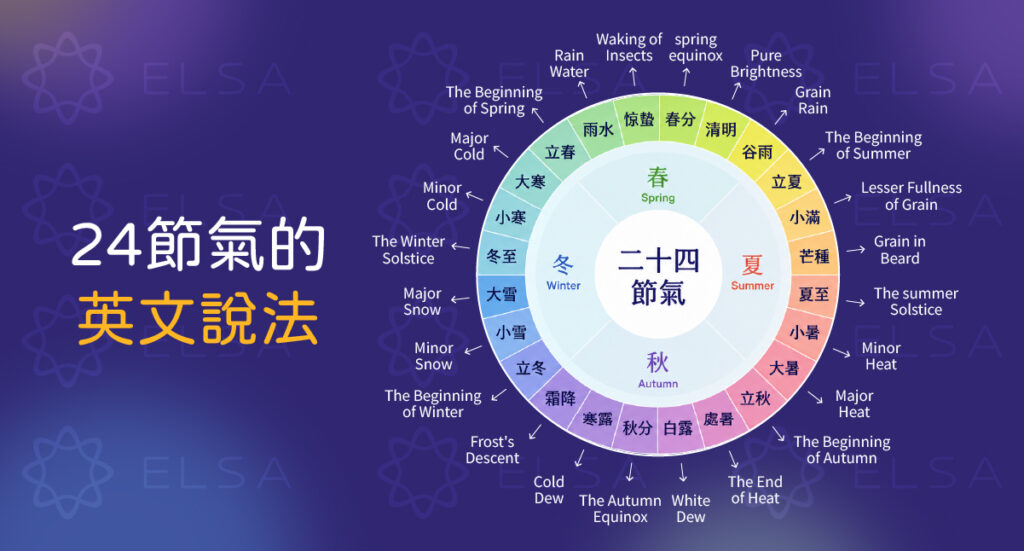
| 詞彙 | 發音 (IPA) | 意思 |
|---|---|---|
| Spring Commences | /sprɪŋ kəˈmɛnsɪz/ | 立春 |
| Rain Water (Spring Showers) | /reɪn ˈwɔːtər/ | 雨水 |
| Insects Awaken | /ˈɪnsekts əˈweɪkən/ | 驚蟄 |
| Vernal Equinox | /ˈvɜːrnəl ˈiːkwɪnɒks/ | 春分 |
| Clear and Bright | /klɪr ænd braɪt/ | 清明 |
| Grain Rain | /ɡreɪn reɪn/ | 穀雨 |
| Summer Commences | /ˈsʌmər kəˈmɛnsɪz/ | 立夏 |
| Grain Full | /ɡreɪn fʊl/ | 小滿 |
| Grain in Ear | /ɡreɪn ɪn ɪr/ | 芒種 |
| Summer Solstice | /ˈsʌmər ˈsɒlstɪs/ | 夏至 |
| Slight Heat | /slaɪt hiːt/ | 小暑 |
| Great Heat | /ɡreɪt hiːt/ | 大暑 |
| Autumn Commences | /ˈɔːtəm kəˈmɛnsɪz/ | 立秋 |
| End of Heat | /ɛnd əv hiːt/ | 處暑 |
| White Dew | /waɪt djuː/ | 白露 |
| Autumnal Equinox | /ɔːˈtʌmnəl ˈiːkwɪnɒks/ | 秋分 |
| Cold Dew | /koʊld djuː/ | 寒露 |
| Frost Descent | /frɔːst dɪˈsɛnt/ | 霜降 |
| Winter Commences | /ˈwɪntər kəˈmɛnsɪz/ | 立冬 |
| Light Snow | /laɪt snoʊ/ | 小雪 |
| Heavy Snow | /ˈhɛvi snoʊ/ | 大雪 |
| Winter Solstice | /ˈwɪntər ˈsɒlstɪs/ | 冬至 |
| Slight Cold | /slaɪt koʊld/ | 小寒 |
| Great Cold | /ɡreɪt koʊld/ | 大寒 |
相關内容:天氣 英文 (Weather): 會話中的常用單字與句型
元宵節英文祝福語
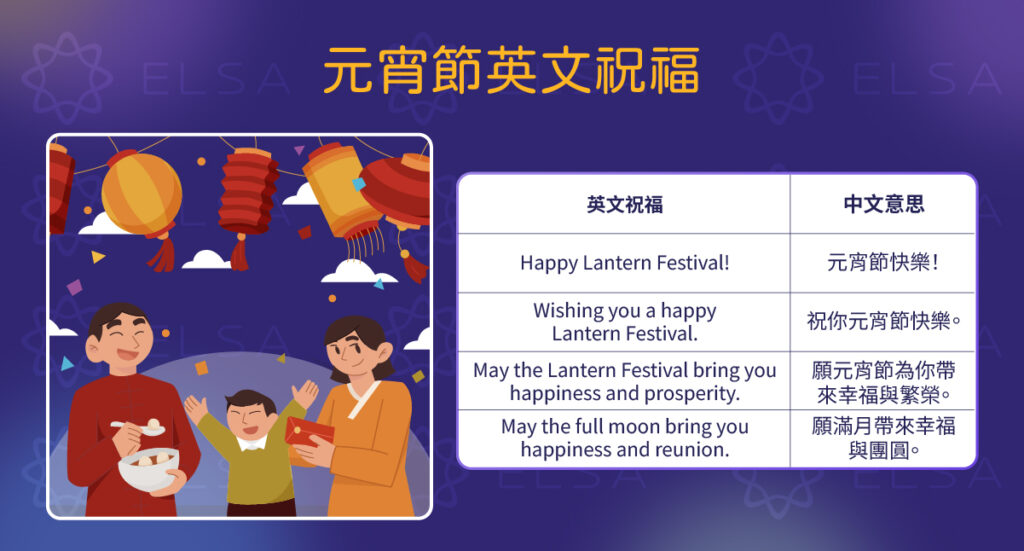
ELSA Speak 帶你了解更多元宵節快樂英文除外的祝福語。
| 祝福語 | 翻譯 |
|---|---|
| Happy Lantern Festival! | 元宵节快乐! |
| Wishing you a happy Lantern Festival. | 祝你元宵节快乐。 |
| Happy Yuanxiao Festival! | 元宵节快乐! |
| May you have a joyful Lantern Festival. | 願你擁有一個快樂的元宵節。 |
| Wishing you happiness and good fortune on the Lantern Festival. | 祝你元宵節幸福美滿、好運連連。 |
| May the Lantern Festival bring you happiness and prosperity. | 願元宵節為你帶來幸福與繁榮。 |
| May the bright lanterns bring you hope and good luck. | 願明亮的燈籠為你帶來希望與好運。 |
| Wishing you a bright and joyful Lantern Festival. | 祝你度過一個明亮而快樂的元宵節。 |
| May your life be as bright as the lanterns tonight. | 願你的人生如今晚的燈籠一樣明亮。 |
| May this Lantern Festival bring warmth and happiness to your family. | 願這個元宵節為你的家庭帶來溫暖與幸福。 |
| May the full moon bring you happiness and reunion. | 願滿月為你帶來幸福與團圓。 |
| May the Lantern Festival fill your life with joy and harmony. | 願元宵節為你的生活充滿喜悅與和諧。 |
| Wishing you a sweet Lantern Festival filled with tangyuan. | 祝你度過一個充滿湯圓的甜蜜元宵節。 |
| May the lantern lights guide you to a bright future. | 願燈籠的光芒指引你走向光明的未來。 |
| Enjoy the Lantern Festival with your loved ones. | 與你所愛的人一起享受元宵節。 |
| Sending you warm wishes for a happy Lantern Festival. | 送上溫暖的祝福,祝你元宵節快樂。 |
| May the Lantern Festival bring peace, joy, and success to you. | 願元宵節為你帶來平安、喜悅與成功。 |
| Wish you a wonderful Lantern Festival and a bright year ahead. | 祝你元宵節愉快,並迎接光明美好的一年。 |
元宵節 英文燈謎
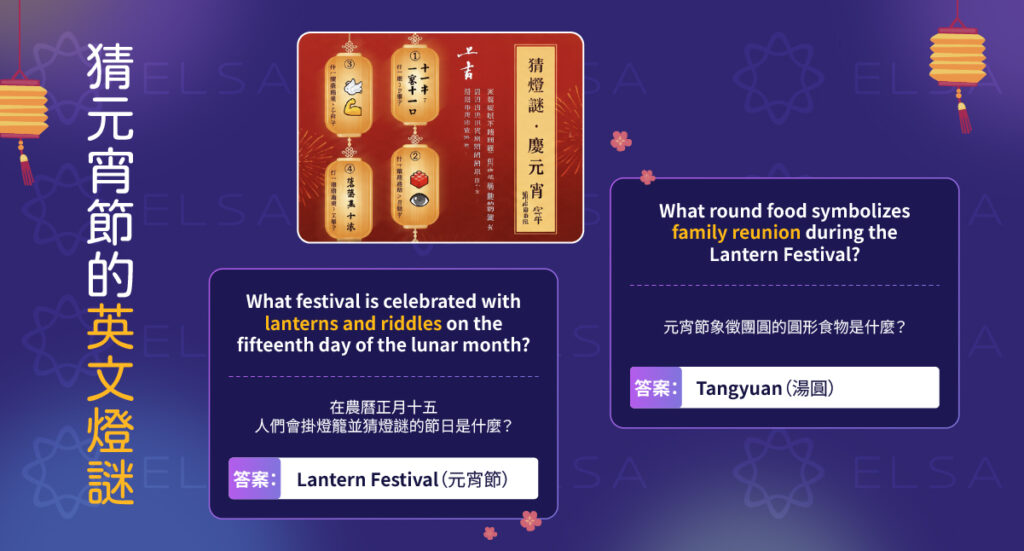
元宵節期間,猜燈謎(Lantern Riddles)是一項非常受歡迎的傳統活動。這些謎語通常掛在燈籠上,供人們思考和解答,營造出歡樂的節日氣氛。
| 謎語 | 答案 |
|---|---|
| What festival is celebrated with lanterns and riddles on the fifteenth day of the lunar month? (在農曆正月十五,人們用燈籠和猜燈謎來慶祝的是什麼節日?) | Lantern Festival (元宵節) |
| What round food do people eat during the Lantern Festival to symbolize family reunion? (在元宵節期間,人們吃什麼圓形食物來象徵家庭團圓? ) | Tangyuan (湯圓) |
| I am round and bright in the sky during the Lantern Festival night. What am I? (在元宵節的夜晚,我又圓又亮地掛在天空中。我是什麼?) | The full moon (滿月) |
| I am colorful, made of paper, and light up the streets during the festival. What am I? (我五顏六色,由紙製成,在節日期間照亮街道。我是什麼?) | Lantern (燈籠) |
| People write wishes on me and release me into the sky. What am I? (人們會在我上面寫下願望,然後把我放飛到天空。我是什麼?) | Sky lantern (天龍) |
| I am a fun activity where people solve puzzles written on lanterns. What am I? (我是一種有趣的活動,人們會解寫在燈籠上的謎語。我是什麼?) | Lantern riddles (燈謎) |
| I dance with long colorful movements during festivals and celebrations. What am I? (我在節慶慶典上跳著舞,舞姿舒展而色彩繽紛。我是什麼?) | Dragon dance (舞龍) |
| I am a traditional performance often seen during festivals and I look like a big cat. What am I? (我是一種經常在節日慶典上出現的傳統表演動物,我的外形像一隻大貓。我是什麼?) | Lion dance (舞獅) |
| I light up the sky with bright colors during celebrations. What am I? (在慶祝活動中,我用明亮的色彩點亮天空。我是什麼? ) | Fireworks (烟花) |
| I am the first full moon of the lunar new year. What festival celebrates me? (我是農曆新年的第一個滿月,哪個節日是為了慶祝我? ) | Lantern Festival (元宵節) |
| I am hung outside houses and streets to celebrate the festival. What am I? (我被掛在房屋外和街道上,用來慶祝節日。我是什麼?) | Lantern (燈籠) |
| I am written on paper and attached to lanterns for people to guess. What am I? (我被寫在紙上,貼在燈籠上讓人們猜。我是什麼? ) | Lantern riddle (燈籠謎語) |
| People gather to admire me during the festival night. I shine brightly in the sky. What am I? (在節日夜晚,人們聚在一起欣賞我,我在天空中明亮地閃耀。我是什麼? ) | The moon (月亮) |
| I am a traditional lantern released into the night sky with wishes. What am I? (我是一種傳統燈籠,帶著人們的願望被放飛到夜空中。我是什麼? ) | Sky lantern (天燈) |
元宵節英文介紹
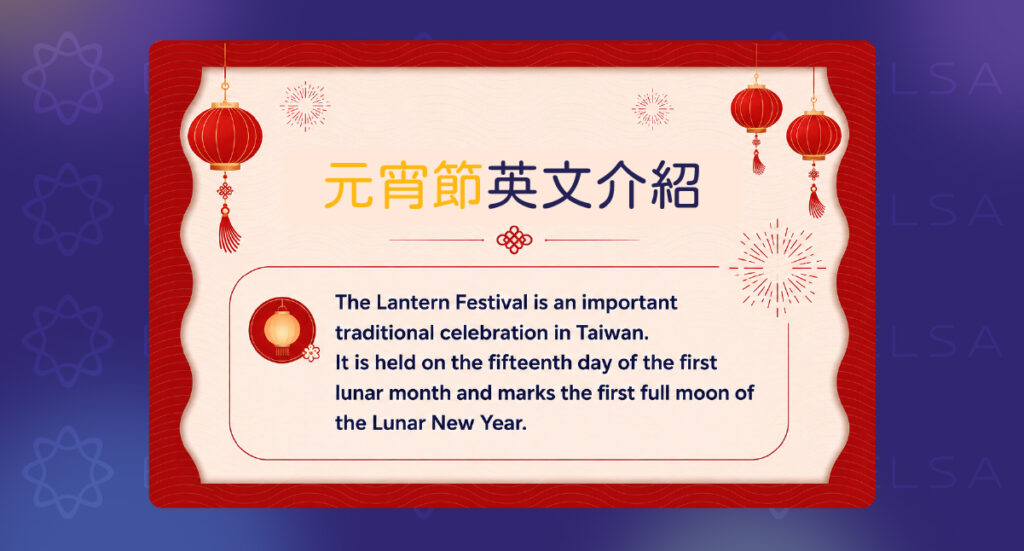
元宵節英文介紹短文
| The Lantern Festival, also known as Yuanxiao Festival, is an important traditional celebration in Taiwan. It is held on the fifteenth day of the first lunar month, marking the first full moon of the Lunar New Year. During this festival, people enjoy colorful lantern displays, guess lantern riddles, and eat tangyuan with their families to celebrate reunion and good fortune. |
翻譯:
元宵節,又稱為 Yuanxiao Festival,是臺灣重要的傳統節慶之一。它在農曆正月十五舉行,標誌著農曆新年後的第一個滿月之夜。每逢這個節日,人們會欣賞繽紛的花燈展覽、猜燈謎,並與家人一起吃湯圓,以慶祝團圓與好運。
詳細的元宵節英文介紹
| The Lantern Festival is one of the most important traditional festivals in Taiwan and many Chinese communities. It takes place on the fifteenth day of the first lunar month and marks the first full moon of the Lunar New Year. During this time, cities across Taiwan hold large lantern exhibitions, cultural performances, and festive activities. People gather with family and friends to watch lantern displays, release sky lanterns, guess lantern riddles, and enjoy traditional foods such as tangyuan, which symbolizes family reunion. The festival is not only a celebration of light and joy but also a way to express hopes for happiness, prosperity, and good fortune in the coming year. |
翻譯:
元宵節是臺灣以及許多華人社群中最重要的傳統節日之一。它在農曆正月十五舉行,標誌著農曆新年後的第一個滿月之夜。在這段期間,臺灣各地都會舉辦大型燈會、文化表演及各種節慶活動 。人們會與家人和朋友一起參觀燈會、施放天燈、猜燈謎,並享用湯圓等傳統食物,象徵家庭團圓。這個節日不僅是光明與喜悅的慶典,也表達了人們對未來一年幸福、繁榮與好運的期望。
元宵節英文文章
元宵節英文作文(供學生參考)
| The Lantern Festival is an important traditional festival celebrated in many Chinese communities, including Taiwan. It takes place on the fifteenth day of the first lunar month and marks the first full moon of the Lunar New Year. During the Lantern Festival, people decorate streets and houses with colorful lanterns. Many families go out at night to watch lantern displays and enjoy the festive atmosphere. One popular activity is guessing lantern riddles, which is both fun and educational for children and adults. People also eat a special food called tangyuan, which are sweet glutinous rice balls. The round shape of tangyuan symbolizes family reunion and happiness. In Taiwan, some places also hold large lantern festivals where visitors can see creative lantern designs and cultural performances. The Lantern Festival is not only a time for celebration but also a moment for families and friends to gather together and wish for good luck in the new year. |
翻譯:
元宵節是華人社群(包括臺灣)中一個重要的傳統節日。它在農曆正月十五舉行,標誌著農曆新年後的第一個滿月之夜。在元宵節期間,街道和公共場所都會掛滿各式花燈。許多家庭會在夜晚外出觀賞燈會,並享受節慶氣氛。其中一項受歡迎的活動是猜燈謎,對兒童與成人來說都既有趣又具有教育意義。人們也會食用一種稱為湯圓的特別食物,即甜味的糯米湯圓。湯圓的圓形象徵家庭團圓與幸福。在臺灣,一些地方還會舉辦大型燈會,遊客可以欣賞富有創意的燈籠設計與文化表演。元宵節不僅是慶祝的時刻,也是家人與朋友團聚並祈求新年好運的時刻。
元宵節英文文章(多益篇)
| The Lantern Festival is an important traditional celebration in many Chinese communities. It takes place on the fifteenth day of the first lunar month and marks the end of the Lunar New Year celebrations. During this festival, people decorate streets with colorful lanterns and enjoy various cultural activities. One of the most popular traditions is guessing lantern riddles. This activity brings families and communities together and creates a joyful atmosphere. In addition, people often eat tangyuan, which are sweet rice balls that symbolize family reunion and happiness. In Taiwan, many cities hold large lantern exhibitions and cultural events during the Lantern Festival. These events attract both local residents and tourists. The festival not only celebrates tradition but also promotes cultural understanding and community bonding. |
翻譯:
元宵節是華人社群中一個重要的傳統節慶。它在農曆正月十五舉行,標誌著農曆新年慶祝活動的結束。在這個節日裡,人們會用五彩繽紛的燈籠裝飾街道,並參與各種文化活動。
其中最受歡迎的傳統之一是猜燈謎,這項活動讓家庭與社區聚集在一起,營造出歡樂的氛圍。此外,人們通常會食用湯圓,這種甜味糯米湯圓象徵家庭團圓與幸福。
在臺灣,許多城市會在元宵節期間舉辦大型燈會與文化活動,吸引本地居民與遊客參與。這個節日不僅慶祝傳統,也促進文化交流與社區凝聚力。
元宵節英文文章(雅思篇)
| The Lantern Festival is a traditional celebration that marks the end of the Lunar New Year festivities in many Chinese communities. It is celebrated on the fifteenth day of the first lunar month, when the first full moon of the year appears in the sky. During the Lantern Festival, streets and public spaces are decorated with beautiful lanterns of different shapes and colors. People gather with their families and friends to watch lantern displays, enjoy fireworks, and participate in cultural activities such as guessing lantern riddles. Another important tradition is eating tangyuan, a type of sweet glutinous rice ball that symbolizes family unity and harmony. In places such as Taiwan, large-scale lantern festivals are held every year, attracting many visitors from around the world. These celebrations not only preserve traditional culture but also provide opportunities for cultural exchange and tourism development. |
翻譯:
元宵節是華人社群中一個傳統節日,標誌著農曆新年慶祝活動的結束。它在農曆正月十五舉行,此時一年中的第一個滿月高掛天空。
在元宵節期間,街道與公共場所會被各式各樣、色彩繽紛的燈籠裝飾得十分美麗。人們會與家人和朋友聚在一起觀賞燈會、欣賞烟花,並參與猜燈謎等文化活動。另一項重要傳統是食用湯圓,這種甜味糯米湯圓象徵家庭團圓與和諧。
在臺灣等地,每年都會舉辦大型燈會,吸引來自世界各地的遊客。這些慶典不僅保存了傳統文化,也促進了文化交流與旅遊發展。
通過這本文章,你將對元宵節 英文有更深入的了解,從元宵節英文單字到台灣元宵節英文介紹,讓你在學習詞彙的同時,也能與國際友人分享這美麗的傳統文化。與 ELSA Speak 的溝通交流英語主題探索更多精彩文章!
練習英文: 區分 practise 與 practise,以及免費實用的練習資源?透過 ELSA Speak 更有效地練習英文,學習單字、文法與口說技巧,並結合練習英文app與練習英文網站,每天持續進步。
練習英文名詞 Practice
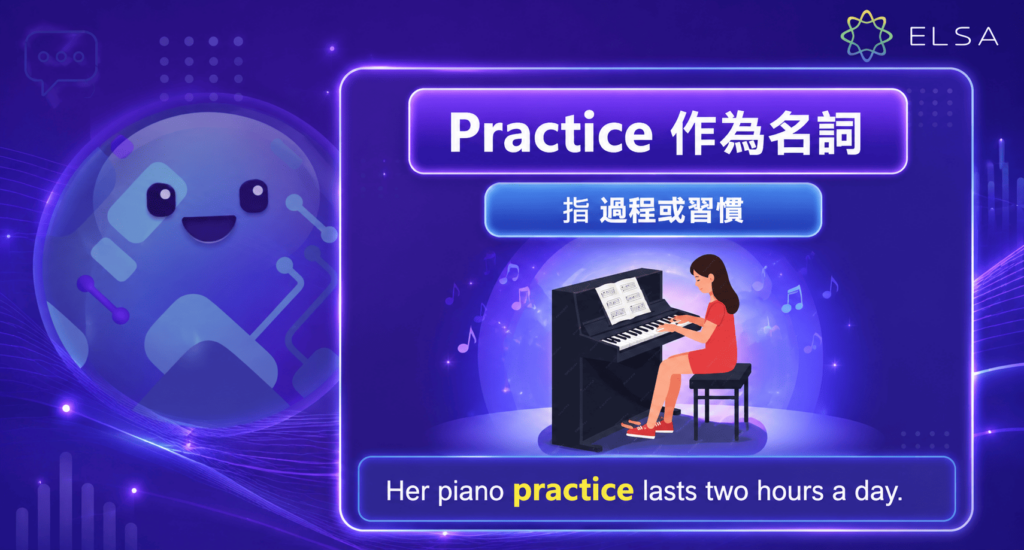
練習英文 practice 作為名詞(noun)時,意指練習、實踐、習慣或具有訓練性質的活動。此用法通常指一個過程或活動,而非正在進行中的具體行為。
practice(名詞)的常用片語:
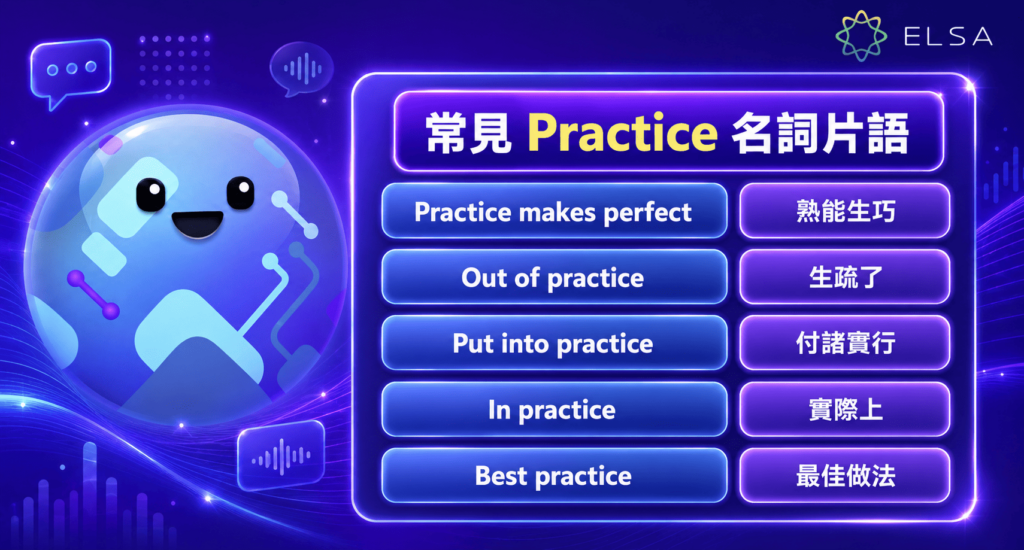
| 片語 | 中文釋義 | 例句 |
|---|---|---|
| Practice makes perfect | 熟能生巧 | You will improve your English over time — practice makes perfect. (你的英文會隨時間進步——熟能生巧。 ) |
| Practice what you preach | 言行合一 | She always advises others to practice what they preach. (她總是建議別人要言行合一。) |
| Out of practice | 生疏了、手生了 | After not playing basketball for years, he felt out of practice when he tried to play again. (多年沒打籃球後,他重拾球時感覺有些生疏。) |
| Put into practice | 付諸實踐、實際運用 | After learning about time management techniques, she decided to put them into practice in her daily life. (學完時間管理技巧後,她決定將其運用於日常生活中。 ) |
| Practice makes progress | 練習帶來進步 | Remember, practice makes progress, so keep working on your skills. (請記住練習帶來進步,所以要持續磨練你的技能。) |
| In practice | 實際上 | In practice, it’s often more difficult than it seems on paper. (實際上,事情通常比紙上談兵要難得多。) |
| Best practice | 最佳做法、業界標準 | We aim to adopt best practices in our business operations. (我們致力於在業務中落實最佳做法。) |
練習英文動詞 Practise / Practice
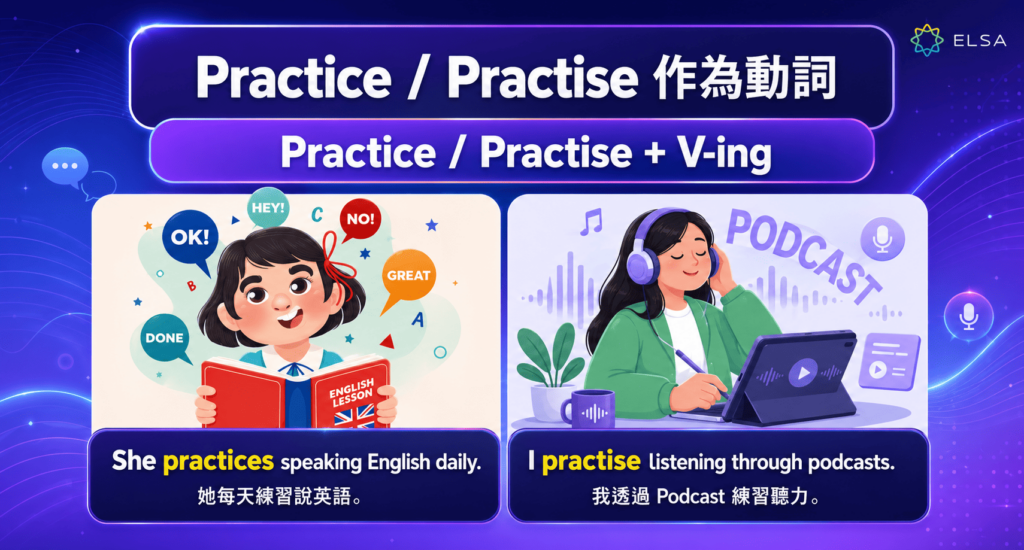
當作為動詞(verb)使用時,practice/practise 意指練習、實踐某個具體行為。此動詞後面必須接受詞,且受詞通常為 V-ing 形式(動名詞)。
重要句型:
| practice/practise + V-ing |
例句 :
- She practises playing the piano for two hours every day. (她每天練習彈鋼琴兩小時。 )
- I practice English with my friends. (我和朋友一起練習英文。)
區分 practise 與 practise
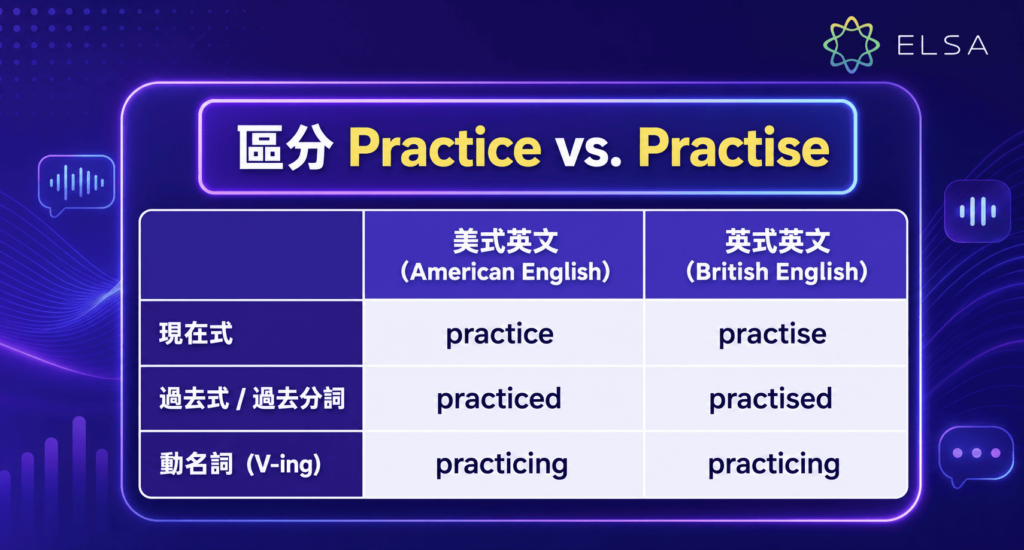
Practice 與 practise 的差異,主要源自英式英語與美式英語的不同用法 :
| 美式 (American English) | 英式 (British English) | |
|---|---|---|
| 現在式 | practice | practise |
| 過去式/過去分詞 | practiced | practised |
| 動名詞 (V-ing) | practicing | practicing |
與 Practice 相關的詞彙
Practice 的同義詞
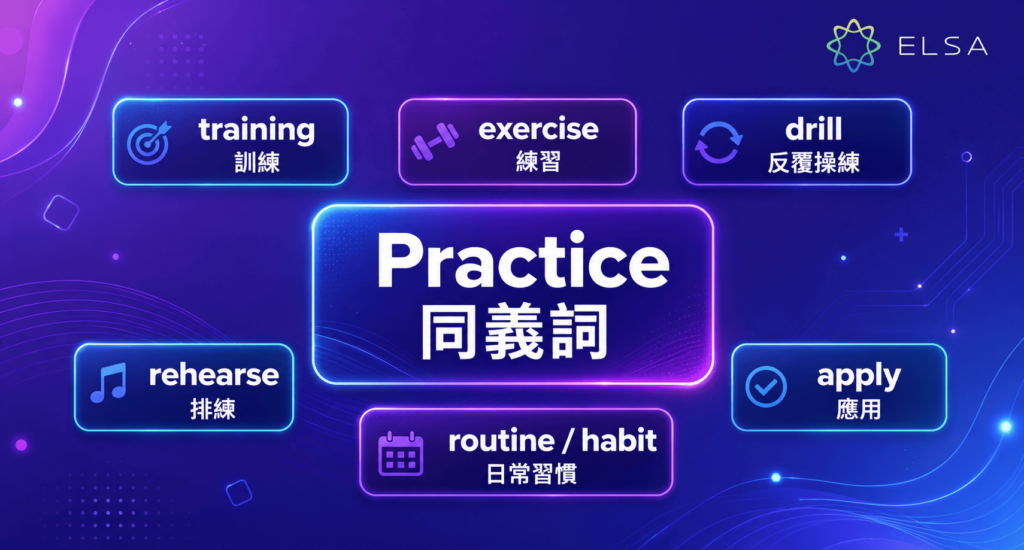
| 英文單字 | 中文釋義 |
|---|---|
| exercise (n/v) | 練習、訓練 |
| training (n) | 訓練、培訓課程 |
| drill (n/v) | 反覆練習 |
| routine (n) | 習慣、日常作息 |
| habit (n) | 習慣 |
| rehearse (v) | 排練、演練 |
| apply (v) | 應用、運用 |
Practice 的反義詞
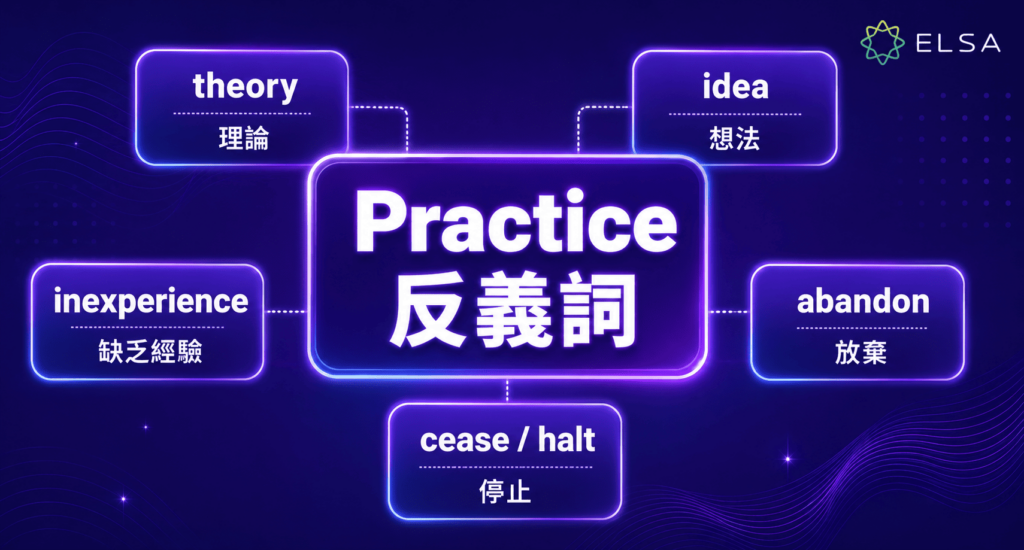
| 英文單字 | 中文釋義 |
|---|---|
| theory (n) | 理論 |
| idea (n) | 想法 |
| inexperience (n) | 缺乏經驗 |
| cessation (n) | 停止、中斷 |
| abandon (v) | 放棄 |
| cease (v) | 停下來 |
| halt (v) | 完全停止 |
不要錯過具有大量功能的英語學習包
ELSA Premium 終身 – 十月優惠
原價:7,150元 現在 4,215 元
ELSA Premium 還有另外以下的學習包:
ELSA Premium 一年:原價:5,250元 現在 2,199 元
ELSA Premium 三個月:原價:2,100元 現在 1,140 元
與 practice 相關的延伸詞彙
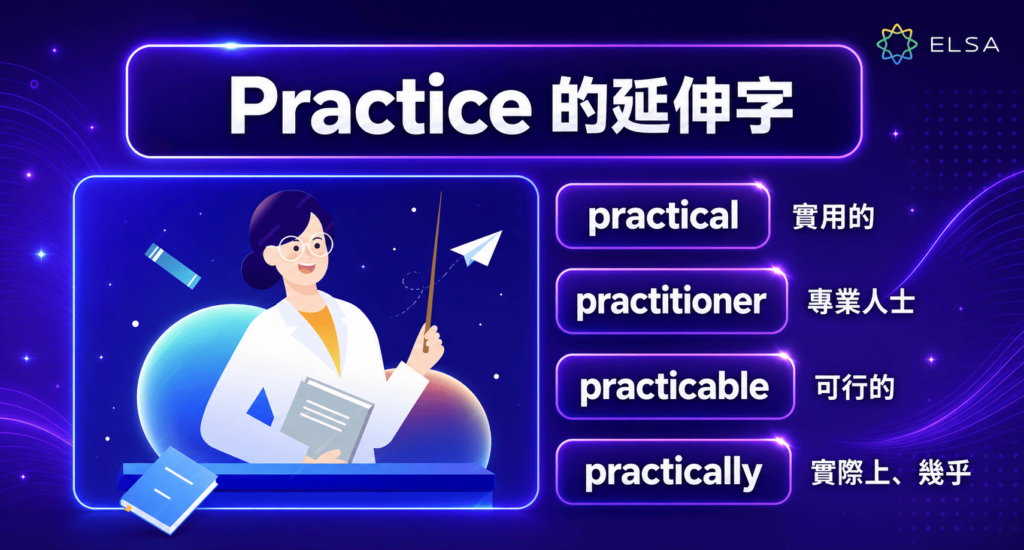
| 英文單字 | 中文釋義 |
|---|---|
| practical (adj.) | 實際的、實用的 |
| practitioner (n.) | 專業從業人員 |
| practicable (adj.) | 可行的 |
| practicability (n.) | 可行性 |
| practically (adv.) | 幾乎、實際上 |
練習英文單字相關
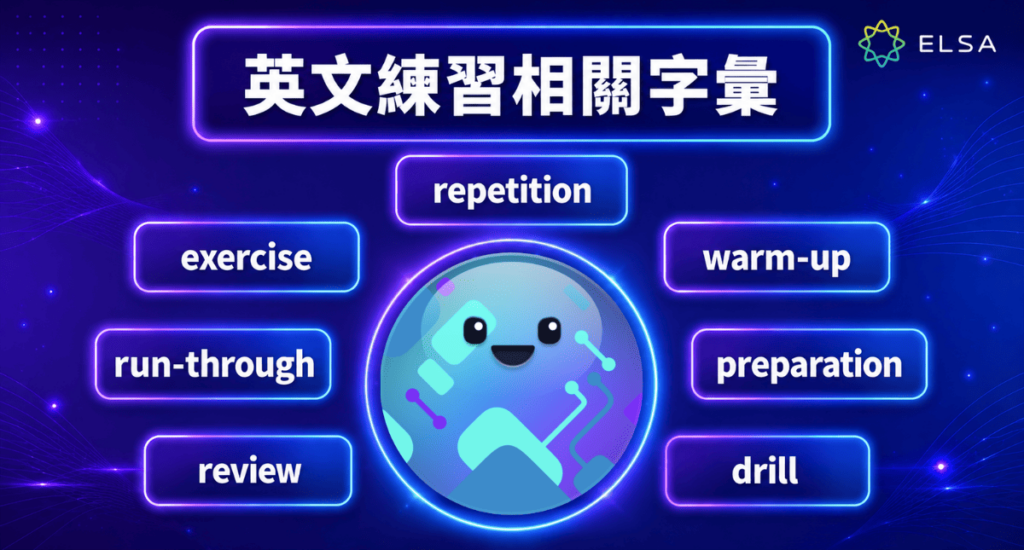
| 英文單字 | 發音(IPA) | 中文釋義 |
|---|---|---|
| practice (n/v) | /ˈpræk.tɪs/ | 練習;實踐 |
| drill (n/v) | /drɪl/ | 反覆練習的習題 |
| review (n/v) | /rɪˈvjuː/ | 複習、重新檢視 |
| run-through (n) | /ˈrʌn.θruː/ | 總彩排 |
| rehearsal (n) | /rɪˈhɜː.səl/ | 排練、演練 |
| exercise (n/v) | /ˈek.sə.saɪz/ | 練習題;鍛鍊 |
| training (n) | /ˈtreɪ.nɪŋ/ | 訓練、培訓過程 |
| repetition (n) | /ˌrep.əˈtɪʃ.ən/ | 重複 |
| warm-up (n/v) | /ˈwɔːm.ʌp/ | 暖身 |
| preparation (n) | /ˌprep.əˈreɪ.ʃən/ | 準備 |
閲讀更多:運動 英文:正確區分 Sport, Exercise 和 Workout
練習英文方法:幫助你持續進步的學習技巧
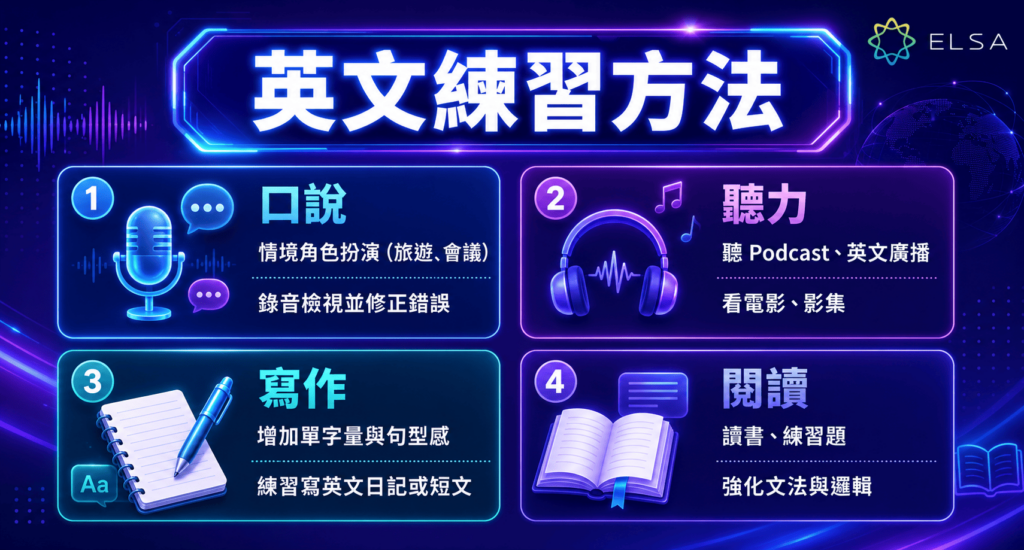
- 情境對話:選擇一個主題(例如:在餐廳點餐、機場辦理登機手續、工作會議、日常閒聊),與 AI 進行英文口說練習。
- 主題討論:選定你感興趣的主題(如旅遊、科技、電影),用英文交流意見與想法。
- 翻譯與句子修正:寫下你想用中文或英文表達的句子,AI 會協助修正文法錯誤並建議更自然的表達方式。
- 測驗/小挑戰:提供幾個單字、片語或造句題目,測試你的英文程度。
除了持續練習聽說讀寫,也別忽略發音基礎;掌握自然發音規則能幫助你更準確地讀出英文單字。
練習英文網站與學習資源
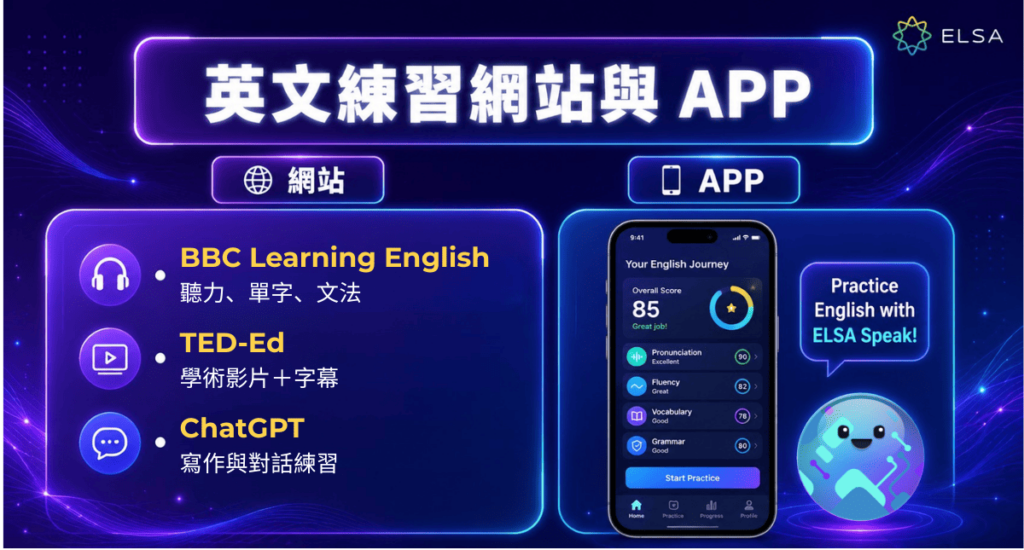
為了更有效率地練習,你可以搭配以下英文練習網站與app:
- BBC Learning English – 聽力、單字、文法練習
- TED-Ed – 透過學術影片練習聽力,附字幕
- ChatGPT – 英文寫作與對話練習
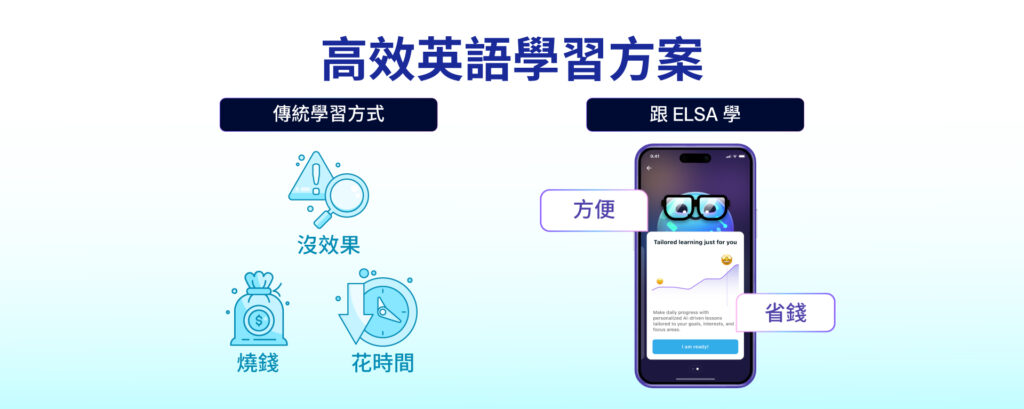
特別值得一提的是,ELSA Speak 是一款全方位的練習英文app,有效結合英文練習遊戲與豐富的英文文法題庫,讓學習者在維持學習興趣的同時,也能有系統地提升技能。有別於零散學習,ELSA Speak 提供清晰的練習英文口語路徑,協助學習者練習發音、單字、文法與口說,並根據個人程度與目標進行調整。
ELSA Speak亮點功能 :
- 個人化 AI Coach:一對一 AI 家教,模擬專屬學習路徑,根據每位學習者的程度、目標與進度自動調整。
- Speech Analyzer:AI語音辨識與IPA詳細分析,即時回饋發音、重音與語調。
- AI Role-play:在日常溝通、旅遊及職場等真實情境中練習英文對話,提升英文對話反應能力。
- AI Interview Coach:模擬真實英文面試,協助練習回答問題,提升自信與職場溝通能力。
- 遊戲化學習(Gamification):整合遊戲與學習挑戰,幫助維持每日學習動力與習慣。
- 多元練習題庫:豐富的單字、文法與主題對話內容,適合各種程度的學習者。
- 情境整合字典:快速準確查詢,並支援在各種使用情境中理解字義。
- 英語檢定備考練習:提供 IELTS (雅思—International English Language Testing System)、TOEFL 等考試的系統化備考路徑。
正確區分 practice 與 practise,有助於學習者在練習英文中精準運用。將這項知識與多元的練習英文方式相結合——包括練習英文 app、練習英文網站及規律的實際練習——你將能持續保持學習動力,並穩定提升英文能力。ELSA Speak 還分享更多精彩的溝通交流英語文章,立即前往探索吧!