Author: Tam Dang
你是否曾經對連接詞英文用法感到困惑?現在就跟 ELSA Speak 一起學習正確使用常見連接詞,分辨它們與介系詞的不同,並認識這組在英文寫作與日常溝通中不可或缺的FANBOYS 連接詞 。
連接詞 英文 是什麼?

英文 連接詞稱為 Conjunction,簡寫為 “conj” 或 “cnj”,在句子中扮演著連接單詞、片語與子句的重要角色。在寫句子、學術英文寫作或日常溝通中,正確使用連接詞不僅能讓語句更加流暢,還能展現清晰的思維邏輯。
例句:
- She stayed home because it was raining. (她待在家裡,因為正在下雨。)
- He didn’t go out although he had free time. (A他雖然有空,但還是不出門。)
英文連接詞有哪些?
目前英文連接詞主要分為三大類型:相關連接詞、從屬連接詞與對等連接詞。

>>閲讀更多:關係代名詞 (Relative Pronouns): who、which、that 用法和區分
對等連接詞 (Coordinating Conjunctions)

對等連接詞是用來連接兩個或多個意思對等的單詞、片語或子句。最常見的對等連接詞就是 FANBOYS連接詞 這組七個字,分別是:for、and、nor、but、or、yet、so。
| 連接詞 | 意思/主要用法 | 結構 | 例句 |
|---|---|---|---|
| For | 解釋原因,類似 because | Clause + for + clause | She does morning exercise every day, for she wants to keep fit.(她每天早上運動,因為她想保持身材。.) |
| And | 補充事物、現象 | N/Clause + and + N/clause | I love drinking coffee and milktea.(我喜歡喝咖啡和奶茶。) |
| Nor | 補充否定元素 | Clause + nor + … | I don’t like playing games nor listening to music.(我不喜歡打電動,也不喜歡聽音樂。) |
| But | 表示對立 | Clause + but + … | He does homework quickly but accurately.(他寫作業寫得很快,但也很準確。) |
| Or | 表示選擇 | Clause + or + … | You can run or swim?(你想慢跑還是游泳?) |
| Yet | 表示對立 (but 類似) | Clause + yet + clause | Lan took a book with her on holiday, yet she didn’t read it.(蘭帶了一本書去度假,但她連一頁都沒讀。) |
| So | 表示結果 | Clause + so + clause | I was tired so I couldn’t go to the office today.(我很累,所以今天沒辦法去辦公室。) |
>>相關内容:因此 英文: So, thus, therefore, hence 的用法
從屬連接詞 (Subordinating Conjunctions)

從屬連接詞用來連接兩個子句,幫助它們在語意上表達出清楚的關係。以下是幾種常見的從屬連接詞分類:
- 時間關係: when, while, before, after, since, as soon as, until
- 因果關係: because, since, as
- 對比關係: although, though, even though
- 條件關係: if, unless, as long as
從屬連接詞 – 時間關係
| 連接詞 | 意思 | 例句 |
|---|---|---|
| when | 當…時 | I was sleeping when he called.(我在睡覺的時候,他打電話來。) |
| while | 同時 | She was cooking while I was reading.(她在做飯的時候,我在看書。) |
| before | 之前 | Wash your hands before you eat.(吃飯前要洗手。) |
| after | 之後 | We went out after it stopped raining.(下雨停了之後我們才出門。) |
| since | 自從 | I haven’t seen her since she moved.(自從她搬走以後,我就沒再見過她。) |
| as soon as | 一…就… | Call me as soon as you arrive.(你一到就打給我。) |
| until | 直到 | He waited until she came.(他一直等到她來了為止。) |
>>閲讀更多:副詞子句(Adverbial Clause):定義、分類、用法、例句與練習
從屬連接詞 – 因果關係
| 連接詞 | 意思 | 例句 |
|---|---|---|
| because | 因為 | She stayed home because she was sick.(她因為生病所以待在家裡。) |
| since | 因為/由於 | Since it’s raining, we’ll cancel the picnic.(因為下雨,我們只好取消野餐。) |
| as | 因為 | As he was tired, he went to bed early.(因為他太累了,所以早早就去睡覺了。) |
從屬連接詞 – 對比關係
| 連接詞 | 意思 | 例句 |
|---|---|---|
| although | 雖然 | Although it was cold, we went hiking.(雖然天氣寒冷,我們還是去爬山了。) |
| though | 儘管 | Though he’s young, he’s very talented.(儘管年紀還小,他卻非常有才華。) |
| even though | 即使 | Even though she tried hard, she failed.(即使她已經很努力了,她還是失敗了。) |
從屬連接詞 – 條件關係
| 連接詞 | 意思 | 例句 |
|---|---|---|
| 連接詞 | 意思 | 例句與翻譯 |
| if | 如果 | If you study hard, you’ll pass.(如果你用功讀書,你就會通過考試。) |
| unless | 除非 | You won’t succeed unless you try.(除非你努力,否則你不會成功。) |
| as long as | 只要 | You can stay as long as you’re quiet.(只要你保持安靜,你就可以留下來。) |
相關連接詞 (Correlative Conjunctions)

相關連接詞是用來連接兩個子句或兩個片語的詞語。這些連接詞具有成對使用的特性,不能單獨出現。
| 連接詞組合 | 用法 | 結構 | 例句 |
|---|---|---|---|
| Either … or | 表示選擇:要麼這個要麼那個 | Either + N/代詞 + or + N/代詞 | I want either the fish or the meat.(我想吃魚或肉。) |
| Neither … nor | 否定兩者:不這個也不那個 | Neither + N/代詞ừ + nor + N/代詞 | I like drinking neither tea nor coffee.(我不喜歡喝茶也不喜歡喝咖啡。) |
| Both … and | 強調並列:兩者皆是 | Both + N/NP + and + N/NP + V (複數) | I love both Literature and English.(我喜歡國文和英文。) |
| Not only … but also | 強調:不僅…而且… | S + V + not only + N + but also + N | He is not only smart but also lenient.(他不僅聰明,而且很善良。) |
| Whether … or | 表示兩種選擇之間的猶豫 | Whether + S + V or + S + Vhoặc Whether + to V or + to V | I didn’t know whether you’d want the fish or the prawn.(我不知道你想吃魚還是蝦。) |
| As … as | 表示同等比較 | S1 + V + as + adj/adv + as + S2 | I don’t think John is as lenient as James.( 我不認為John 像James那樣善良。) |
| So … that / Such … that | 表示結果:這個導致那個 | – So + adj/adv + that + clause- Such + (a/an) + adj + N + that + clause | – He was so tired that he went to bed early.(他太累了,所以早早就去睡覺了。)– It was such a difficult exam that he knew he wouldn’t pass.(那是一場非常難的考試,以致於他知道自己無法通過。.) |
| Rather … than | 比較選擇:喜歡這個多過那個 | – Rather than + N/Adj/V-ing- to V + rather than + V-ing/V- Rather than + V-ing + … | She’d rather dance than sing.她喜歡跳舞多過唱歌。 |
英文作文 連接詞
英文寫作 連接詞扮演著關鍵角色,有助於表達文章的邏輯性與條理性。以下是由 ELSA Speak 精選的連接詞英文整理及其例句,幫助你寫作更順暢、得分更高。
轉折連接詞

| 連接詞 | 意思 | 位置 | 例句 |
|---|---|---|---|
| Nevertheless | 儘管如此,然而 | 句首或句中 | Nevertheless, she continued working.(儘管如此,她還是繼續工作。) |
| On the contrary | 相反地 | 句中 | He said he was tired; on the contrary, he looked very energetic.(他說他很累,然而看起來精神十足。) |
| However | 然而,但是 | 句首或句中 | I studied hard; however, I failed the test.(我很努力學習,然而還是考試不及格。) |
| But | 但是 | 通常在句中 | I like the idea, but it’s not practical.(我喜歡那個想法,但它不太實際。) |
| Although / Though | 雖然 | 句首或句中 | Although it rained, we went hiking.(雖然下雨,我們仍然去爬山了。) |
| Even though | 即使(比 although 更強) | 句首或句中 | Even though it was late, she stayed up to finish it.(即使已經很晚了,她還是熬夜完成工作。) |
| Nonetheless | 然而,儘管如此 | 句首或句中 | It was raining; nonetheless, we played football.(雖然下雨,我們仍然去打球。) |
| Despite / In spite of | 儘管、不顧 | 句首或句中(後接名詞/片語) | Despite the cold weather, they went swimming.(儘管天氣寒冷,他們還是去游泳。) |
| Still | 然而、儘管如此 | 通常在句中 | He didn’t study; still, he passed the exam.(他沒怎麼念書,但還是通過了考試。 |
| Whereas | 而、然而(表示對比) | 兩個對等子句之間 | Mary likes tea, whereas John prefers coffee.(Mary 喜歡茶,而 John 喜歡咖啡。) |
句中的 prefers 用來表達 John 對咖啡的偏好,想進一步了解 prefer 的相關句型與用法,可以參考 prefer 用法。
表示順序的連接詞

| 連接詞 | 意思 | 例句 |
|---|---|---|
| First, …At first, …Firstly, … | 首先 | First, the Principle of Equal Liberty is introduced.(首先,提出了自由與平等原則。) |
| Second, … | 第二 | Second, the Difference Principle follows.(第二,接著是差異原則。) |
| Finally, … | 最後 | Finally, we conclude that action is necessary.(最後,我們得出結論必須採取行動。) |
| On one hand, … | 一方面 | On one hand, it exploits the income of the poor.(一方面,它剝削了窮人的收入。) |
| On the other hand, … | 另一方面 | On the other hand, it causes alienation.(另一方面,它導致了異化。) |
表示層次列舉的連接詞

| 連接詞 | 意思 | 位置 | 例句 |
|---|---|---|---|
| Moreover, … | 而且、此外 | 句首或句中 | I can cook myself now. Moreover, I can feel romance now.(我可以自己做飯。而且,我還能感受到浪漫的氣息。) |
| Besides, … | 此外、另外 | 句首或句中 | The car is too expensive. Besides, it is not compulsory.(這輛車太貴了。此外,它也不是必需的。) |
| In addition, … | 除此之外、再者 | 常用於句首 | He is a professor. In addition, he is a television commentator.(他是位教授。此外,他還是電視評論員。) |
| Then, … | 而且、也tiếp | 句首或句中 (口語常用) | She is good, but then, so is he.(她很厲害,他也一樣。) |
| Furthermore, … | 更進一步地、再加上 | 句首或句中 | Furthermore, he is no longer hungry now.(更進一步地,他現在也不餓了。) |
>>更多相關連接詞:除了 英文(In addition to):定義、用法、結構與同義詞
表示並列關係的連接詞 – 同等並列

| 連接詞 | 意思 | 位置/用法 | 例句 |
|---|---|---|---|
| Not only … but also … | 不僅…而且… | 成對使用,強調兩個同等重要的概念 | Not only students but also teachers enjoyed the event.(不僅學生,連老師也都很喜歡這個活動。) |
| Neither … nor … | 既不…也不… | 成對使用,用來排除兩個選項 | Neither Tom nor his brother passed the test.(Tom 和他哥哥都沒通過這次考試。) |
| No less than | 不亞於… | 用來強調價值或程度上的對等 | He is respected no less than his father.(他受到的尊敬不亞於他的父親。) |
| Not so much … as … | 與其說是…不如說是… | 用來強調比較或轉換觀點 | It’s not so much a novel as a memoir.(與其說它是小說,不如說是回憶錄。) |
| As much … as … | 和…一樣多 | 強調對等的愛好、興趣或程度 | She loves science as much as art.(她對科學的熱愛,和對藝術一樣多。) |
強調語氣的連接詞

| 連接詞 | 意思 | 位置/用法 | 例句 |
|---|---|---|---|
| Obviously, | 顯然、明顯地 | 句首或句中 | Obviously, we can’t achieve all these goals immediately.(顯然,我們不可能立刻實現所有的目標。) |
| Apparently, | 看起來、似乎 | 句首或句中 | Apparently, he was much surprised at the news.(看起來,他對這個消息感到非常驚訝。) |
| In fact, | 事實上、其實 | 句首或逗號之後 | In fact, no one knows how the pyramids were built.(事實上,沒有人知道金字塔是如何建造的。) |
| Undoubtedly, | 毫無疑問 | 句首或句中 | Undoubtedly, that is sad news for us.(毫無疑問,這對我們來說是個壞消息。) |
| Indeed, | 的確、確實 | 句首或句中 (常接在 and 或 but 之後) | It was a difficult task. Indeed, few could do it.(這是一項艱鉅的任務,的確,能做到的人非常少。) |
| Clearly, | 很明顯… | 句首或句中 | Clearly, he has no intention to apologize.(很明顯,他並不打算道歉。) |
| Surely, | 肯定、一定 | 常用於句首(語氣較 “undoubtedly” 溫和) | Surely, this will cause some problems.(肯定這件事會引發一些問題。) |
| Of course, | 當然 | 句首或句中 (可搭配逗號使用) | Of course, we must follow the rules.(當然,我們必須遵守規則。) |
| Without a doubt, | 毫無疑問地 | 句首(比 “surely” 正式) | Without a doubt, this is her best performance.(毫無疑問,這是她最精彩的演出。) |
| It is worth noting that… | 值得注意的是… | 用於引出分析中需要強調的句子 | It is worth noting that inflation affects everyone differently.(值得注意的是,通貨膨脹對每個人的影響方式都不同。) |
>>閲讀更多:附加問句 (Tag Question):結構、用法和應用練習
因果關係的連接詞

| 連接詞 | 意思 | 位置/用法 | 例句 |
|---|---|---|---|
| Because | 因為 | 句首或句中 | Because it rained, the match was canceled.(因為下雨,所以比賽被取消了。) |
| Due to | 由於 | 通常接在 be 動詞之後,或置於句首 | The accident was due to careless driving.(事故發生是由於駕駛不小心。) |
| Therefore, | 所以/因此 | 句首或在兩子句之間 | The road was flooded. Therefore, we took another route.(路淹水了,因此我們改走別的路。) |
| Hence, | 因此/所以 | 正式語境,常用於句首或句中 | She is obese, and hence she needs to keep fit.(她變胖了,因此她需要控制體重。) |
| As a result, | 結果是 | 常用於表示結果的子句開頭 | He forgot to set the alarm. As a result, he was late.(他忘了設鬧鐘,結果就是他遲到了) |
| Thus, | 因此/所以 | 正式語境,常用於句首 | He was the eldest son. Thus, he inherited the land.(他是長子,因此他繼承了土地。) |
| Owing to | 由於(如 “due to”) | 正式語境,常置於句首或 be 動詞之後 | Owing to bad weather, the flight was delayed.(由於天氣惡劣,航班被延誤了。) |
| So | 所以 | 通常連接兩個子句 | I was tired, so I went to bed early.(我很累,所以我早點睡。) |
| For this reason, | 基於這個原因 | 用來引出結論或明顯的結果句 | He lacked experience. For this reason, he was not hired.(他缺乏經驗,因此他沒有被錄取。) |
| As | 因為 | 用法與 because 類似,常用於書面語 | As it was raining, we stayed inside.(因為下雨,所以我們待在家裡。) |
| Since | 既然/因為(比“as” 正式) | 用於句首,表示原因 | Since you’re here early, let’s start the meeting.(既然你來得早,我們就開始開會吧。) |
>>更多詞匯:然而英文是什麼?如何使用 however、nevertheless 和具體代替單詞
比較關係的連接詞

| 連接詞 | 意思 | 位置/用法 | 例句 |
|---|---|---|---|
| Equally | 平等地/同樣地 | 句首、句中或句尾 | Everyone should be treated equally.(每個人都應該被平等對待。) |
| Similarly | 類似地/同樣地 | 通常放在句首或兩子句之間 | Similarly, my brother was threatened.(類似地,我哥哥也受到了威脅。) |
| Just as … so (too)… | 正如…一樣… | 正式用法 | Just as water is essential to life, so is oxygen.(正如水對生命至關重要,氧氣也是如此。) |
| As … as … | 和…一樣 … | 表示同等比較 | She is as tall as her brother.(她和她哥哥一樣高。) |
| More … than … | 比…更… | 用於不等比較 | This book is more interesting than the last one.(這本書比上一本更有趣。) |
| Compared to/with | 和…相比 | 句首或句中 | Compared to last year, sales have doubled.(和去年相比,銷售額翻了一倍。) |
| In the same way | 以類似方式 | 比較兩個行動或事件時放在句首 | In the same way, the second group responded positively.(同樣地,第二組也做出了正面的反應。) |
| As if/As though | 就像 | 用來表示假設性的比較 | He acts as if he were the boss.(他表現得好像他是老闆一樣。) |
對照-對比關係的連接詞

| 連接詞 | 意思 | 位置/用法 | 例句 |
|---|---|---|---|
| While | 而、雖然 | 用於兩個對立子句之間或句首 | Hong Kong is cold, while in Harbin it is even colder.(香港很冷,而哈爾濱更冷。) |
| Unlike | 不像 | 放在名詞或名詞片語前 | Unlike Mary, Tom is very introverted.(不像 Mary,Tom 非常內向。) |
| By contrast, | 相反地 | 用於句首,強調明顯對比 | By contrast, he is more handsome.(相反地,他更帥氣。.) |
| Nevertheless, | 然而、儘管如此 | 放在句首、句中或句尾 | He is not smart. Nevertheless, I like him.(他不聰明,然而我還是喜歡他。) |
| In contrast, | 與此相反 | 常用於句首 | In contrast, the second group performed poorly.(與此相反,第二組表現較差。) |
| On the contrary, | 恰恰相反 | 用於駁斥或直接反駁前句 | I’m not saying he’s lazy. On the contrary, he works very hard.(我不是說他懶惰。恰恰相反,他非常勤奮。) |
| Whereas | 而、與此同時 | 連接兩個子句,語氣較正式 | I prefer tea, whereas she prefers coffee.(我喜歡喝茶,而她喜歡喝咖啡。) |
| Even though | 雖然 | 句首或句中 | Even though it was raining, we went hiking.(雖然下雨,我們還是去爬山了。) |
| Although / Though | 雖然 | 句首或句中 | Although he’s rich, he lives simply.(雖然他很有錢,但他生活得非常簡樸。) |
| Conversely, | 相反地(邏輯上) | 正式語境,常見於學術寫作 | He usually sleeps early. Conversely, she stays up late.(他通常早睡。相反地,她總是熬夜。) |
用於結論與總結的連接詞

| 連接詞 | 意思 | 位置/用法 | 例句 |
|---|---|---|---|
| 連接詞 | 意思 | 位置/用法 | 例句與翻譯 |
| To conclude, | 總結來說 | 總結句的句首 | To conclude, the dinner is delicious.(總結來說,晚餐非常美味。) |
| To sum up, | 總結 | 最後一段或總結部分句首 | To sum up, Albert Camus is a great writer.(總結來說,Albert Camus一位傑出的作家。) |
| In summary, | 簡而言之 | 正式語氣,常用於結尾句首 | In summary, glucose is for respiration.(簡而言之,葡萄糖用於呼吸作用的過程中。) |
| In conclusion, | 總結來看 | 常見於學術寫作 | In conclusion, environmental issues require global cooperation.(總結來看,環境問題需要全球合作。) |
| Overall, | 整體而言 | 用來概括前面多個觀點,常用於最後一句的句首 | Overall, the team performed well despite difficulties.(整體而言,儘管困難重重,團隊表現得非常好。) |
| All in all, | 總的來說 | 口吻較中性,常用於一般書寫 | All in all, it was a successful event.(總的來說,那是一場成功的活動。) |
| Ultimately, | 最終、終究 | 強調最後的結果 | Ultimately, it’s your decision to make.(最終,這是你的決定。) |
| Thus, | 因此 | 將簡短結論與前文連接 | She didn’t study. Thus, she failed the test.(她沒讀書,因此她沒通過考試。) |
| As a result, | 結果是 | 總結因果關係 | He worked hard. As a result, he got promoted.(他努力工作,結果是他被升職了。) |
舉例的連接詞

| 連接詞 | 意思 | 位置/用法 | 例句 |
|---|---|---|---|
| Such as | 如、例如 | 用於名詞之後,或在句中 | You should eat more fruits such as oranges and apples.(你應該多吃水果,如橙子和蘋果。) |
| For example, | 例如 | 常用於句首或句中,通常置於逗號後 | Many philosophers are great. For example, Nietzsche and Kant.(有許多偉大的哲學家,例如Nietzsche 和 Kant。 ) |
| To illustrate, | 舉例說明 | 多用於句首,語氣較學術 | To illustrate, the rise in temperature affects crop yields.(舉例說明,氣溫上升會影響農作物的產量。) |
| Namely, | 具體來說 | 引出具體例子時使用(常接在逗號後) | He has only one hobby, namely, collecting stamps.(他只有一個興趣,具體來說是收集郵票。) |
| Including | 包括 | 常用於句中,在總稱名詞後列舉例子 | I’ve visited several countries, including Japan and Korea.(我曾經去過許多國家,包括日本和韓國。) |
| In particular, | 具體來說 | 用於總結後引出一個具體例子 | Many vegetables are healthy. In particular, spinach is rich in iron.(很多蔬菜對健康有益,具體來說,菠菜富含鐵質。) |
| For instance, | 舉例來說 | 類似 “for example”,可用於句首或句中 | There are jobs more dangerous than truck driving; for instance, training lions.(有些工作比開卡車更危險,舉例來說,像是馴獅。) |
例句中的分號(;)用來連接前後兩個相關的完整句子,想進一步了解這類標點符號的正確用法,可以參考 分號用法。
>>閲讀相關:For example 用法: 通過易於理解的例子和替代詞進行詳細說明
使用連接詞的注意

對等連接詞
- 當從屬子句位於主句之前時,使用逗號隔開。
- 從屬子句位於主句之後,則不使用逗號。
從屬連接詞
- 連接的是兩個獨立子句,在中間加上逗號。
- 如果連接詞只是連接單詞或片語,而非完整子句,則不加逗號。
區分連接詞 介系詞

| 連接詞 (Conjunctions) | 介系詞 (Prepositions) | |
|---|---|---|
| 功能 | 連接兩個詞、片語或子句 | 連接名詞或代名詞與句子的其他部分 |
| 在句中的位置 | 通常位於兩個被連接的單位(詞、片語、子句)之間 | – 位於名詞或代名詞之前- 在某些結構中可放在句尾如疑問句 |
| 後面接什麼? | 一個子句、單詞或片語 | 一個名詞、代名詞或名詞片語 |
| 常見例子 | and, but, or, because, although, so, if | in, on, at, by, with, under, about, before, after |
| 句中例子 | I stayed at home because it was raining. (我待在家裡,因為正在下雨。) | I stayed at home because of the rain. (我待在家裡,因為那場雨。) |
英文連接詞練習題與答案

練習題
練習 1: 選擇正確的連接詞填入空格處
1. She was cleaning the floor …………….. her father was reading the newspaper.
A. when
B. after
C. before
D. while
2. She’s not only beautiful _______ intelligent.
A. but also
B. but
C. however
D. yet
3. Everyone thought she would accept the offer _______, she turned it down.
A. However
B. So
C. Too
D. Moreover
4. It was cloudy. _______, the photos came out very bad.
A. Result
B. As a result
C. However
D. But
5. We’re going to buy a special ticket _______ we can go anywhere we like on the way.
A. as if
B. since
C. in order
D. so that
練習 2: 將適當的連接詞填入句子中
- Sally invited me to her party last weekend _______, I had to tell her I couldn’t come.
- _______ we hadn’t eaten for over 12 hours, we weren’t hungry.
- It is not _______ 3pm that he got home.
- Do you want some burger _______ hot dog?
- My father has passed out _______ his son has bad results.
- Honda makes cars _______ motorbikes.
- They have a lot of difficulties in their life _______ their poverty.
- Many people believe him _______ he often tells a lie.
- _______ her poorness, she feels happy.
- Olivia booked a babysitter _______ she could go out for the evening.
- She’ll only do the job _______ you pay her more.
- How can you expect your children to be truthful _______ you yourself tell lies?
答案
練習 1
| 題號 | 1 | 2 | 3 | 4 | 5 |
| 答案 | D | A | A | B | D |
練習 2
| 題號 | 1 | 2 | 3 | 4 |
| 答案 | However | Even though | Until | Or |
| 題號 | 5 | 6 | 7 | 8 |
| 答案 | Because | As well as | In spite of | Although |
| 題號 | 9 | 10 | 11 | 12 |
| 答案 | In spite of | So that | If | When |
熟練掌握如 while、as、when 等連接詞,以及 FANBOYS 連接詞群組,能幫助你書寫英文更加流暢且專業。別忘了與介系詞做明確區分,以避免常見的文法錯誤。如果你想用更容易記憶、正確發音的方式學好英語文法,馬上造訪 ELSA Speak 吧!
與 ELSA Speak 學習過去分詞英文:定義、用法、常用過去分詞表、簡單易懂的例句。此外,你就學會過去分詞過去式的差別,以便在日常寫作和口語中正確運用。
過去分詞是什麼?

在過去式 過去分詞 (Past Participle)動詞的形式加上後綴“-ed” (用於規則動詞)和其他變化(用於不規則動詞)。
一些過去分詞例句例子:
- I finished my homework last night. (我昨晚完成了作業。)
- No one believed that I graduated from NTPU with a good degree. (沒有人相信我以優異的成績從NTPU畢業。)
>>閲讀更多:ed 發音:規則、發音和易於理解的學習範例

如何構成過去分詞?

在常規動詞中加上“-ed”
對於規則動詞,過去分詞是在動詞末尾加上後綴“ed”形成的。
例子:
- Work → Worked
- Wish → Wished
在添加後綴“-ed”時,需要注意以下幾種情況:
| 過去分詞變化規則 | 範例 |
|---|---|
| 以 2 個韻母 + 1 個聲母或 2 個聲母結尾的動詞 → 加 –ed | need (需要) → needed seem (好像) → seemed kick (踢) → kicked call (打) → called |
| 以 -e 或 -ee 結尾的動詞 → 只要加 -d | wave (揮) → waved agree (同意 → agreed smile (笑) → smiled |
| 以聲母 + y 結尾的動詞 → 在加上 –ed 之前將 y 變成 i | try (努力) → tried dry (弄乾) → dried study (學習) → studied |
| 以韻母+聲母結尾的單音節動詞 → 在加-ed之前雙寫聲母(以-w、-x、-y結尾的動詞無需雙寫) | stop (停) → stopped fit (合適) → fitted flex (秀)→ flexed play (玩) → played |
| 以韻母 + 聲母結尾的多音節動詞,重音在最後一個音節 → 雙寫聲母然後加上 –ed | prefer (更喜歡) → preferred regret (後悔) → regretted commit (承諾) → committed |
| 以韻母 + -L 結尾的多音節動詞 → 在加 -ed 之前雙寫 -L(美式英語中,如果重音不在最後一個音節上,則不雙寫 -L) | travel (旅行) → travelled control (控制) → controlled |
| 以 -c 結尾的動詞 → 在加 -ed 之前加上 k | traffic (交通) → trafficked mimic (模仿) → mimicked picnic (去野餐) → picnicked |
不規則動詞過去分詞表
不規則動詞在變成過去分詞時沒有任何規則。因此,掌握這些不規則動詞的唯一方法就是記憶和經常練習。
以下是常見不規則過去分詞表,供你參考:
| 原體 (V1) | 過去 (V2) | 過去分詞 (V3) | 意思 |
|---|---|---|---|
| be | was/were | been | 是,在 |
| become | became | become | 變得 |
| begin | began | begun | 開始 |
| break | broke | broken | 弄破 |
| bring | brought | brought | 帶來 |
| build | built | built | 建築 |
| buy | bought | bought | 買 |
| catch | caught | caught | 抓 |
| choose | chose | chosen | 選 |
| come | came | come | 到 |
| do | did | done | 做 |
| drink | drank | drunk | 喝 |
| drive | drove | driven | 開車 |
| eat | ate | eaten | 吃 |
| fall | fell | fallen | 摔倒 |
| feel | felt | felt | 覺得 |
| find | found | found | 找到 |
| fly | flew | flown | 飛 |
| forget | forgot | forgotten | 忘 |
| get | got | gotten/got | 得到 |
| give | gave | given | 給 |
| go | went | gone | 去 |
| have | had | had | 有 |
| hear | heard | heard | 聼 |
| keep | kept | kept | 保持 |
| know | knew | known | 知道 |
| leave | left | left | 離開 |
| lose | lost | lost | 失去 |
| make | made | made | 做/製作 |
| meet | met | met | 見 |
| pay | paid | paid | 付錢 |
| read | read /red/ | read /red/ | 讀 |
| run | ran | run | 跑 |
| say | said | said | 說 |
| see | saw | seen | 看見/看 |
| sell | sold | sold | 賣 |
| send | sent | sent | 寄 |
| sing | sang | sung | 唱 |
| sit | sat | sat | 坐 |
| sleep | slept | slept | 睡覺 |
| speak | spoke | spoken | 説話 |
| stand | stood | stood | 站 |
| swim | swam | swum | 游泳 |
| take | took | taken | 拿 |
| teach | taught | taught | 教 |
| tell | told | told | 告訴 |
| think | thought | thought | 想 |
| understand | understood | understood | 懂 |
| wear | wore | worn | 穿 |
| win | won | won | 贏 |
| write | wrote | written | 寫 |
>>參考此文了解更多:動詞三態是什麽? 動詞三態的區別和最準確的用法。
過去分詞用法
完成式的過去分詞

過去分詞通常用於完成式。具體是現在完成式、過去完成式和未來完成式。
現在完成式結構:
| (+) S + have/has + V3/-ed (Past Participle) (-) S + have/has + not + V3/-ed (?) Have/Has + S + V3/-ed + …? |
例子:
- My English has improved a lot thanks to using ELSA Speak. (通過使用 ELSA Speak,我的英語水平提高了很多。)
- She has not finished her homework. (她還沒有完成作業。)
- Have you been to Paris? (你去過巴黎嗎?)
>>相關内容:Have been 用法:完整公式、例句與用法區別
過去完成式結構:
| (+) S + had + V3/-ed (-) S + had + not + V3/-ed (?) Had + S + V3/-ed + …? |
例子:
- I had finished my homework before I went to bed last night. (昨晚睡覺前我已經完成作業了。)
- My sister hadn’t washed the dishes when my mother came home. (當我媽媽回家時,我姐姐還沒有洗碗。)
- Had you finished your work before the meeting started? (會議開始前你的工作做完了嗎?)
未來完成式結構:
| (+) S + will/won’t + have + V3/-ed (-) S + will/won’t + not + have + V3/-ed (?) Will + S + have + V3/-ed + …? |
例子
- She will have finished this book before 10 o’clock this evening. (她在今天晚上10點前將完成這本書。)
- She won’t have finished the project by tomorrow. (到明天她還無法完成這個計畫。)
- Will they have left by the time we get there? (當我們到達那裡時他們已經離開了嗎?)
>>了解更多英文時態:12 種英文時態:結構、識別標誌、用法、記憶技巧與應用練習
過去分詞形容詞的用法

過去分詞在句子中也用作形容詞。過去分詞形容詞描述一個人因某件事或事件而產生的感受或情緒。
例子:
- My brother is interested in that book. (我弟弟對那本書很有興趣。)
- My mother is tired of her work. (我媽媽對工作感到厭倦。)
用於被動句

被動句是一種主詞為受某一個對象影響的人或事物的結構。
結構:
| S + (輔動詞) + to be + (not) + V3/-ed + (by O) |
例子:
- The book was written by my brother last week. (這本書是我哥哥上週寫的。)
- The food has been cooked by professional chefs. (食物均由專業廚師烹調。)
>>相關内容:被動語態是什麽?探索公式、結構和註釋以及應用練習,以避免混淆

用於簡化的被動關係子句

除了上述用法外,當子句為被動形式時,過去分詞也用於減化關係子句中。
結構:
| …Noun/Noun phrase +關係代詞+ be + V3/-ed… ⇒ …Noun/Noun phrase + V3/-ed… |
例子:
- The car that was parked in front of the house is mine. (停在家門前的那輛車是我的。)
→ The car parked in front of the house is mine.
- The shirt which was sold last week is Jane’s favorite. (上週賣掉的襯衫是簡最喜歡的。)
→ The T-shirt sold yesterday is Jane’s favorite.
用於第 3 類條件句

過去分詞可用於第三類條件句,用於陳述過去不可能發生的事件或現象,通常包含不切實際的假設。
結構:
| If + S + had + V3/-ed, S + would/could/might + have + V3/-ed .. |
例子:
- If I had known it was going to rain, I would have taken an umbrella. (如果我知道會下雨,我就會帶一把傘。)
- If they had studied harder, they would have passed the exam. (如果他們更努力學習,他們就會通過考試。)
>>相關内容:If 用法,概念,結構與練習: 一、二、三,混合
帶有能願動詞+ “have” (perfect modals)

過去分詞後接能願動詞+”have” (perfect modals) 用於表達過去可能發生,但因某種原因而沒有發生的動作或事件。
結構:
| S + 能願動詞 + “have” + V3/-ed |
例子:
- She could have finished the project earlier. (她本來就可以早點完成這個專案。)
- We should have called you before coming. (我們來之前就應該打電話給你。)
區分過去分詞與英語中的其他語法結構
過去式過去分詞差別

| 一般過去式 | 過去分詞 (Past Participle) | |
|---|---|---|
| 形式 | – 規則動詞:加-ed – 不規則:形式 2 (V2) | – 規則動詞:加-ed – 不規則:形式 3 (V3) |
| 例子 | walked, ate, went, did | walked, eaten, gone, done |
| 用法 | 描述過去發生的動作 | – 用於完成式 – 是形容詞 – 用於被動句 |
| 句子中的位置 | 在過去式的主詞之後:He went home. | – have/has/had 之後: He has gone home. – be 之後(被動): It was broken. |
| 用的是哪一種時態? | 一般過去式 | – 完成式 – 被動式 – 簡化被動結構,形容詞 |
| 特別說明 | 不與have/has/had使用 | 不單獨表達過去的行為 |
現在分詞和過去分詞的區別

| 現在分詞 (V-ing) | 過去分詞 (V3/ed) | |
|---|---|---|
| 形式 | 動詞 + -ing | 動詞形式 V3 或加 -ed(用於規則動詞) |
| 性質 | 描述正在進行且主動的動作。 | 表達已完成或被動的動作 |
| 主要用法 | – 用作主詞、賓語、補語 – 用於簡化子句(主動語態) | – 用於被動句,完成式 – 用作形容詞– 被動式簡化子句 |
| 例子 | – Reading books is my hobby. – The boy singing is my friend. – I saw him running. | – The book written by her was amazing. – He has finished his homework. – The gift sent yesterday is from my aunt. |
過去分詞練習

練習
練習 1: 選出正確答案
- She likes the film so much. It’s really (amazed/amazing).
- It’s really (terrifying/terrified) experience. We will never forget it.
- My brother reads a (fascinated/fascinating) book. It made him (surprised/surprising) at the immigrants.
- People easily (embarrassed/embarrassing) when we can’t express ourself well in USA.
- During the first few years, many immigrants feel (hindering/hindered) by their slow economic advancement.
- My sister felt (disappointed/disappointing) very when her visa to England was denied.
- We used to go (fishing/fished) together when we were 16 years old.
- Many baseball players from the US (excited/excited) when they are selected to play for their National team.
- (Got/Getting) stuck in traffic, I knew I would be fined for being late for work.
- (Made/Making) in China, the car was sold at a low price.
練習 2: 用現在分詞或過去分詞重寫句子
1. A beautiful girl was sitting next to me on the train. I don’t talk to her much
→ I didn’t talk much to the …………………………………………………..
2. A taxi was taking my family to the airport. It was badly damaged.
→ The …………………………………………………..
3. There is a shop at the end of this street. That shop sells very good Korean food.
→ At the end of the street there’s a …………………………………………………..
4. A factory has just opened in the town. It employs 250 people.
→ A………………………………………………….. has just opened in the town.
5. The company sent me a brochure. It contained important confidential information..
→ The company sent me …………………………………………………..
答案
答案 1:
| 句子 | 1 | 2 | 3 | 4 | 5 |
| 答案 | amazing | terrifying | fascinating | embarrassed | hindered |
| 句子 | 6 | 7 | 8 | 9 | 10 |
| 答案 | disappointed | fishing | excited | getting | made |
答案 2:
- I didn’t talk much to the beautiful girl sitting next to me on the train.
- The taxi taking my family to the airport was badly damaged.
- At the end of the street there’s a good Korean food
- A factory employing 250 people has just opened in the town.
- The company sent me a brochure containing important confidential information.
常見問題
過去分詞是動詞嗎?
→ 過去分詞是動詞的一種形式,而不是單獨的動詞。
have 過去分詞是什麼?
→ “have” 的過去分詞是 had.
過去分詞是 V2 還是 V3?
→過去分詞是 V3。
希望通過本文,你能更理解過去分詞,了解如何正確使用過去分詞的語法,以及如何將其與一般過去式區分開來。繼續通過例句和不規則動詞表練習,以加深記憶。掌握這些知識將為你在各種情況下更自信、更準確地使用英語奠定堅實的基礎。別忘了關注 ELSA Speak,以獲得更多關於英語文法的新知識!
想提升英文實力卻擔心預算有限?現在,你可以用超優惠價格輕鬆入手 ELSA Speak 英語課程,而且不必一次付清。特別是使用AFTEE 先享後結帳的新用戶,購買 ELSA Speak 課程時還能享有更多專屬優惠。
現在購買 ELSA Speak,直接使用 AFTEE 先享後付最便利!
專屬優惠:
- 活動一:AFTEE 先享後付新戶專屬,現折10%(上限 100元)
- 活動二:ELSA學員加碼優惠,結帳選擇 AFTEE先享後付 ,滿 2,500 元現折 100 元
符合資格者,系統將自動套用折扣,活動一與活動二(可同時使用)
立即輸入優惠碼「AFTEETW」享受折扣!

ELSA Speak x AFTEE 優惠活動指南
使用 AFTEE先享後付 購買 ELSA Speak 套餐的詳細步驟
步驟 1: 選定學習課程 → 填寫購買訊息單 → 前往 ELSA Speak 結帳頁面

步驟 2: 輸入優惠碼「AFTEETW」

步驟 3: 使用 AFTEE先享後付 結帳,按照頁面指示輸入自己的台灣手機號碼並通過簡訊驗證,確認金額後即可完成結帳。

步驟 4:完成交易並享受專屬優惠(trikethrough)– 立即啟用 ELSA Speak 學習帳號,先學習 – 後付款

注意事項:
- 新用戶專屬:AFTEE先享後付 將自動現折 10% 優惠!(上限100元)
- 最短需14天內完成繳費(訂單成立後,您將收到繳費通知簡訊,此簡訊即為您的電子繳費單;若為 AFTEE APP 會員,則將先後收到訂單成立與繳費的 APP 通知。多元繳費管道:超商/ATM / 網銀轉帳/電子支付/綁定銀行帳戶)
- 無需綁定信用卡
- 一次付清免手續費,分期付款則依系統顯示為主,選擇期數後會顯示對應的手續費。
「AFTEE先享後付」的詳細說明及注意事項

【如何使用 AFTEE先享後付】
- 消費時於結帳方式選擇「AFTEE先享後付」後,將跳轉至「AFTEE先享後付」結帳頁面。
- 輸入手機號碼並通過簡訊認證、確認金額後,即可完成結帳。
- 訂單成立後,您將收到繳費通知簡訊,此簡訊即為您的電子繳費單;若為 AFTEE APP 會員,則將先後收到訂單成立與繳費的 APP 通知。
- 完成購買後,於 14-45 天之內,完成消費款項之繳費即可,您可使用便利超商條碼繳費、線下 ATM 或網銀轉帳繳費;若為 AFTEE APP 會員,則可透過 APP 約定帳號扣款繳費、網銀轉帳、便利超商條碼繳費及電子支付四大管道繳費。
【注意事項】
- 透過由恩沛科技股份有限公司提供之「AFTEE先享後付」服務完成之交易,需依本服務之必要範圍內提供個人資料,並將交易相關給付款項請求債權轉讓予恩沛科技股份有限公司。
- 關於個人資料處理事宜,請瀏覽以下網址:https://aftee.tw/terms/#terms3
- 未成年的使用者請事先徵得法定代理人或監護人之同意方可使用「AFTEE先享後付」,若未經同意申辦者引起之損失,本公司不負相關責任;未滿15歲者,則不得申請或使用本服務。
- 使用「AFTEE先享後付」時,將依據個別帳號之用戶狀況,依本公司即時審查核予不同之上限額度;若仍有額度不足之情形,本公司將視審查結果請求用戶進行身份認證。
- 嚴禁一人註冊多個帳號或使用他人資訊註冊。若發現惡意使用之情形,恩沛科技股份有限公司將有權停止該用戶之使用額度並採取法律行動。
ELSA Speak x AFTEE 優惠活動相關資訊

活動期限
本優惠為限時活動,截止於 31/12/2025。把握機會於活動期間內購買 ELSA Speak 課程,即可透過 AFTEE 付款方式來享受專屬優惠!
適用對象
- 適用於所有用戶(不限新舊戶)購買 ELSA Speak 輸入折扣碼,結帳享 “3% 折扣”
- 使用 AFTEE先享後付 付款限 AFTEE 新戶享有10%現折優惠(上限100)
為什麼選擇 ELSA Speak?
- 透過 AI 家教練習標準口音,提高發音準確度與英語反應力,自信開口說英文
- 高度個人化學習路線——依據你的程度、興趣、目標與職業量身打造
- 豐富學習內容:超過 200+ 主題、9000+ 課程與 48000+ 練習題
- 學習靈活便利——每天只需 10 分鐘,3 個月就能明顯提升英語實力

ELSA Speak 熱銷課程限時超殺優惠:
ELSA Speak 巨額優惠套餐:

ELSA PREMIUM 終身套餐
原價:7,150 元 -> 4,115 元(折扣 33%)
使用 AFTEETW11 付款再折 NT$300
ELSA PREMIUM 一年套餐
原價:5,250 元 -> 2,099 元(折扣 56%)
使用 AFTEETW11 付款再折 NT$200
ELSA PROFESSIONAL
原價:5,890 元 -> 3,019 元(折扣 49%)
使用 AFTEETW11 付款再折 NT$300!
ELSA Speak 其他優惠套餐

ELSA PRO 終身套餐
原價:4,332 元 -> 4,332 元(折扣 0%)

ELSA PRO 一年套餐
原價:2,450 元 -> 2,450 元(折扣 0%)

ELSA PREMIUM 三個月套餐
原價:2,100 元 -> 1,140 元(折扣 46%)
ELSA Speak x AFTEE 先享後付活動 Q&A
Q:如何使用 AFTEE 結帳?
A:AFTEE先享後付結帳流程
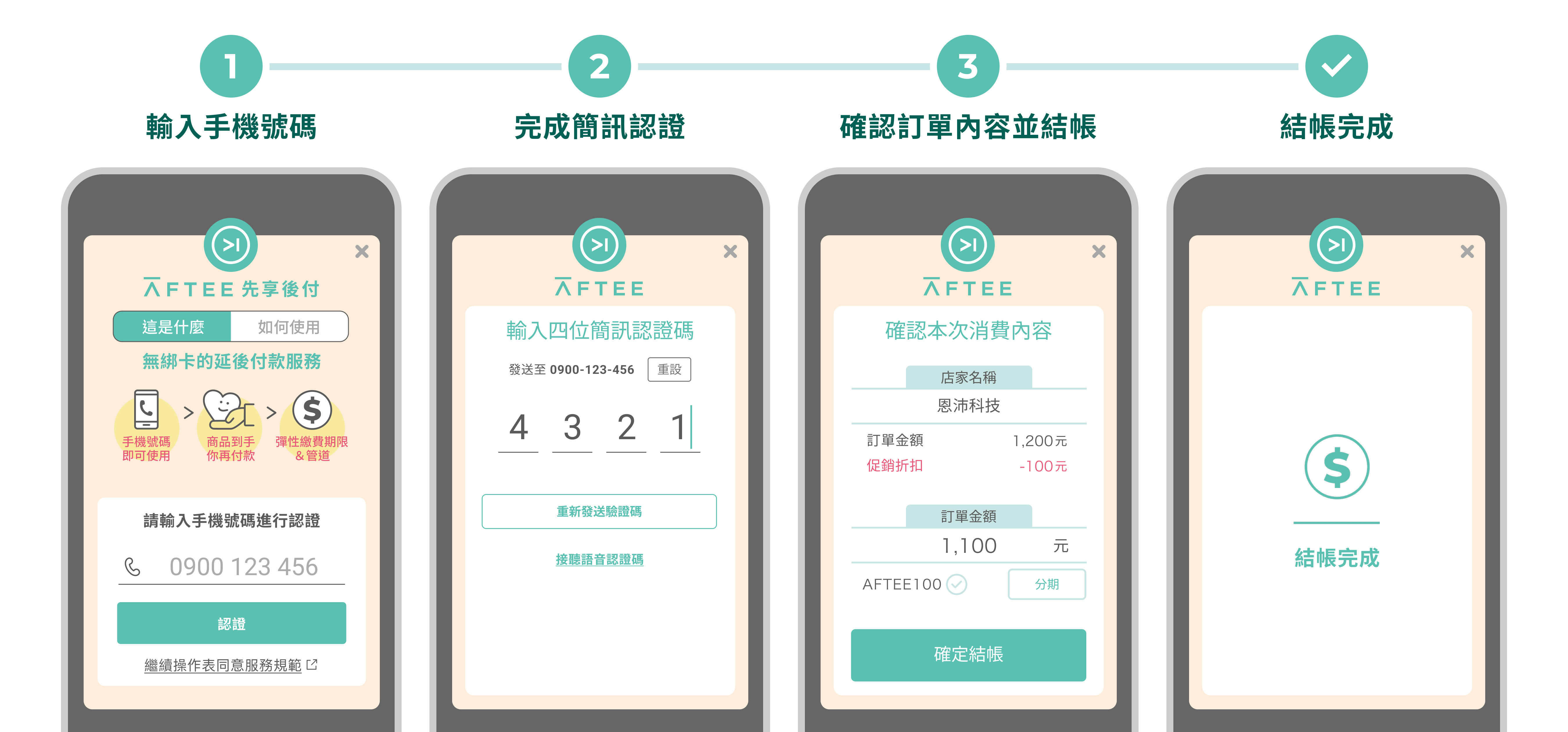
- 消費時於結帳方式選擇「AFTEE先享後付」後,將跳轉至「AFTEE先享後付」結帳頁面。
- 輸入手機號碼並通過簡訊認證、確認金額後,即可完成結帳。
- 訂單成立後,您將收到繳費通知簡訊,此簡訊即為您的電子繳費單;若為 AFTEE APP 會員,則將先後收到訂單成立與繳費的 APP 通知。
Q:使用 AFTEE先享後付 後如何繳費?
A:在消費者透過 AFTEE先享後付 完成購買後,於 14-45 天之內需完成消費款項之繳費,該怎麼做呢?根據消費者是否有下載 AFTEE APP,會有不同的方式:
- 非 AFTEE APP 會員
若是初次使用 AFTEE先享後付 的用戶,在消費完成後,將透過「手機簡訊發送電子繳費單」,消費者點選簡訊內附連結即可確認消費內容,並透過電子繳費單中的資訊以「便利超商條碼繳費」、線下 ATM 或網銀轉帳即可完成繳費。 - AFTEE APP 會員
在訂單確認後,消費者會先透過 APP 收到訂單成立的推播,後續開放繳費後也將「以 APP 推播繳費通知」,消費者可透過 APP 確認即時訂單內容、隨時進行繳費。APP 會員支援七大繳費管道,包含「約定帳號扣款繳費」、「網銀轉帳」、「便利超商條碼繳費」及「電子支付」四大繳費管道,且繳費期限最高延至 45 天。
若在消費後已經過數日,但仍未收到任何形式的繳費通知,也可以諮詢 AFTEE先享後付 客服中心協助確認。
Q:使用 AFTEE 有身份限制嗎?
A:AFTEE 服務對象為使用台灣門號的18歲以上成年用戶且限台灣國內使用,同時需以手機接收SMS認證碼,如果您的手機不能接收 SMS,請選用其他結帳方式。
Q:使用 AFTEE 需要手續費或額外費用嗎?
A:使用 AFTEE 結帳,若出現以下情況,可能衍生其他手續費:
1.若您超過繳費期限未繳費,將產生逾期滯納金
2.若您使用分期付款,將依據系統顯示向您收取分期手續費。
Q:AFTEE 支援哪些繳費方式?
A:AFTEE 支援便利超商繳費、線下 ATM 或網銀轉帳繳費;若為 AFTEE APP 會員,則可透過 APP 約定帳號扣款繳費、網銀轉帳、便利超商條碼繳費及電子支付四大管道繳費。
Q:如果忘記繳費/逾期付款怎麼辦?
A:如果逾期付款會產生逾期滯納金,請留意。
Q:沒有信用卡可以使用 AFTEE 嗎?
A:AFTEE 無需綁定信用卡,僅需使用自己的台灣手機號碼即可結帳。
Q:如果有帳單或AFTEE結帳問題該找誰?
A:您可透過 AFTEE 的官網、LINE 或 Facebook 客服聯繫,服務時間為週一至週五 10:00 ~ 17:00。
Q:課程可以更改或取消嗎?
A:取消規則將依ELSA Speak的政策為準,請聯繫 ELSA Speak 客服協助處理。
Q:如欲查看 AFTEE先享後付 產品與服務相關資訊?
A:請觀覽一下鏈接
AFTEE 官網:https://aftee.tw/
AFTEE先享後付 常見問題:https://aftee.cc/9djel3
AFTEE先享後付 客服中心:https://aftee.cc/7hupw5
別錯過擁有 ELSA Speak 優質課程的最佳時機!立即造訪 ELSA Speak 官方網站,使用 AFTEE 作為付款方式,立刻拿下優惠——現在下單,立即開學,付款輕鬆!
Yet 用法非常多樣,且容易混淆。你是否已經知道 yet用法句尾、yet 用法 位置,以及 “have yet to”、 “not yet” 或連接詞 “and yet” 的使用方式了嗎?一起來跟 ELSA Speak 探索最常見且正確的 yet 用法吧!
Yet 英文是什麼意思?

Yet 可以翻譯成中文為「還」、「迄今」、「至今」、「直到現在」、「仍然」、「然而」。
Yet是一個靈活的英文單詞,根據語境可作為副詞(adverb)或連接詞(conjunction)使用。它是現在完成時和帶有轉折語氣句中常見的重要單詞之一。
Yet連接詞
作為連接詞,“yet” 用來連接兩個對立的子句,具有轉折的語氣,意思與 but、 however 或 nevertheless 類似。
- 意思: 但是、然而、儘管如此
- 句中位置: 通常位於兩個子句之間,放在逗號之後或 “and” 之後
例句:
- She was tired, yet she kept going. (她很疲倦,然而她還是繼續走下去。)
- He is young, yet he is wise beyond his years. (他年紀很輕,但卻比同齡人更有智慧。)
- So many questions and yet so few answers. (問題很多,但答案卻很少。)
Yet 副詞
作為副詞,“yet” 通常用於現在完成時的否定句或疑問句中,表示某事現在尚未發生,但說話者預期它將在未來某個時刻發生。
- Nghĩa: 還沒、尚未
- 句中位置: 通常放在句尾
例句:
- I haven’t finished my homework yet. (我還沒做完作業。)
- Have you emailed our boss about the proposal yet? (你寄出給老闆的提案電郵了嗎?)
Yet現在完成式中用法

在現在完成式的否定句中
在現在完成式下, “Yet” 最常見的用法是放在句尾。
公式:
| S + have/ has + not (haven’t/ hasn’t) + V3 + yet |
Note: S = 主詞; V3 = 過去分詞 (Past Participle)
例句: They haven’t arrived yet. (他們還沒到。)
在現在完成時的疑問句中
在肯定句型的疑問句中,Yet 表示說話者正在期待某事會發生。
公式:
| Have/ has + S + V3 + yet? |
Note: S = 主詞; V3 = 過去分詞 (Past Participle)
例句:
- Have you eaten lunch yet? (你吃午餐了嗎?)
- Hasn’t he called back yet? (他還沒打回來嗎?)
Note: 當使用含有 Yet 的否定疑問句時,說話者預期答案是否定的。
含有 “be” 的 Yet 句子結構

片語 “be yet to”
用來強調某件預計將在未來發生的事情。
公式:
| S + be yet to + V_inf |
Note: S = 主詞; V_inf = 動詞原形
例句:
- The festival is yet to take place. (節慶尚未舉行。)
- She is yet to respond to our invitation. (她仍未回覆我們的邀請。)
最高級比較句之後
用來描述對某件尚未發生之事的驚訝或期待,直到目前為止都還沒發生。
公式:
| S + to be (am/is/are) + the + superlative adjective + yet + present perfect |
例句:
- It’s the best movie I’ve seen yet I haven’t told anyone about it. (這是我看過最棒的電影,但我竟然還沒跟任何人提過。)
- That was the most challenging test yet I haven’t received my grade. (那是目前為止最難的考試,但我還沒拿到成績。)
Yet 延伸結構

強調結構
Yet 也可用來加強語氣,意思接近 “even”,特別是在“more”, “another” và “again” 前面。
例句:
- I have been washing the dishes, and yet more dirty ones keep piling up. (我剛洗完碗,結果髒碗又堆了一堆。)
- The cost of electricity increased yet again. (電價又一次上漲了。)
搭配情態動詞
Yet 可與情態動詞如 “may”, “could”, “might” 一起使用… 表示某事儘管當下情況不利,但未來仍有可能發生。
例句: You may win yet. (你未來可能會贏得比賽。.)
片語 “have yet to”
“Have yet to do” 是英文中的一個片語,意思是“尚未做”或“還沒完成”。這個片語用來表示一個行動或任務截至目前為止仍未完成,但可能會在不久的將來完成。
公式:
| +) S + have/ has yet to + V_inf –) S + have/ has not yet to + V_inf ?) Have/Has + S + yet to + V_inf |
Note: S = 主詞; V_inf = 動詞原形
例句:
- Lisa has yet to read the book required for the class. (Lisa 尚未閱讀課堂上指定的那本書。)
- She has not yet called me. (她還沒打電話給我。)
- Have they yet to announce the winner? (他們還沒宣布贏家,對吧?)
Yet 與 Still 區別

| Yet | Still | |
|---|---|---|
| 相同點 | – 都是副詞 – 都與時間有關 – 都表示動作尚未完成 | |
| 不同點 | – 用於否定句、疑問句 – 通常放在句尾 – 表示”尚未”,含有某事將要發生的期待含義 | – 用於肯定句(有時用於否定) – 通常放在主要動詞前 – 表示”仍然”,強調持續性 |
| 例句 | – I haven’t eaten yet. (我還沒吃。) – Has she finished her work yet? (她完成工作了嗎?) – He hasn’t called me yet. (他還沒打電話給我。) | – I still haven’t eaten. (我仍然沒吃。) – She still works there. (她仍然在那裡工作。) – I still remember that day. (我仍然記得那一天。) |
Yet 搭配的單詞/片語

| 片語 | 意思 | 例句 |
|---|---|---|
| Not just yet | 還沒到時候、不久之後 | I’m not ready to leave just yet. (我現在還沒準備好離開。) |
| Yet to come | 尚未到來、仍在未來 | The best is yet to come. (最美好的事還在前方。) |
| As yet | 到目前為止 | As yet, no one has claimed responsibility. (到現在為止,還沒有人承擔責任。) |
| Not out of the woods yet | 還未脫離困境,仍處於風險中 | He’s recovering, but he’s not out of the woods yet. (他正在康復,但仍未完全脫離危險。) |
| So near (and) yet so far | 近在咫尺卻錯失,表達遺憾 | Victory was so near and yet so far. (勝利近在眼前卻又失之交臂。) |
| Better yet | 或者更好的是 | Call me tomorrow, or better yet, email me. (明天打給我,或者更好的是發封郵件。) |
英文中使用 Yet 常見的錯誤

語序錯誤
將 Yet 放在不合適的位置會導致句子難以理解。
例子:
- 錯誤: Yet the bank hasn’t approved my loan application.
- 正確: The bank hasn’t yet approved my loan application. (銀行尚未確認我的貸款申請。)
文法錯誤
學習者應該仔細檢查句子的語法,確保時態(現在或過去)使用正確,從而避免語法錯誤或句構不當。
例子:
- 錯誤: The students have yet understood the lesson.
- 正確: The students have yet to understand the lesson. (學生們還沒理解這課內容。)
濫用 Yet
在一段文字中使用 Yet 過多,會讓句子顯得冗長、單調,且產生重複用詞的問題。
例子:
- 錯誤: I haven’t yet completed the assignment yet, and I still have yet to research the topic.
- 正確: I haven’t completed the assignment yet, and I still need to research the topic. (我還沒做完作業,還得準備報告。)
Yet 用法練習

練習題
練習 1: 請將下列句子排列成正確順序
- arrived/ your/ has/ yet/ letter
→ ____________________?
- and/ humble/ she’s/ yet/ so/ she’s/ famous
→ ______________________.
- yet/ he/ take/ medicine/ to/ his/ is
→ _______________________.
- food/ she/ tasted/ yet/ has/ not/ the
→ _______________________.
- stopped/ yet/ my/ working/ phone’s/ again
→ _______________________!
練習 2: 選出最正確的答案
- He’s done it yet ___! (is/again/together)
- Zoey has bought yet ___ bouquet for herself. (another/is/are)
- We ___ yet win another match! (may/again/another)
- Both of us ___ yet end up getting lost again. (are/be/could)
- Wall Rose ___ yet triumph again! (shall/be/is)
答案
練習 1:
- Has your letter arrived yet?
- She’s famous and yet she’s so humble.
- He is yet to take his medicine.
- She has not tasted the food yet.
- My phone’s stopped working yet again!
練習 2:
| 題號 | 1 | 2 | 3 | 4 | 5 |
| 答案 | again | another | may | could | shall |
Yet 用法非常多樣,不僅有多種 yet用法位置,還包括像 have not yet、better yet 或 though yet 等進階結構。每種用法都帶有不同的語氣與意涵,有助於更準確地表達想法。別忘了繼續關注 ELSA Speak 上的其他英語文法主題,每天進步一點,提升語言能力!
當學習英文文法時,你肯定曾聽說過「形容詞子句」與「名詞子句」。雖然這是兩個非常重要的文法部分,但許多學習者仍無法清楚區形容詞子句名詞子句差別,或者常常混淆 how、that 的使用,尤其在需要簡化關係代名詞時也容易出錯。本文中,ELSA Speak 將協助你全面掌握相關概念:從關係子句、限制性與非限制性子句,到如何用分詞來簡化形容詞子句,並附上實戰練習題幫助你更熟練。
| Key takeaways: – 形容詞子句 用來修飾名詞 (也就是 “先行詞”) 。 + 關係代名詞: who, whom, whose, which, that + 關係副詞: when, where, why + 限制性子句: 沒有逗號,為句子必要資訊 + 非限制性子句: 有逗號,提供額外補充說明 – 簡化形容詞子句: 若關係代名詞是受詞,且子句中已有主詞,可省略該關係代名詞。 |
形容詞子句是什麼?

形容詞子句英文為 Adjective Clause,又稱為關係子句,是一種從屬子句,用來描述或修飾名詞,在句中起到形容詞的作用。形容詞子句通常以關係代名詞開頭,如 that、which 或 who。
例句:
- Jack caught a fish, which was gigantic! (傑克釣到了一條超級大的魚。)
➞ “which was gigantic” 是形容詞子句, 用來修飾名詞 “Fish”。
- The guy who lives next to my house is a painter. (住在我家旁邊的那個人是一位畫家。)
➞ “who lives next to my house” 是形容詞子句, 用來修飾主語 “The guy”。
>>閲讀更多:所有關於八種英文詞性:用法、例子及在句子中的位置
形容詞子句的分類
根據“被替代的詞”(也稱為“先行詞(antecedent)”),我們可以將形容詞子句分為兩大類:使用關係代名詞的子句與使用關係副詞的子句。
關係代名詞 形容詞子句

常見的關係代名詞如下: who, whom, whose, which, that, 用於代替已經提到的人、物或事件。
| 對象(先行詞) | 主格(主語) | 受格(受詞) | 所有格 |
|---|---|---|---|
| 人 | who | whom | whose |
| 物/動物 | which | which | whose / of which |
| 人 + 物 (混合) | that | that | — |
例子:
- He is a cruel kid who kills animals without blinking an eye。
→ “kid” 是人,且作主詞 → 使用 who。
- He is the one whom Lily has a secret crush on。
→ “the one” 是人,作受詞 → 使用 whom (可以省略若前面沒有介詞)。
- I know the girl whose first name is Woods。.
→ “the girl”是人,且擁有 “first name” → 使用 whose。
- I really treasure the watch which you gave me on my birthday。
→ “the watch” l是物,作受詞 → 使用 which。
- The book that I borrowed from the library is very interesting。
→ “the book” 是物,作受詞 → 使用 that 代替 which。
注意: 關係代名詞 who, whom, which 都可以用 that 來代替 除了whose之外。
>>閲讀更多:所有格代名詞 (Possessive Pronouns): 用法、區別和練習
關係副詞 形容詞子句

若先行詞是表示時間、地點或原因的名詞,則使用關係副詞: when, where, why。
| 先行詞(名詞) | 使用的關係副詞 |
|---|---|
| 表示時間 | when |
| 表示地點 | where |
| 表示原因 | why |
例子:
- I will never forget the day when I first met you。
→ “the day” 是時間 → 使用 when。
- This is the coffee shop where we first met。
→ “the coffee shop” 是地點 → 使用 where 引導形容詞子句。
- I think that’s the main reason why she left you。
→ “the main reason” 是原因 → 使用 why。
>>閲讀更多:副詞子句(Adverbial Clause):定義、分類、用法、例句與練習
形容詞子句的用法

從前面的內容中我們已經了解,形容詞子句(Adjective Clause)在句中起到修飾名詞的作用——使句意更加明確與具體。然而,根據補充資訊的重要程度,形容詞子句可分為兩種:形容詞子句限定非限定,我們來區分這兩種形容詞子句分詞構句吧!
形容詞子句限定 (Restrictive Adjective Clause)
這類子句是必要的資訊,用來明確指稱先行詞的意思。若省略此子句,句子雖然語法正確,但語意將變得不清楚,讓聽者或讀者無法理解具體是誰或是什麼。
特點:
- 不使用逗號。
- 無法省略,否則意思會不完整。
例子: I will never forget the day when I first met you.
(我永遠不會忘記第一次遇見你的那一天。)
→ 若省略 “when I first met you”, 剩下的句子是 “I will never forget the day.” – 聽起來非常模糊,無法確定是哪一天。
>>閲讀更多:附加問句 (Tag Question):結構、用法和應用練習
形容詞子句非限定 (Non-restrictive Adjective Clause)
此類子句屬於額外補充資訊,不必要,即使省略也不影響整句話的主體意思。通常以逗號與主句分開,表示該子句為附加說明。
特點:
- 必須用逗號隔開。
- 不能使用 that 作為關係代名詞。
- 對句子的主要意思不是必要的資訊。
例子: Johnny Depp, who played the role of Captain Jack in the movie Pirates of the Caribbean, is coming to the premiere next month. (Johnny Depp – 曾在神鬼奇航中飾演傑克船長 – 將於下月出席首映。)
→ 若省略 “who played the role…”, 句子仍然完整明確: “Johnny Depp is coming to the premiere next month。”
>>閲讀相關:冠詞 a、an、the 是什麼?初學者如何輕鬆地掌握冠詞用法?
形容詞子句 省略方式

句子太長了怎麽辦?來學習一下形容詞子句 簡化方式吧。在形容詞子句中,關係代名詞常常可以被省略, 判斷方法:
- 當關係代名詞是受詞 (whom, which, that)
- 在關係代名詞之後有完整的主詞
公式:
| 名詞(先行詞) + 關係代名詞 + S + V → 名詞 + S + V |
例子:
- This is the book that I was talking about. (我正在說的是那本書。)
= This is the book I was talking about.
- This is the movie which I have seen three times. (那部電影我已經看了三次。)
= This is the movie I have seen three times.
什麼情況下不能省略關係代名詞?若關係代名詞本身是子句的主詞,則不能省略。
無法省略的例子:
- I met someone she dated in high school. (錯)
- I met someone whom she dated in high school – 我遇見了那個曾在高中時和她約會過的人。(對)
小技巧:
- 若關係代名詞後面是動詞 ➞ 不能省略關係代名詞。
- 若關係代名詞後面是名詞 ➞ 可以省略關係代名詞。
>>閲讀更多:被動語態是什麽?探索公式、結構和註釋以及應用練習,以避免混淆
區分形容詞子句與其他相似語法結構
形容詞子句名詞子句差別

| 形容詞子句 | 名詞子句 | |
|---|---|---|
| 功能 | 修飾名詞 | 在句中作主詞、受詞或補語 |
| 位置 | 緊接在所修飾的名詞之後 | 位置較靈活:位於句首、動詞或介系詞之後 |
| 開頭 | who, whom, whose, which, that, when, where | that, what, who, whether, if, how, why… |
| 動詞結構 | 有 | 有 |
| 例句 | The boy who won the prize is my friend. (得獎的那個男孩是我朋友。) | What he said surprised me. (他說的話讓我很驚訝。) |
區分形容詞子句 形容詞片語

| 形容詞子句 | 形容詞片語 | |
|---|---|---|
| 功能 | 修飾名詞 | 也修飾名詞 |
| 結構 | 具有主詞與動詞 (完整子句) | 無主詞,通常是 V-ing/V-ed phrase |
| 簡化子句 | 可以簡化成片語 | 是簡化形式或較簡短的描述方式 |
| 例句 | The girl who is wearing red is my sister. (那位穿紅衣的女孩是我妹妹。) | The girl wearing red is my sister. (穿紅衣的女孩是我妹妹。) |
區分形容詞子句 同位語

| 形容詞子句 | 同位語 | |
|---|---|---|
| 功能 | 修飾名詞 | 解釋或說明前面的名詞 |
| 判斷標誌 | 有關係代名詞 + 動詞 | 兩個名詞並列,沒有連接詞 |
| 動詞結構 | 有 | 沒有 |
| 例句 | The author who wrote this book is famous. (寫這本書的作者非常有名。) | J.K. Rowling, the author of Harry Potter, is famous. (J.K. Rowling,哈利波特的作者,非常有名。) |
形容詞子句練習題

練習題
練習題 1: 運用形容詞子句知識改寫句子:
- The man was sick. He looked very pale.
- He was sitting in the emergency room. It was very crowded.
- A nurse was nearby. He called her.
- The nurse called a doctor. She came quickly.
- The doctor asked him to lie down. She looked very worried.
練習題 2: 選出正確答案:
1. The cougar, ______ grows to around 8 feet in length, is a member of the cat family.
A. whom
B. who
C. which
D. that
2. Cougars sometimes prey on sheep and goats, so they may be killed by the farmers ______ animals they attack.
A. which
B. whom
C. who
D. whose
3. The cougar has powerful legs, ______ it uses to climb and to jump into trees.
A. which
B. whom
C. who
D. whose
4. The cougar lives in deserts, forests, plains and mountains, but according to scientists ______ have studied the animal, it is becoming endangered in some areas.
A. whom
B. which
C. who
D. whose
5. However, cougars very rarely attack humans, of ______ they are usually afraid.
A. who
B. whom
C. which
D. that
6. The town ______ we visited last summer was very beautiful.
A. where
B. which
C. who
D. whose
7. The woman ______ car was stolen called the police.
A. which
B. who
C. whom
D. whose
8. That’s the house ______ I was born.
A. where
B. which
C. whom
D. that
9. The boy ______ is standing over there is my cousin.
A. whom
B. which
C. who
D. where
10. I don’t like people ______ talk too loudly in public.
A. whom
B. which
C. who
D. whose
答案
練習題 1:
- The man, who was sick, looked very pale.
- He was sitting in the emergency room, which was very crowded.
- He called a nurse, who was nearby.
- The nurse called a doctor, who came quickly.
- The doctor, who looked very worried, asked him to lie down.
練習題 2:
| 題號 | 1 | 2 | 3 | 4 | 5 |
| 答案 | C. which | D. whose | A. which | C. who | B. whom |
| 題號 | 6 | 7 | 8 | 9 | 10 |
| 答案 | B. which | D. whose | A. where | C. who | C. who |
深入理解形容詞子句與名詞子句,不僅能幫助你掌握英文語法,還能提升你的學術寫作能力與專業溝通技巧。別忘了經常練習,試著將形容詞子句簡化為分詞構句,並反覆練習區分限制性與非限制性子句,才能真正掌握這一語法要點。若你想進一步學習更多英語文法主題,歡迎造訪 ELSA Speak 官方網站,學習更高效,發音更道地,如同母語人士!
在學習英語時,數字是最基本且需要牢牢掌握的知識之一。本文中,ELSA Speak 將為你提供所有與英文數字有關的知識,例如:11英文、12英文或完整的1–100英文數字表,以及英文數字寫法與準確的數字英文轉換方式。
數字 (Cardinal Numbers)
完整的1-100英文數字表
| 數字 | 英文寫法 |
|---|---|
| 1 | one |
| 2 | two |
| 3 | three |
| 4 | four |
| 5 | five |
| 6 | six |
| 7 | seven |
| 8 | eight |
| 9 | nine |
| 10 | ten |
| 11 | eleven |
| 12 | twelve |
| 13 | thirteen |
| 14 | fourteen |
| 15 | fifteen |
| 16 | sixteen |
| 17 | seventeen |
| 18 | eighteen |
| 19 | nineteen |
| 20 | twenty |
| 21 | twenty-one |
| 22 | twenty-two |
| 23 | twenty-three |
| 24 | twenty-four |
| 25 | twenty-five |
| 26 | twenty-six |
| 27 | twenty-seven |
| 28 | twenty-eight |
| 29 | twenty-nine |
| 30 | thirty |
| 31 | thirty-one |
| 32 | thirty-two |
| 33 | thirty-three |
| 34 | thirty-four |
| 35 | thirty-five |
| 36 | thirty-six |
| 37 | thirty-seven |
| 38 | thirty-eight |
| 39 | thirty-nine |
| 40 | forty |
| 41 | forty-one |
| 42 | forty-two |
| 43 | forty-three |
| 44 | forty-four |
| 45 | forty-five |
| 46 | forty-six |
| 47 | forty-seven |
| 48 | forty-eight |
| 49 | forty-nine |
| 50 | fifty |
| 51 | fifty-one |
| 52 | fifty-two |
| 53 | fifty-three |
| 54 | fifty-four |
| 55 | fifty-five |
| 56 | fifty-six |
| 57 | fifty-seven |
| 58 | fifty-eight |
| 59 | fifty-nine |
| 60 | sixty |
| 61 | sixty-one |
| 62 | sixty-two |
| 63 | sixty-three |
| 64 | sixty-four |
| 65 | sixty-five |
| 66 | sixty-six |
| 67 | sixty-seven |
| 68 | sixty-eight |
| 69 | sixty-nine |
| 70 | seventy |
| 71 | seventy-one |
| 72 | seventy-two |
| 73 | seventy-three |
| 74 | seventy-four |
| 75 | seventy-five |
| 76 | seventy-six |
| 77 | seventy-seven |
| 78 | seventy-eight |
| 79 | seventy-nine |
| 80 | eighty |
| 81 | eighty-one |
| 82 | eighty-two |
| 83 | eighty-three |
| 84 | eighty-four |
| 85 | eighty-five |
| 86 | eighty-six |
| 87 | eighty-seven |
| 88 | eighty-eight |
| 89 | eighty-nine |
| 90 | ninety |
| 91 | ninety-one |
| 92 | ninety-two |
| 93 | ninety-three |
| 94 | ninety-four |
| 95 | ninety-five |
| 96 | ninety-six |
| 97 | ninety-seven |
| 98 | ninety-eight |
| 99 | ninety-nine |
| 100 | one hundred |
數字英文說法與範例
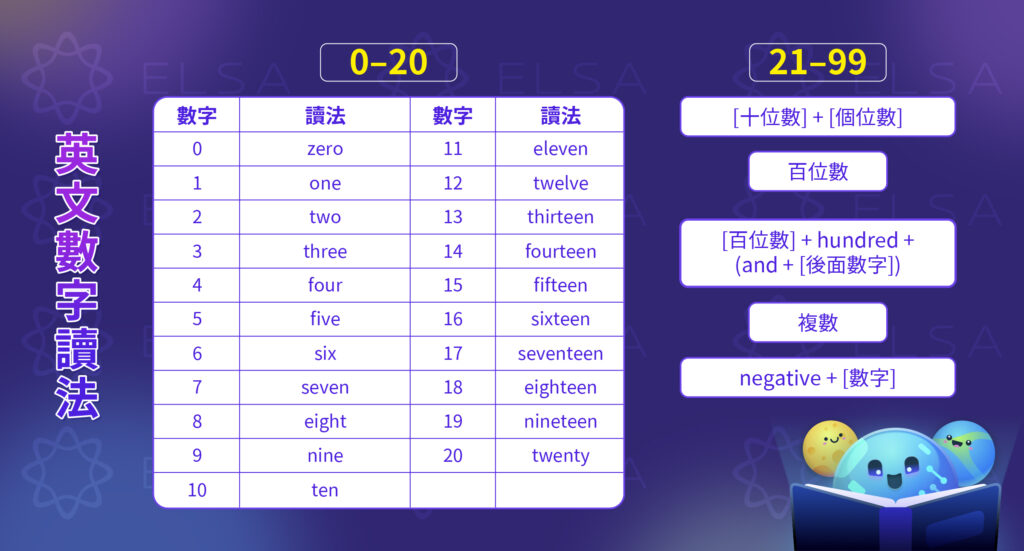
0 – 20 英文數字
從 0 到 20 的數字都有獨立的單字形式,如下: Zero, one, two, three, four, five, six, seven, eight, nine, ten, eleven, twelve, thirteen, fourteen, fifteen, sixteen, seventeen, eighteen, nineteen, twenty。
Note:記好 1-20英文單詞,後面更大的數字就好記了。回答此問題:12的英文是什麽?→ twelve
21 – 99三位數 數字
從 21 到 99 的數字是由以下單字組合而成 twenty, thirty, forty, fifty, sixty, seventy, eighty, 或 ninety 再加上 1 到 9 的單位數字。
公式:
| [十位數] + [個位數] |
例如:
| 數字 | 十位數 | 個位數 | 完整寫法 |
|---|---|---|---|
| 25 | Twenty | Five | Twenty-five |
| 39 | Thirty | Nine | Thirty-nine |
| 41 | Forty | One | Forty-one |
| 65 | Sixty | Five | Sixty-five |
| 73 | Seventy | Three | Seventy-three |
| 99 | Ninety | Nine | Ninety-nine |
百位數的英文數字
百位數的讀法是將百位數字與 1 到 99 的數字結合。
公式:
| [百位數] + hundred + (and + [十位數 + 個位數]) (若有後半部分) |
注意: 只有當 “hundred” 後面還有十位或個位時,才使用 “and”。
例如:
| 數字 | 英文讀法 |
|---|---|
| 100 | One hundred |
| 101 | One hundred and one |
| 115 | One hundred and fifteen |
| 120 | One hundred and twenty |
| 134 | One hundred and thirty-four |
| 200 | Two hundred |
| 250 | Two hundred and fifty |
| 300 | Three hundred |
| 365 | Three hundred and sixty-five |
| 999 | Nine hundred and ninety-nine |
千、百萬、十億的數字
| 數字 | 英文讀法 | IPA音標 |
|---|---|---|
| 1,000 | One thousand | /wʌn ˈθaʊ.zənd/ |
| 10,000 | Ten thousand | /ten ˈθaʊ.zənd/ |
| 100,000 | One hundred thousand | /wʌn ˈhʌn.drəd ˈθaʊ.zənd/ |
| 1,000,000 | One million | /wʌn ˈmɪl.jən/ |
| 1,000,000,000 | One billion | /wʌn ˈbɪl.jən/ |
| 1,000,000,000,000 | One trillion | /wʌn ˈtrɪl.jən/ |
同樣地,對於非整數數字,在數字後加上對應百位、十位與個位:
| 數字 | 英文讀法 |
|---|---|
| 2,500 | Two thousand five hundred |
| 6,345 | Six thousand three hundred and forty-five |
| 3,200,000 | Three million two hundred thousand |
| 5,364,500 | Five million three hundred sixty-four thousand five hundred |
| 2,000,500,000 | Two billion five hundred thousand |
| 3,123,456,789 | Three billion one hundred twenty-three million four hundred fifty-six thousand seven hundred and eighty-nine |
負數英文數字
在數字前加上“negative”即可表示負數。
例子:
- –10: negative ten
- –3.5: negative three point five
英文數字使用方式
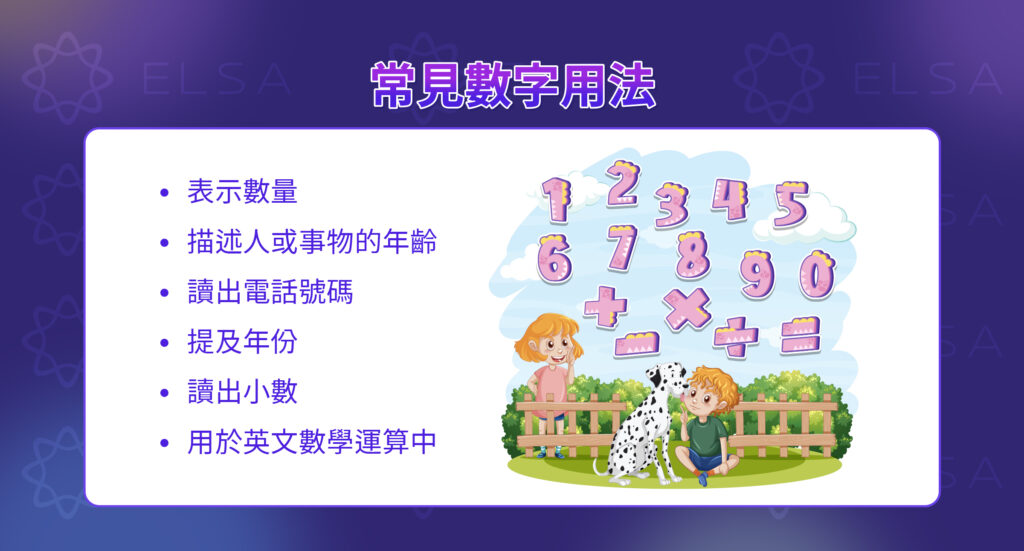
英文數字在英語溝通中是不可或缺的一部分。 若想正確使用英文數字,你需要掌握它們在以下情境中的用法:
| 使用情境 | 英文例句 | 翻譯 |
|---|---|---|
| 描述數量 | I have two cats. | 我有兩隻貓。 |
| She bought five books. | 她買了五本書。 | |
| 談論人或物的年齡 | He is twenty years old. | 他二十歲了。 |
| This tree is fifty years old. | 這棵樹已有五十年樹齡。 | |
| 讀電話號碼 | My phone number is 123-456-7890. | 我的電話號碼是123-456-7890。 |
| Call me at 098-765-4321. | 請打098-765-4321聯絡我. | |
| 提及年份 | She was born in 1990. | 她出生於 1990 年。 |
| The event happened in 2023. | 這個事件發生於 2023 年。 | |
| 讀小數點 | The price is 3.75 dollars. | 價格是三點七五美元。 |
| Pi is approximately 3.14. | 圓周率約為三點一四。 | |
| 用於英文算術運算中 | Two plus three equals five. | 二加三等於五。 |
| Ten divided by two is five. | 十除以二等於五。 |
注意:英文中各種數學符號的名稱
| 符號 | 英文名稱 |
|---|---|
| + | plus |
| – | minus/subtract |
| × 或 * | multiplied by/times |
| ÷ 或 / | divided by |
| = | equals/is |
使用時需注意:
- 電話號碼: 每一位數字需單獨讀出。
例如: 098-765-4321 (zero nine eight, seven six five, four three two one)
- 年份:
- 2000 年之前: 以兩位一組的方式讀出(例如: 1990: nineteen ninety)
- 2000 年之後: 可讀
- 2005: two thousand and five hoặc twenty oh five
- 2023: two thousand twenty-three hoặc twenty twenty-three
- 小數點數字: 使用 “point” 表示小數點,點後的每個數字都需單獨讀出。
- 3.14: three point one four
- 7.05: seven point zero five
- 負數 (Negative numbers): 數字前加上 “negative”
使用英文數字的注意事項
數字中的重音
當你發音英文數字時,正確的重音位置可以幫助聽者更清楚理解,避免混淆:
- 結尾為 “-teen” 的數字(như thirteen, fourteen) 通常重音落在最後一個音節。
例如: Thirteen → /θɜːˈtiːn/
- 結尾為 “-ty” 的數字 (như thirty, forty) 通常重音落在第一個音節。
例如: Thirty → /ˈθɜːrti/
英式英語與美式英語在讀數方式上的差異
有兩種英語變體在讀數方式上存在一些細微差異:
- 數字 0:
- 英式英語 常用 “nought” 或 “oh” (在電話中用)。
- 美式英語 一般使用 “zero”。
- 年份的讀法:
- 英式英語 傾向於兩位一組讀: 2010 → twenty ten
- 美式英語 可以讀: two thousand ten 或 twenty ten
- 比較範例:
- 101: one-oh-one (英式英語) 與 one-zero-one (Anh – 美式英語)
- 2018: twenty eighteen (英式英語) 和 twenty eighteen 或c two thousand eighteen (美式英語)
數時 “and” 的說法
“and” 用來連接百位數/千位數與其後的數位部分:
- 111: One hundred and eleven
- 1280: One thousand two hundred and eighty
- 3001: Three thousand and one
確定數量時,數字後不加 “-s”
永遠不要直接在基數後加上 -s 來表示具體的數量。不過,在表示概數或大致數量時,可以加 -s,並搭配 “of” 使用:
| 詞組 | 中文意思 |
|---|---|
| Tens of cars | 幾十輛汽車 |
| Dozens of eggs | 幾打雞蛋 |
| Hundreds of people | 數百人 |
| Thousands of trees | 數千棵樹 |
| Millions of fans | 數百萬名粉絲 |
| Billions of money | 數十億金錢 |
寫和讀數字時常見錯誤
- 忘記連字號: 從 21 到 99 的數字需要在十位與個位之間加上連字號。
- 正確: twenty-one
- 錯誤: twentyone
- 混淆 “-teen” 和 “-ty”:
- 16: Sixteen → /ˌsɪkˈstiːn/
- 60: Sixty → /ˈsɪk.sti/
Note: 兩種數字的重音位置不同是區分它們的關鍵。
- 讀錯大數字: 閱讀大數時要清楚分辨每個數量級,以避免混淆 百萬 (million) 與 十億(billion).
- 1,000,000: One million
- 1,000,000,000: One billion
>>閲讀更多:英文日期寫法全面指南:星期、日期、月份、年份以及正確結構
英文數字與序數的差異
區分英文數字與序數
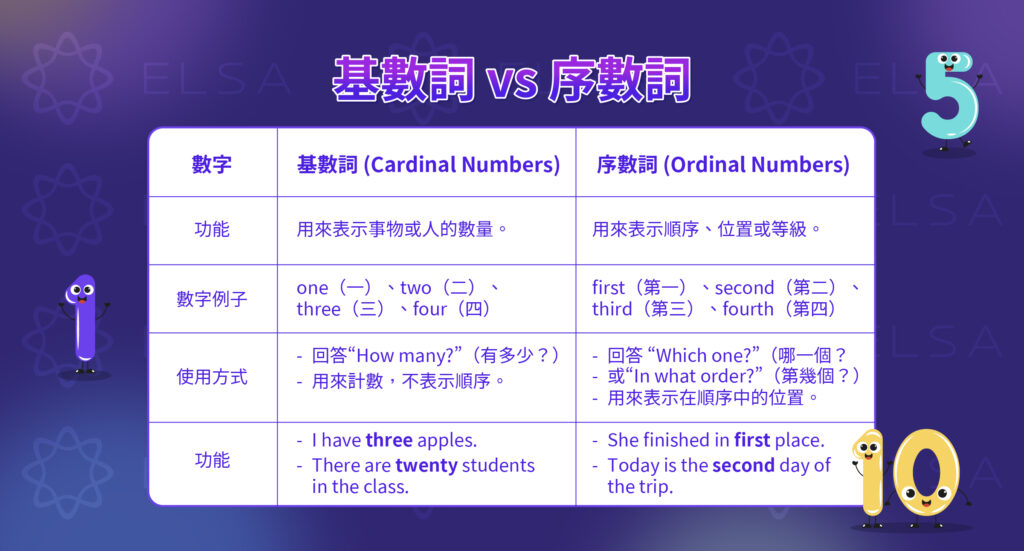
| 數字 (Cardinal Numbers) | 序數 (Ordinal Numbers) | |
|---|---|---|
| 功能 | 用來表示事物或人的數量。 | 用來表示順序、位置、等級或日期。 |
| 數字範例 | one (一), two (二), three (三), four (四) | first (第一), second (第二), third (第三), fourth (第四) |
| 用法 | – 回答 “How many?” (多少?) – 用來計數,不表示順序。 | – 回答 “Which one?” (哪一個?) 或 “In what order?”– 用來表示位置或順序。 |
| 例句 | – I have three apples. (我有三個蘋果。) – There are twenty students in the class. (班上有二十名學生。) | – She finished in first place. (她得了第一名。) – Today is the second day of the trip. (今天是旅程的第二天。) |
>>閲讀更多:1-12月份英文縮寫:閱讀方法和記憶技巧
數字英文轉換成序數的規則
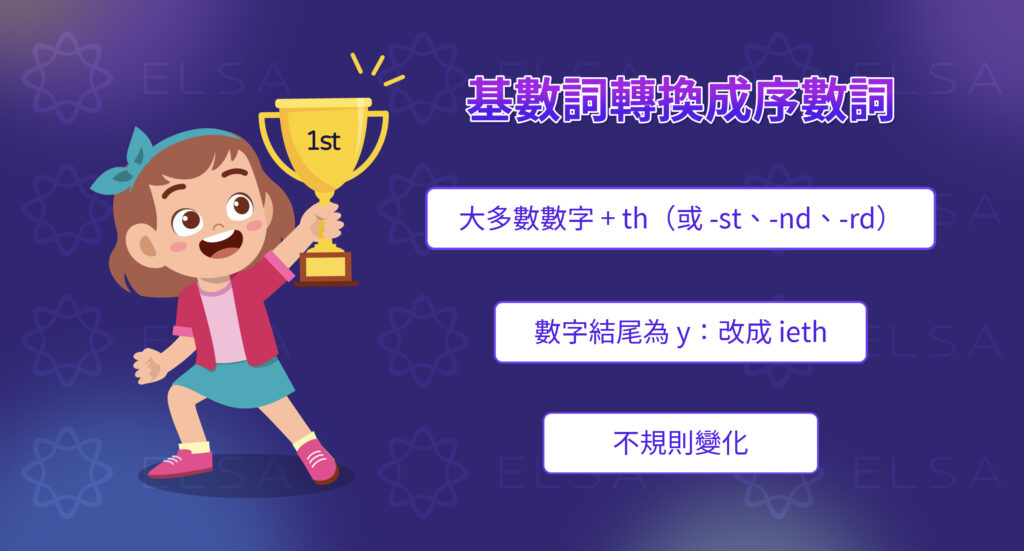
最簡單的方式將英文數字轉換為序數,就是根據末位數字加上 -st、-nd、-rd 或 -th,
但需注意一些不規則變化的情況,如 first、second、third 等。讓我們與 ELSA Speak 一起透過以下例子進一步了解吧!
- 加上 -th 在數字後 變為相應的序數
- Five → fiveth
- Eight → eighth
- Eleven → eleventh
- 數字以 -y 結尾 + -th, 轉為 -ieth 相應的序數
- Eighty → eightieth
- Twenty → twentieth
- Forty → fortieth
- 部分不規則變化的轉換序數例外情況
- One → first
- Two → second
- Three → third
- Four → forth
- Five → fifth
- Eight → eighth
- Nine → ninth
- Eleven → eleventh
- Twelve → twelfth
- Thirteen → thirteenth
1-50 英文數字與序數對照表:
| 數字 (Cardinal) | 拼寫 | 序數 (Ordinal) | 拼寫 |
|---|---|---|---|
| 1 | one | 1st | first |
| 2 | two | 2nd | second |
| 3 | three | 3rd | third |
| 4 | four | 4th | fourth |
| 5 | five | 5th | fifth |
| 6 | six | 6th | sixth |
| 7 | seven | 7th | seventh |
| 8 | eight | 8th | eighth |
| 9 | nine | 9th | ninth |
| 10 | ten | 10th | tenth |
| 11 | eleven | 11th | eleventh |
| 12 | twelve | 12th | twelfth |
| 13 | thirteen | 13th | thirteenth |
| 14 | fourteen | 14th | fourteenth |
| 15 | fifteen | 15th | fifteenth |
| 16 | sixteen | 16th | sixteenth |
| 17 | seventeen | 17th | seventeenth |
| 18 | eighteen | 18th | eighteenth |
| 19 | nineteen | 19th | nineteenth |
| 20 | twenty | 20th | twentieth |
| 21 | twenty-one | 21st | twenty-first |
| 22 | twenty-two | 22nd | twenty-second |
| 23 | twenty-three | 23rd | twenty-third |
| 24 | twenty-four | 24th | twenty-fourth |
| 25 | twenty-five | 25th | twenty-fifth |
| 26 | twenty-six | 26th | twenty-sixth |
| 27 | twenty-seven | 27th | twenty-seventh |
| 28 | twenty-eight | 28th | twenty-eighth |
| 29 | twenty-nine | 29th | twenty-ninth |
| 30 | thirty | 30th | thirtieth |
| 31 | thirty-one | 31st | thirty-first |
| 32 | thirty-two | 32nd | thirty-second |
| 33 | thirty-three | 33rd | thirty-third |
| 34 | thirty-four | 34th | thirty-fourth |
| 35 | thirty-five | 35th | thirty-fifth |
| 36 | thirty-six | 36th | thirty-sixth |
| 37 | thirty-seven | 37th | thirty-seventh |
| 38 | thirty-eight | 38th | thirty-eighth |
| 39 | thirty-nine | 39th | thirty-ninth |
| 40 | forty | 40th | fortieth |
| 41 | forty-one | 41st | forty-first |
| 42 | forty-two | 42nd | forty-second |
| 43 | forty-three | 43rd | forty-third |
| 44 | forty-four | 44th | forty-fourth |
| 45 | forty-five | 45th | forty-fifth |
| 46 | forty-six | 46th | forty-sixth |
| 47 | forty-seven | 47th | forty-seventh |
| 48 | forty-eight | 48th | forty-eighth |
| 49 | forty-nine | 49th | forty-ninth |
| 50 | fifty | 50th | fiftieth |
英文數字有關的成語
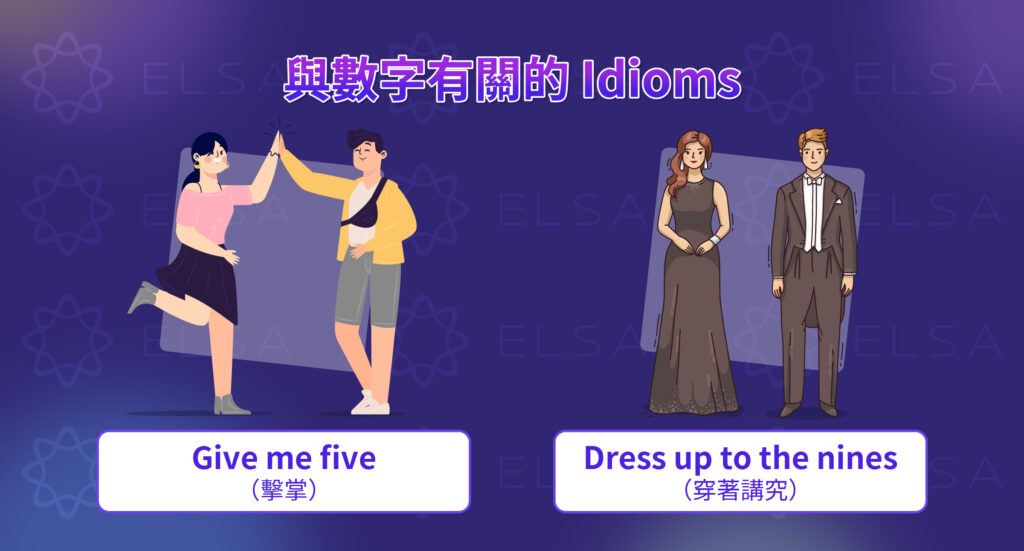
以下是一些包含數字的英文成語,有助於你擴展詞彙量、深入了解母語文化,並讓口語表達更自然靈活:
| 成語(Idioms) | 意思 | 例句 & 翻譯 |
|---|---|---|
| Look out for number one | 把自己擺在第一位 | In business, it’s important to look out for number one.(在商業中,首先要為自己著想。) |
| Back to square one | 回到起點 | After the failure, we’re back to square one.(失敗之後,我們必須從頭再來。) |
| One in the eye for someone | 打臉/讓人難堪 | Her success was one in the eye for her critics.(她的成功狠狠打了批評者的臉。) |
| Be six feet under | 死了 | Someday we’ll all be six feet under.(終有一天我們都得入土。) |
| Give me five | 擊掌打招呼 | Good game! Give me five!(比賽太精彩了!擊掌一下!) |
| Watch your six | 注意身後/保持警惕 | Always watch your six in this area.(在這一區要隨時保持警惕。) |
| Talk nineteen to the dozen | 說話非常快 | He talks nineteen to the dozen when he’s nervous.(他緊張時會說個不停。) |
| A nine-day wonder | 曇花一現的名氣 | His fame was just a nine-day wonder.(他的名聲只是曇花一現。) |
| Dress up to the nines | 穿著華麗 | She dressed up to the nines for the party.(她盛裝出席派對。) |
| Be given the third degree | 嚴厲盤問 | The suspect was given the third degree by the detectives.(嫌犯被警方嚴厲盤問。) |
| Third time lucky | 事不過三(第三次會成功) | I failed twice, but third time lucky!(我失敗了兩次,但希望第三次會成功!) |
| Once in a blue moon | 千載難逢 | We go out to eat once in a blue moon.(我們很少在外用餐。) |
| Second to none | 無與倫比/最棒的 | Her skills are second to none in the team.(她的技能是隊上最頂尖的。) |
| Put two and two together | 根據線索推理出真相 | I saw them leave together and put two and two together.(我看到他們一起離開,就猜出事情真相了。) |
| At the eleventh hour | 最後一刻 | They submitted the report at the eleventh hour.(他們在最後一刻才交了報告。) |
英文數字的常用句型
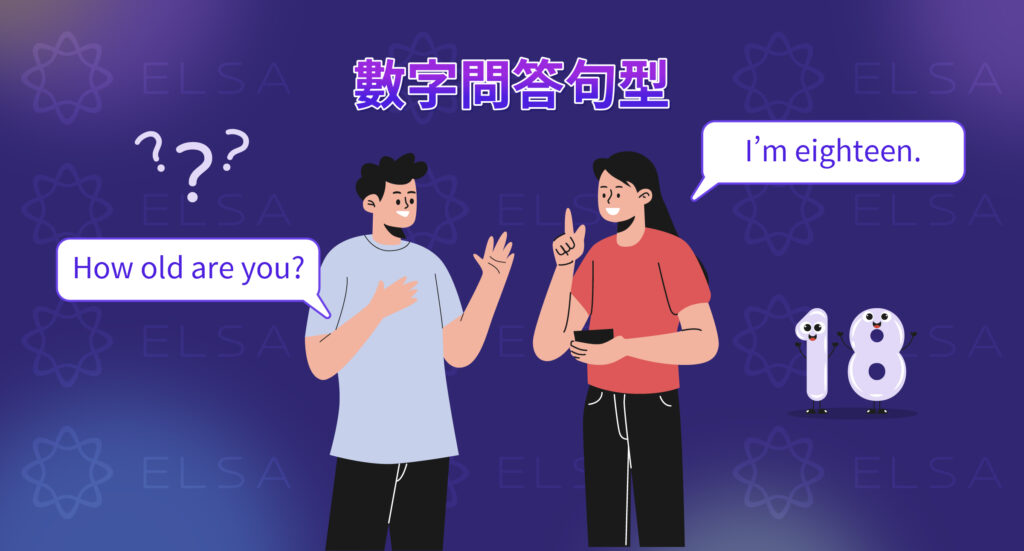
| 問句 | 回答 |
|---|---|
| How old are you?(你幾歲?) | I’m turning 15 next month.(我下個月就滿 15 歲了。) |
| How many people are there now?(現在那裡有多少人?) | Only 10.(只有 10 個人而已。) |
| When did you graduate from the university?(你什麼時候大學畢業的?) | I graduated from NTPU in 2018.(我於 2018 年畢業於國立臺北大學。) |
| What’s your phone number?(你的電話號碼是多少?) | My number’s zero nine six two one five two two two eight.(你可以打 0962152228聯絡我。) |
| How many percent are you sure about this?(你對這件事有多確定?) | Only twelve percent.(大概只有 12% 吧。) |
英文數字練習題

練習題
練習 1: 使用數字與序數寫出下列數字的正確讀法
| 題目 | 1 | 2 | 3 | 4 | 5 |
| 0962152228 | 5/6 | 7/10 | 4 – 4 = 0 | 13 + 12 = 25 | |
| 題目 | 6 | 7 | 8 | 9 | 10 |
| 10 x 12 = 120 | 25 : 5 = 5 | 2,86 | 99,99 | 1996 |
練習 2: 為以下題目選出正確答案
題目 1: Henry scored his goal in the last _______ games.
A. two
B. second (2nd)
題目 2: Marilyn has lunch at __________ o’clock.
A. 11
B. eleventh (11th)
題目 3: My mom just bought me _________ boxes of cookies.
A. fourth (4th)
B. four
題目 4: My sister’s position is _________ in her class.
A. three
B. third (3rd)
題目 5: Today’s the _________ day of our holiday in Paris.
A. first (1st)
B. one
題目 6: Happy is ________ years old.
A. 13
B. thirteenth (13th)
題目 7: It will take you _______ hours to get from Taipei to Austria by plane.
A. twentieth (20th)
B. 20
題目 8: Today is ________ of July.
A. sixteen
B. sixteenth (16th)
題目 9: Sarah won the _______ prize.
A. second (2nd)
B. 2
題目 10: The skirt costs _______ dollars.
A. fifty
B. fiftieth (50th)
練習 3: 寫出以下英文數字與序數的讀法
| 題目 | 1 | 2 | 3 | 4 | 5 |
| 2475 | 18896 | 170 | 27th | 71st | |
| 題目 | 6 | 7 | 8 | 9 | 10 |
| 0903 610 631 | 62nd | 2019 | 1918 | 83rd |
答案
練習 1:
| 題目 | 答案 |
|---|---|
| 1 | zero nine six two one five two two two eight |
| 2 | five sixths |
| 3 | seven tenths |
| 4 | a / one half |
| 5 | thirteen plus twelve equals twenty-five |
| 6 | five minus five equals zero |
| 7 | ten times twelve equals one hundred and twenty |
| 8 | twenty-four divided by four equals six |
| 9 | two point eight |
| 10 | ninety-nine point ninety-nine |
| 11 | three point fourteen |
| 12 | nineteen ninety-six |
練習 2:
| 題目 | 1 | 2 | 3 | 4 | 5 |
| 答案 | A | A | B | B | A |
| 題目 | 6 | 7 | 8 | 9 | 10 |
| 答案 | A | B | B | A | A |
練習 3:
| 題號 | 英文讀法 |
|---|---|
| 1. 2475 | twenty-four seventy-five hoặc two thousand four hundred and seventy-five |
| 2. 18896 | eighteen thousand eight hundred and ninety-six |
| 3. 170 | one seventy hoặc one hundred and seventy |
| 4. 27th | twenty-seventh |
| 5. 71st | seventy-first |
| 6. 0903 610 631 | zero nine zero three six one zero six three one |
| 7. 62nd | sixty-second |
| 8. 2019 | two thousand nineteen hoặc twenty nineteen |
| 9. 1918 | nineteen eighteen |
| 10. 83rd | eighty-third |
熟練掌握英文數字用法,是你學好英文、無論在日常溝通還是學術表達中都不可或缺的基礎。請務必收藏這份英文數字對照表,並且經常搭配數字英文單字進行練習,提升語言反應速度。別忘了常常練習數字的讀寫,這樣才更容易記住,並能在正確的語境中靈活運用。歡迎到 ELSA Speak 查看更多英語根據對象主題文章,獲取更多實用知識喔!
在學習英文時,冠詞是一個基本的語法部分,但常常讓學習者感到困惑。你是否曾經自問什麼時候用an?或在一句話中不知道the a 用法?ELSA Speak 將幫助你清楚了解冠詞是什麼、冠詞有哪些,以及準確且容易記住 a、an、the 冠詞用法。
| Key takeaways: 冠詞 英文 是指用在名詞前的詞語,包括: a, an, the “A/An” – 用於單數可數名詞,當提到的是尚未確定或首次提及的事物。 + “A” 子音開頭的詞前 + “An” 母音開頭的詞前 “The” – 可用於可數名詞與不可數名詞,當提到的是已知的、之前提過的,或是唯一的人或事物。 —— 不使用冠詞的情況是複數或不可數名詞而所談內容是泛指(不特定)時。 |
冠詞 英文 是什麼 ?
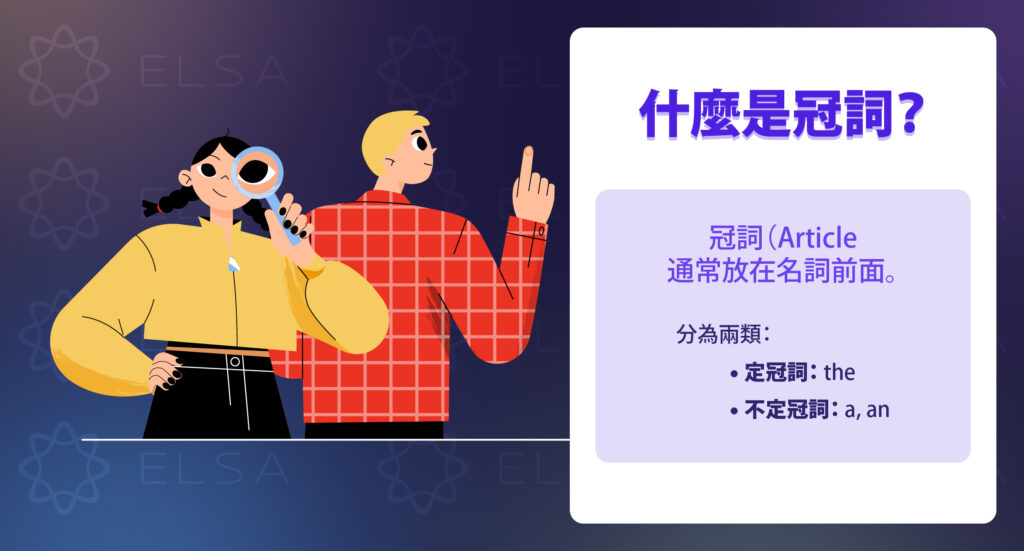
冠詞 英文(Article)是出現在名詞之前的詞,用來讓讀者辨別這個名詞是「特定的」還是「不特定的」。實際上,冠詞並不被視為一種獨立詞性,而更常被當作形容詞的一部分,用來修飾名詞。
冠詞 英文可分為兩大類:
- 定冠詞 (definite article) – “The”
- 不定冠詞 (Indefinite article) – “a, an”
舉例:
- I see a dog. The dog is running across the road very fast. (我看到一隻狗。那隻狗正快速地穿過馬路。)
- Please give me the pen on the table. (請把桌上的那支筆給我。)
冠詞有哪些?
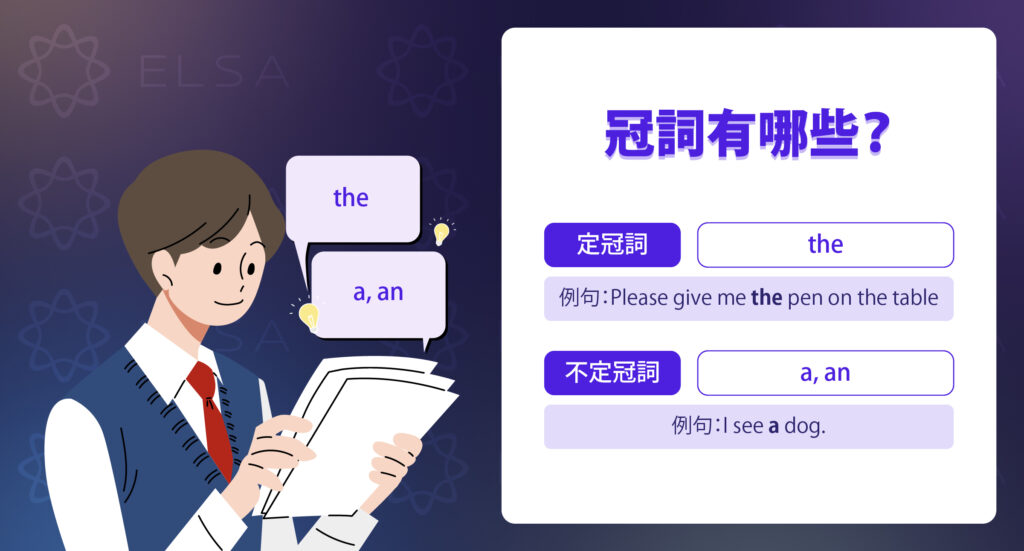
不定冠詞英文 – Indefinite article
英文中有兩個不定冠詞 a 和 an:
- “a” 用於以子音音素開頭的單數可數名詞。
例子: a table (一張桌子), a book (一本書)
- “an” 用於以母音音素(e, u, i, o, a) 或無聲 “h” 開頭的單數可數名詞.
例子: an hour (一小時), an apple (一顆蘋果)
>>閲讀不定代名詞 英文:不定代名詞 (Indefinite pronouns): 用法和題庫
定冠詞英文 – Definite article
定冠詞是什麼? 在英文中常用的定冠詞是the。The用於特定的事物(說話者與聽話者都知道的對象)。“the” 可用於單數可數名詞,也可用於複數不可數名詞。
例子:
- The man talking to Jane is my boyfriend. (正在和 Jane 說話的那個男人是我男朋友。).
- Yesterday, I saw an accident here. The accident left one person injured and the motorcycle severely damaged. (昨天,我在這裡看到了一場車禍。那場車禍導致一人受傷,摩托車也嚴重損壞。)
注意: 冠詞 “the” 用來指代明確知道的人或事物,而冠詞 “a” 與 “an’ 用於尚未明確或首次提及的對象。
閲讀更多:關係代名詞 (Relative Pronouns): who、which、that 用法和區分
冠詞 英文用法
冠詞在英文的口語與書面語中都非常常見。然而,要如何正確使用英文冠詞呢?一起跟著 ELSA Speak 來深入了解。
a an 用法
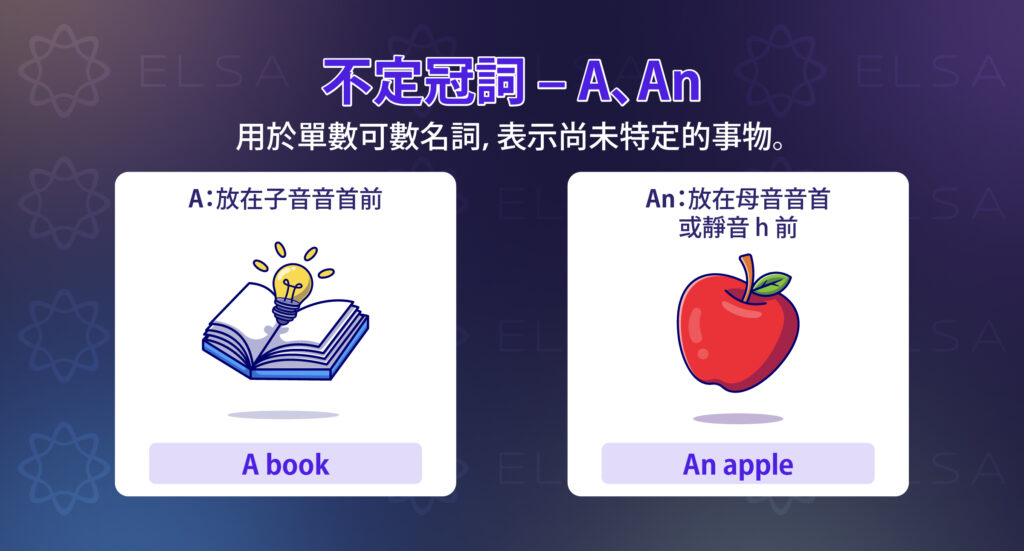
“a” 冠詞用法
| 英文例句 | 翻譯 | |
|---|---|---|
| “A” 用在以母音字母開頭但發音為子音的字詞前 /juː/ | – a uniform /ˈjuːnəfɔːm/ – a universal truth /juːnəˈvɜːsəl/ | – 一套制服 – 一個普遍真理 |
| “A” 用於表示速度、價格、比率、分數的慣用語中 | – a one second (½) – 3 times a day – $2 a kilo | – 一秒 – 每天三次 – 每公斤兩元 |
| “A” 用於數字或表示數量的片語中 | – a one thousand – a couple – a lot | – 一千 – 一對 – 很多 |
什麼時候用 an?
冠詞 “an” 用於以母音 (u, e, a, i, o) 開頭的名詞. 或者某些雖以子音字母開頭但無聲發音(不發音).
例子: an egg, an apple, an hour, an MC
不使用 a, an 情況
除了上面介紹的“a”, “an” 冠詞使用方法外,你也需要注意以下幾種不使用不定冠詞:
| 英文例句 | 翻譯 | |
|---|---|---|
| 不使用 “a/an” 在複數名詞前 | – An apple → Apples – An egg → Eggs | – 一顆蘋果 → 幾顆蘋果 – 一顆雞蛋 → 幾顆雞蛋 |
| 不使用 “a/an” 不可數或抽象名詞前 | What I need now is confidence. | 我現在需要的是信心。 |
| 不使用 “a/an” 餐名前 (除非有形容詞修飾) | I eat breakfast at 6 o’clock. | 我早上六點吃早餐。 |
The 冠詞用法
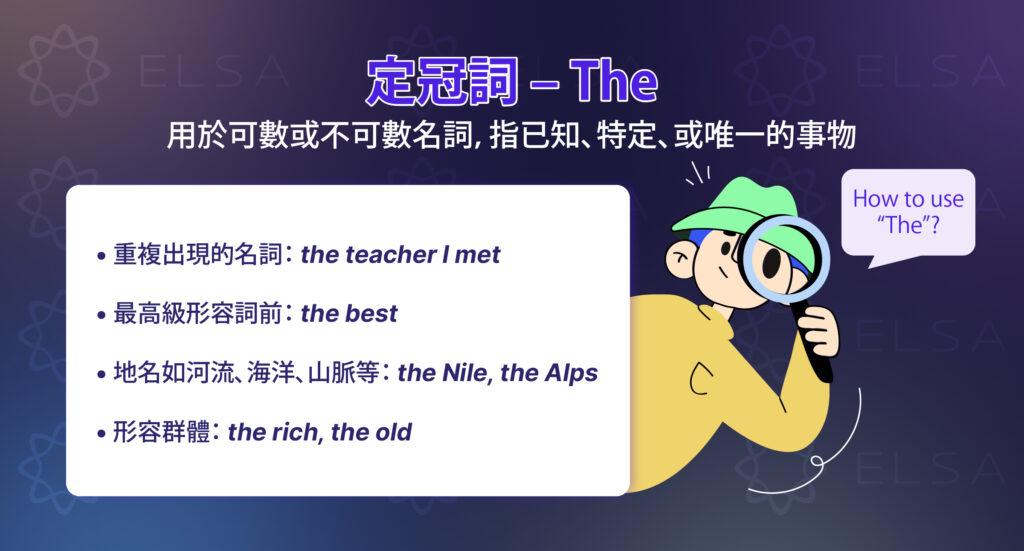
The 冠詞 英文 用法
“the” 冠詞 英文 用法扮演著重要角色,用來明確指出說話者或作者所指的特定對象。冠詞 “the” 可搭配可數名詞與不可數名詞使用。當搭配不可數名詞 冠詞時,”the” 用於表示已明確指出的某個特定數量、部分或面向。這有助於區分對某個概念的泛指陳述與對已知對象的具體說明。
| 名詞種類 | 什麼時候使用定冠詞? | 範例 |
|---|---|---|
| 可數名詞 | 指整個特定的群體或類屬 | The kangaroo is an animal that loves to hop. |
| 可數專有名詞 | The moon rises above the horizon. | |
| 不可數名詞 | 特指的不可數名詞 | We examined the water in streams. |
| 第1個名詞 + of + 第2個名詞 | The edge of the horizon is the furthest visible distance. |
使用 “the” 冠詞 英文情況
| 使用情境 | 例句 |
|---|---|
| 物體或群體是唯一的 | The sun, the earth, the world |
| 名詞在前文已被提及 | I see a dog. The dog is chasing a cat. The cat is chasing a mouse. |
| 名詞由片語或關係子句修飾 | The teacher that I met yesterday is my sister-in-law. |
| 說話者與聽話者都清楚的特定事物 | Please pass the jar of honey. |
| 最高級或序數詞前: the best, the first, the only… | – You are the best in my life.- He is the tallest person in the world. |
| The + 單數名詞 代表整個類群 | The whale is in danger of becoming extinct. |
| the + 形容詞 表示具有某特徵的一群人 | The old, the poor, the rich |
| 用於特定的地理,海域,河流,群島,山崖,複數國家,沙漠,地域名稱之前 | The Pacific, the Nile, the Alps, the United States, the Sahara |
| 當地點非作原始用途時 | They went to the school to see their children. |
| The + 姓氏 (複數) 表示全家人 | The Smiths, The Browns |
不使用 “the” 冠詞 情況
| 英文例句 | 翻譯 | |
|---|---|---|
| 在單一國家名稱、大洲、山名、湖名、街道名稱前(聯邦除外) | Europe, Asia, France, Wall Street, Sword Lake | 歐洲、亞洲、法國、華爾街、還劍湖 |
| 當名詞為不可數名詞或泛指的複數名詞 | – I like dogs. – Oranges are good for your health. | – 我喜歡這些狗。 – 橙子對你的健康有益。 |
| 在抽象名詞前(除非指特定情況) | – Men fear death. – The death of his father… | – 男人懼怕死亡。 – 他父親的死亡…. |
| 不加 “the” 在 所有格形容詞或所有格名詞後 | – My friend, (not my the friend ) – The man’s wife (not the wife of the man) | – 我的朋友 – 那個男人的妻子 |
| 在餐名或頭銜前 | They invited friends to dinner. | 他們邀請你共進晚餐。 |
| 泛指名詞:運動、季節、交通工具、方向/時間的片語等 | – Come by car – In spring – From left to right | – 搭車 – 在春季 – 從左至右 |
不使用冠詞情況
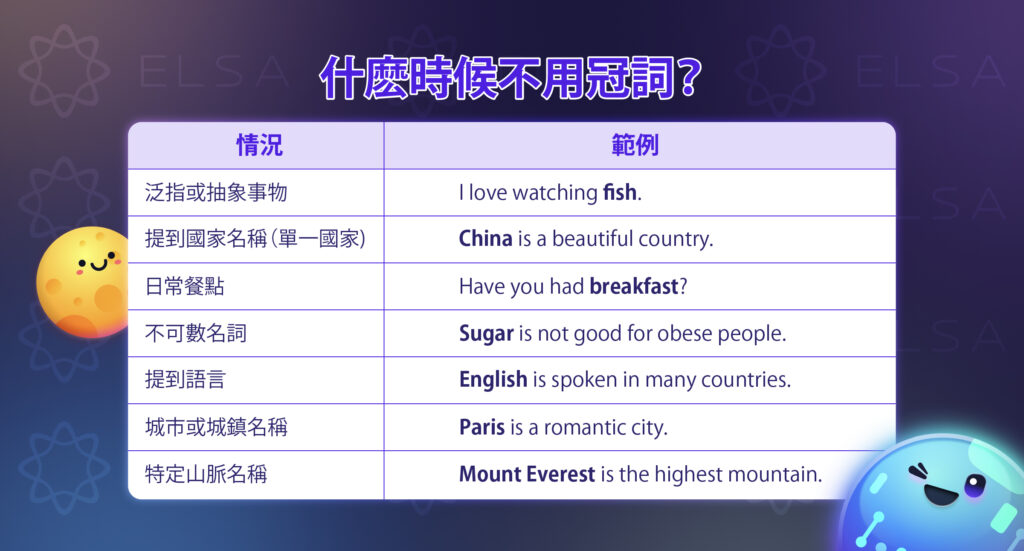
此外,在使用冠詞時,您還需要注意以下幾種情況:
| 英文例句 | 翻譯 | |
|---|---|---|
| 談論某件普遍或抽象的事物時 | I love watching fish. | 我喜歡觀賞魚群。 |
| 當談到國家名稱時 | China is a beautiful country. | 中國是一個美麗的國家。 |
| 談論每日三餐時 | Have you had breakfast? | 你吃早餐了嗎? |
| 談論不可數名詞時 | Sugar is not good for obese people. | 糖對肥胖者不好。 |
| 談論語言時 | English is spoken in many countries. | 英語在許多國家被使用。 |
| 談論城市或城鎮時 | Paris is a romantic city. | 巴黎是一座浪漫的城市。 |
| 談論具體山峰時 | Mount Everest is the highest mountain. | 珠穆朗瑪峰是最高的山。 |
區分 the 和 a/an 的用法
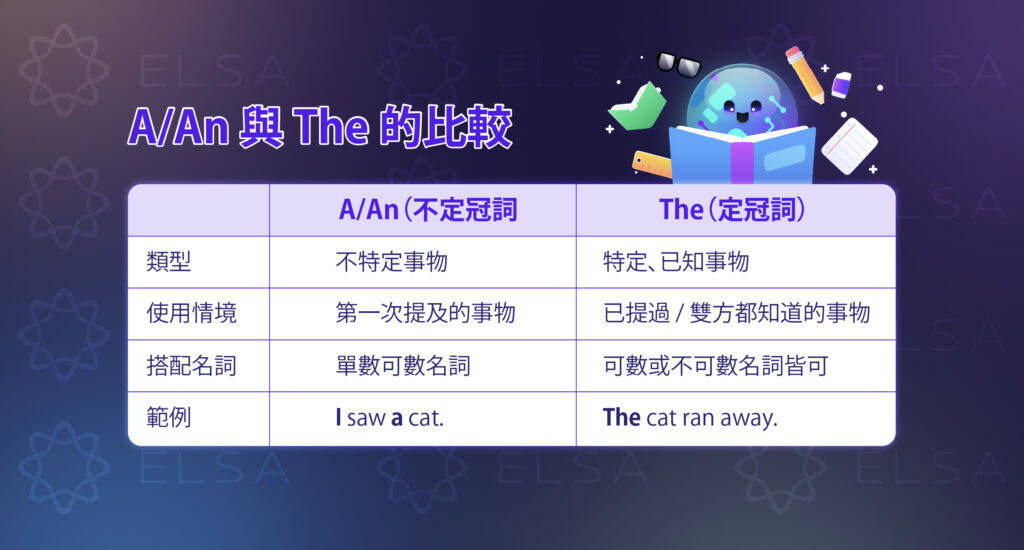
| A/An | The | |
|---|---|---|
| 類型 | 不定冠詞 | 定冠詞 |
| 意義 | 某個不特定的事物、尚未提及過的 | 已知的、之前提到過的事物 |
| 使用時機 | 第一次提及 | 已經提及過 / 誰都知道 |
| 搭配名詞 | 單數可數名詞 | 可數名詞或不可數名詞皆可 |
| 例子 | I saw a cat. | The cat ran away. |
| 注意事項 | A + 子音開頭, An + 母音開頭 | 適用於所有發音開頭 |
冠詞練習題與解答
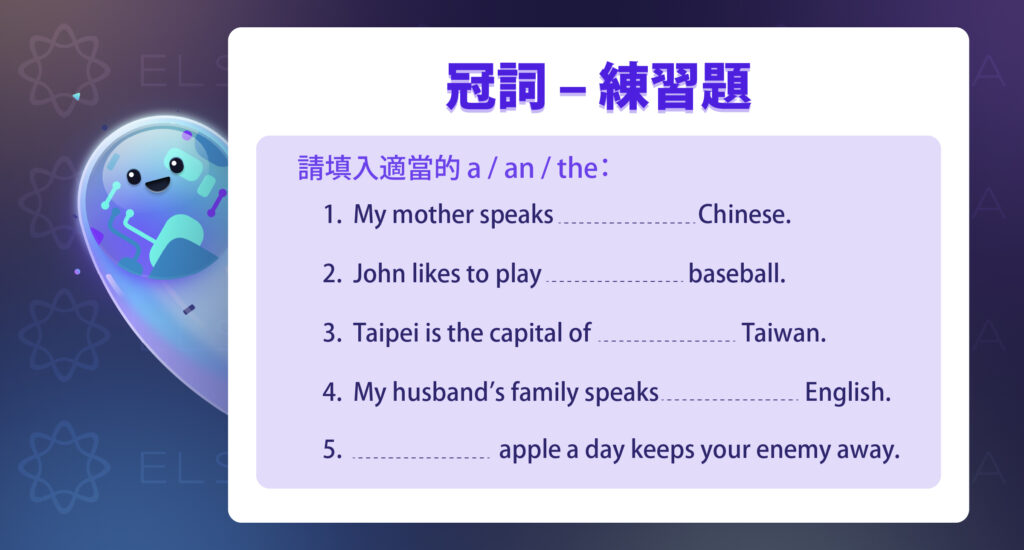
練習題
冠詞練習題 1: 在空格中填入適當的 a an the
- My best friend is studying in ………… university in Taipei.
- My mother speaks ………… Chinese.
- She borrowed ………… pen from your pile of pencils and pens.
- John likes to play …………baseball.
- My brother bought ………… umbrella to go out in the rain.
- She lived on ………… Main Street when she first came to town.
- Taipei is the capital of ………… Taiwan.
- My husband’s family speaks ………… English.
- ………… apple a day keeps your enemy away.
- My grandparents have ………… cat and ………… dog.
冠詞練習題 2: 選出正確答案
- My brother is making …….. cake for his birthday.
A. a
B. an
C. the - She tasted …….. birthday cake her father had made.
A. a
B. an
C. the - The children have …….. new teacher called Mr. Linh.
A. a
B. an
C. the - All pupils must obey …….. rules.
A. a
B. an
C. the - My mother turned on …….. radio to listen to …….. news.
(選兩次: 對應“radio” 和 “news”)
A. a
B. an
C. the - Thu is in the USA studying for …….. MBA.
A. a
B. an
C. the - The teacher read …….. interesting article from the newspaper.
A. a
B. an
C. the - There was …….. huge crowd of people outside the church.
A. a
B. an
C. the - My friend talked for …….. hour about his school project.
A. a
B. an
C. the - …….. European expert was invited to speak to the committee.
A. a
B. an
C. the
解答
練習 1:
| 題號 | 1 | 2 | 3 | 4 | 5 |
| 答案 | a | no article | a | no article | an |
| 題號 | 6 | 7 | 8 | 9 | 10 |
| 答案 | no article | no article | no article | an | a / a |
練習 2:
| 題號 | 1 | 2 | 3 | 4 | 5 |
| 答案 | A | C | A | C | C |
| 題號 | 6 | 7 | 8 | 9 | 10 |
| 答案 | B | B | A | B | A |
掌握好冠詞英文,是你學好外語的重要基礎。請經常練習,並牢記本篇中分享的冠詞用法,避免常見的語法錯誤。 別忘了常回 ELSA Speak 官方網站探索更多實用的英語文法主題,幫助你學得更正確、發音更準確,每一天都更有自信!
詞性是英文基礎而又重要的知識之一。然而,許多人經常混淆可數名詞與不可數名詞,從而導致句構和語法錯誤。因此,現在就讓我們跟著 ELSA Speak 一起學習可數名詞與不可數名詞吧!
可數名詞與不可數名詞的定義
名詞是構成英文的基本要素,而可數名詞與不可數名詞則是詞性中最基本的部分,在日常交流與考試中都非常常見。然而,這同時也是最容易讓人混淆的部分。那麼什麼是可數名詞?什麼是不可數名詞?我們接著往下看。
>>更多内容:所有關於八種英文詞性:用法、例子及在句子中的位置
可數名詞

可數名詞 (Countable Nouns) 是指能夠單獨存在並可以數出數量的事物名詞,前面可以加上數字。
例子: An table (⼀張桌⼦), three dogs (三隻狗), four books (四本書)
分類
可數名詞 分為兩類:
- 單數可數名詞
- 複數可數名詞
單數可數名詞在變為複數形式時,通常在名詞後加上 “s” 或 “es”。
- 若名詞以: S, sh, ch, x, o, 結尾,複數需加上 “es”。
- 若名詞以 “y” 結尾,變複數時要將 “y” 改為 “i” 再加 “es”。
- 若名詞以 fe, f, ff 結尾,則去掉這些字母,改加 “ves” 。
例子:
| 單數名詞 | 複數名詞 | 翻譯 |
|---|---|---|
| a glass | three glasses | 三個玻璃杯 |
| a family | five families | 五個家庭 |
| a knife | knives | 一些刀子 |
>>閲讀更多:數字英文:1–100 的英文數字表與轉換方式
不規則名詞複數對照表
| 單數名詞 | 複數名詞 | 意思 |
|---|---|---|
| man | men | 男人 |
| woman | women | 女人 |
| child | children | 小孩 |
| sheep | sheep | 綿羊 |
| tooth | teeth | 牙齒 |
| foot | feet | 腳 |
| fish | fish | 魚 |
| bacterium | bacteria | 細菌 |
不可數名詞

不可數名詞 英文為 Uncountable Nouns 是指那些無法計算個數的事物或現象的名詞,也就是説對於不可數名詞 單複數是不存在的。這些名詞通常用來表示物質、抽象概念,或一些無法單獨計數的事物。
例子: Advice (建議), sugar (糖), rain (雨),…
分類
不可數名詞主要分為五大類:
- 表示抽象概念的名詞: Help (幫助), knowledge (知識), advice (建議), information (資訊),…
- 表示食物的名詞: meat (肉), rice (米), water (水),…
- 表示自然現象的名詞: Rain (雨), snow (雪), heat (熱), wind (風),…
- 表示活動的名詞: walking (走路), cooking (煮飯), sleeping (睡覺),…
- 表示學科或專業領域的名詞: Music (音樂), mathematics (數學), history (歷史),…
常見不可數名詞
| 詞彙 | 發音 (IPA) | 意思 |
|---|---|---|
| advertising | /ˈædvərˌtaɪzɪŋ/ | 廣告 |
| advice | /ædˈvaɪs/ | 建議 |
| air | /ɛr/ | 空氣 |
| anger | /ˈæŋgə/ | 憤怒 |
| beauty | /ˈbjuːti/ | 美麗 |
| chemistry | /ˈkɛməstri/ | 化學 |
| clothing | /ˈkloʊðɪŋ/ | 衣物 |
| confidence | /ˈkɑnfədəns/ | 自信 |
| correspondence | /ˌkɔrəˈspɑndəns/ | 書信 |
| economics | /ˌɛkəˈnɑmɪks/ | 經濟學 |
| education | /ˌɛʤəˈkeɪʃən/ | 教育 |
| employment | /ɛmˈplɔɪmənt/ | 就業 |
| environment | /ɪnˈvaɪrənmənt/ | 環境 |
| equipment | /ɪˈkwɪpmənt/ | 設備 |
| evidence | /ˈɛvədəns/ | 證據 |
| food | /fud/ | 食物 |
| furniture | /ˈfɜrnɪʧər/ | 傢俱 |
| fear | /fɪə/ | 恐懼 |
| history | /ˈhɪstəri/ | 歷史 |
| homework | /ˈhoʊmˌwɜrk/ | 作業 |
| love | /lʌv/ | 愛 |
| information | /ˌɪnfərˈmeɪʃən/ | 資訊 |
| justice | /ˈʤʌstəs/ | 正義 |
| knowledge | /ˈnɑləʤ/ | 知識 |
| literature | /ˈlɪtərəʧər/ | 文學 |
| luggage / baggage | /ˈlʌgəʤ/ /ˈbægəʤ/ | 行李 |
| machinery | /məˈʃinəri/ | 機械設備 |
| maths | /mæθs/ | 數學 |
| meat | /mit/ | 肉類 |
| merchandise = goods | /ˈmɜrʧənˌdaɪz/ = /gʊdz/ | 商品 |
| money | /ˈmʌni/ | 金錢 (不包括如美元、越南盾等) |
| news | /nuz/ | 新聞 |
| physics | /ˈfɪzɪks/ | 物理 |
| politics | /ˈpɑləˌtɪks/ | 政治 |
| tea | /tiː/ | 茶 |
| research | /rɪˈsɜːʧ/ | 研究 |
| rice | /raɪs/ | 米 |
| sugar | /ˈʃʊgə/ | 糖 |
| safety | /ˈseɪfti/ | 安全 |
| water | /ˈwɔːtə/ | 水 |
可數名詞 不可數名詞 的使用方法
可數不可數名詞 動詞的搭配方式

可數名詞與動詞的搭配
- 單數可數名詞 在一般現在式中動詞需用 第三人稱單數形式 (加上 -s 或 -es)。
例子:- The apple is red.
- The car runs fast.
- 複數可數名詞在一般現在式中,動詞使用 原形 (不加 -s、-es) 。
例子:- The apples are fresh.
- The cars run fast.
不可數名詞 動詞搭配
不可數名詞在一般現在式中,動詞永遠使用單數形式。
例子:
- The water is cold.
- Advice helps people make better decisions.
注意事項
- 可數名詞的複數形式需搭配複數動詞。
- 不可數名詞永遠搭配單數動詞。
- 有些名詞依據語境,可以是可數也可以是不可數 (例子: fish)。
>>閲讀更多:所有格代名詞 (Possessive Pronouns): 用法、區別和練習
可數名詞與不可數名詞 冠詞與量詞的搭配方式

在使用可數或不可數名詞時,需注意前面所搭配的冠詞與量詞。有些冠詞可以用於兩種名詞。但有些則只適用可數名詞或不可數名詞。
可數名詞常搭配: a, an, many, a few, few, 或具體的數字。
例子:
- A teacher (一位老師)
- A few books (幾本書)
- Two laptops (兩台筆電)
詢問可數名詞的數量時,使用句型: How many
例子:
- How many books do you have? (你有多少本書?)
- How many buildings does your university have? (你的大學有多少棟樓?)
不可數名詞常搭配: Much, little, a little bit of
例子:
- Little experience (少許經驗)
- A little bit of money (一點錢)
- Much sugar (很多糖)
詢問不可數名詞的量時,使用句型: How much
例子:
- How much sugar do you put in your coffee? (你加多少糖到咖啡裡?)
- How much money do you have left? (你還剩多少錢?)
同時用於可數與不可數名詞的量詞: some, any, no, a lot of/lots of, plenty of
例子:
- Some books (一些書), some coffee (一些咖啡)
- Any advertising (任何廣告), any pens ( 任何襪子)
- A lot of trees (許多樹), a lot of fun (許多樂趣)
可數與不可數皆可的名詞特殊情況
有些名詞可以依語境不同,同時作為可數名詞或不可數名詞使用

事實上,英語中有許多詞彙是多義詞。因此,有一些名詞既可以當作可數名詞,也可以當作不可數名詞來使用。
例子: Coffee
- She wants a coffee. (她想要一杯咖啡) – 可數名詞
- Would you like some coffee? (你想喝咖啡嗎?) – 不可數名詞
有一些詞可以同時是可數名詞也可以是不可數名詞,例如:
| 詞彙 | 發音 (IPA) | 意思 |
|---|---|---|
| time | /taɪm/ | 時間 |
| cheese | /ʧiːz/ | 起司 |
| truth | /truːθ/ | 真相 |
| currency | /ˈkʌrənsi/ | 貨幣 |
| education | /ˌɛdju(ː)ˈkeɪʃən/ | 教育 |
| lack | /læk/ | 缺乏 |
| danger | /ˈdeɪnʤə/ | 危險 |
| entertainment | /ˌɛntəˈteɪnmənt/ | 娛樂 |
| failure | /ˈfeɪljə/ | 失敗 |
| food | /fuːd/ | 食物 |
| friendship | /ˈfrɛndʃɪp/ | 友誼 |
| love | /lʌv/ | 愛 |
| paper | /ˈpeɪpə/ | 紙張 |
| power | /ˈpaʊə/ | 能源、權力 |
有一些可數名詞在變成複數時,不遵循一般在字尾加上 “s” 或 “es” 的規則

| 單數名詞 | 複數名詞 | 意思 |
|---|---|---|
| woman | women | 女人 |
| tooth | teeth | 牙齒 |
| person | people | 人、人們 |
| man | men | 男人 |
| foot | feet | 腳 |
| child | children | 小孩 |
| mouse | mice | 老鼠 |
| louse | lice | 虱子 |
| goose | geese | 鵝 |
| ox | oxen | 公牛 |
| fish | fish | 魚 |
| sheep | sheep | 綿羊 |
| deer | deer | 鹿 |
不可數名詞結尾為 ‘s’

在英語中,有一些不可數名詞的結尾是 “-s” 這容易讓學習者誤以為它們是複數形式。以下是一些常見例子,學習時需要特別留意:
| 名詞 | 意思 |
|---|---|
| news | 新聞、消息 |
| linguistics | 語言學 |
| mathematics | 數學 |
| physics | 物理學 |
| athletics | 田徑 |
| politics | 政治 |
| economics | 經濟學 |
| ethics | 倫理學 |
| statistics | 統計學 |
| measles | 麻疹 |
| mumps | 腮腺炎 |
| billiards | 撞球 |
| headquarters | 總部 |
複數形式的名詞

英語中也有一些名詞永遠以複數形式出現(特別名詞). 請參考以下表格:
| 名詞 | 意思 |
|---|---|
| sunglasses | 太陽眼鏡 |
| scissors | 剪刀 |
| tweezers | 鑷子 |
| binoculars | 望遠鏡 |
| refreshments | 飲料 |
| headquarters | 總部 |
| premises | 基礎 |
| gymnastics | 體操 |
| congratulations | 祝賀 |
| clothes | 衣服 |
| jeans | 牛仔褲 |
| shorts | 短褲 |
| trousers | 長褲 |
| underpants | 內褲 |
| tights | 緊身褲 |
| stockings | 襪子 |
| pajamas | 睡衣 |
| braces | 牙套 |
| goods | 貨物 |
| odds | 機率 |
| troops | 軍隊 |
| scales | 體重機、天秤 |
| intestines | 腸子 |
| acoustics | 聲學 |
| manners | 禮儀 |
| ethics | 道德 |
| mathematics | 數學 |
區分可數名詞與不可數名詞

| 可數名詞 (Countable Nouns) | 不可數名詞 (Uncountable Nouns) | |
|---|---|---|
| 形態 | 有兩種形態: 單數 與 複數.複數形式通常以 -s/-es 結尾。 | 只有一種形態, 沒有複數形式。 |
| 冠詞與數量詞搭配 | – 不單獨使用,常搭配 冠詞 (a/an) 或數量詞使用。 – 常搭配: a/an, many, few, a few | – 可單獨使用,或與 “the” 及 計量/分類短語搭配。 – 常搭配: much, little, a little, a little bit of. |
| 數字結合 | 可直接放在數字後面,如: one, two, three,… 例子: two books, five pens | 不能直接接數字。 需搭配計量單位使用: two cups of tea, three bottles of water |
| 常用疑問句 | 常用: How many…? 例子: How many students are there? | 常用: How much…? 例子: How much water do you drink? |
| 例子 | book, pen, car, apple, house, student, cat | water, money, sugar, advice, furniture, information, milk, rice |
>>學習技巧:2025 年幫助你在家最有效地學英文的秘訣
英文 不可數名詞的量化方式

不可數名詞無法直接用數字來量化,但可以透過量詞來表達其數量或具體化其意義。例如,當我們想具體說明 “water”的數量時, 通常會搭配像是 “cup”, “bottle”, “glass”,… đ形成不可數名詞的量化片語: “a cup of water” (一杯水), “two bottles of water” (兩瓶水), “three glasses of water” (三杯水),…
通用結構:
| 數量 + 測量單位 + of + 不可數名詞 |
常見例子:
| 測量單位 | 不可數名詞 | 量化詞組 | 意思 |
|---|---|---|---|
| bar | chocolate | a bar of chocolate | 一條巧克力 |
| game | chess | a game of chess | 一盤棋 |
| can | tuna | a can of tuna | 一罐鮪魚 |
| piece | advice | a piece of advice | 一則建議 |
| bowl | cereal | a bowl of cereal | 一碗穀物 |
| bar/cake | soap | a bar/cake of soap | 一塊肥皂 |
| peal | laughter | a peal of laughter | 一陣笑聲 |
| glass | beer | a glass of beer | 一杯啤酒 |
| cup | coffee | a cup of coffee | 一杯咖啡 |
| loaf | bread | a loaf of bread | 一條麵包 |
| rasher | bacon | a rasher of bacon | 一片火腿 |
| act | kindness | an act of kindness | 一個善舉 |
| fit | anger | a fit of anger | 一陣怒氣 |
| work | art | a work of art | 一件藝術品 |
| piece | information | a piece of information | 一點資訊 |
| pat | butter | a pat of butter | 一小塊奶油 |
| carton | milk | a carton of milk | 一盒牛奶 |
| glimmer | hope | a glimmer of hope | 一線希望 |
| scoop | ice cream | a scoop of ice cream | 一勺冰淇淋 |
| item | clothing | an item of clothing | 一件衣服 |
| piece | furniture | a piece of furniture | 一件家具 |
| tube | toothpaste | a tube of toothpaste | 一條牙膏 |
| speck | dust | a speck of dust | 一粒灰塵 |
| grain | rice | a grain of rice | 一粒米 |
| drop | blood | a drop of blood | 一滴血 |
| clove | garlic | a clove of garlic | 一瓣大蒜 |
可數名詞不可數名詞練習(附答案)

練習題
練習 1: 使用 a/an 完成句子,搭配給出的單字
提供單詞: question, sugar, coat, decision, accident, biscuit, blood, letter, moment, music, electricity, key
- It wasn’t your fault. It was………..
- Listen! Can you hear………..?
- I couldn’t get into the house because I didn’t have ………..
- It’s very warm today. Why are you wearing………..?
- Do you take ……………..in your coffee?
- Are you hungry? Would you like ………..with your coffee?
- Our lives would be very difficult without…………….
- I didn’t phone them. I wrote………….instead.
- The heart pumps …………………through the body.
- Excuse me, but can I ask you………….?
- I’m not ready yet. Can you wait………….., please?
- We can’t delay much longer. We have to make ……………..soon.
練習 2: 找出錯誤並修正
- There are many dirts on the floor.
- We want more fuels than that.
- He drank two milks.
- Ten inks are needed for our class.
- He sent me many foods.
- Many golds are found there.
- He gave me a great deal of troubles.
- Cows eat glasses.
- The rain has left many waters.
- I didn’t have many luggages.
練習 3: 將括號中的單字轉換為複數形式
- Study the next four (chapter).
- Can you recommend some science (book)?
- My brother had two (tooth) pulled out the other day.
- My sister can always hear (echo) in this mountain.
- My parents are proud of their (son-in-law).
- Did he raise these (tomato) in his garden?
- She thinks they need two (radio).
- His (foot) really hurt.
- The (roof) of these houses are tiled.
- Get him two (loaf) of bread.
練習 4: 將括號中的動詞變為正確形式
- These people (be) ………………. protesting against the president
- The man over there (want) ………………. to meet the manager
- Her children (hate) ………………. eating pasta
- He is ill. His foot (hurt) ………………..
- Each of the following sentences (have) ………………. a mistake. Find it.
練習 5: 使用 a/an/some 完成句子
Can she have ………………. biscuits and ………………. glass of milk, please?
My mother would like ………………. sausages and ………………. eggs, please?
Would you like ………………. organge or ………………. pear?
Does she want ………………. chips with your chicken?
Would he like ………………. wine? And ………………. cheese, too?
She’d like ………………. egg and ………………. cereals for lunch.
He’d like ………………. steak, ………………. rice and ………………. green salad
Does he want ………………. chips with his chicken?
如果你也想學習在餐廳點牛排時如何用英文表達不同的熟度,可以參考 牛排熟度英文,讓點餐時的表達更清楚自然。
練習 6: 將下列名詞分類為可數名詞與不可數名詞
- Tea
- Butter
- Song
- Living room
- Hour
- Coffee
- Child
- Homework
- Key
- Orange
答案
練習 1:
| 1. an accident | 2. music | 3. a key | 4. a coat | 5. coffee | 6. a biscuit |
| 7. electricity | 8. a letter | 9. blood | 10. a question | 11. a moment | 12. a decision |
練習 2:
| 句子 | 錯誤單詞 | 正確修正方式 |
|---|---|---|
| 1 | are many dirts | is much dirt |
| 2 | fuels | fuel |
| 3 | two milks | two glasses of milk |
| 4 | inks | pens |
| 5 | many foods | much food |
| 6 | Many golds | much gold |
| 7 | a great deal troubles | a lot of trouble |
| 8 | 正確 | |
| 9 | may waters | much water |
| 10 | many luggages | much luggage |
練習 3:
| 1. chapters | 2. books | 3. teeth | 4. echoes | 5. sons-in-law |
| 6. tomatoes | 7. radios | 8. feet | 9. roofs | 10. loaves |
練習 4:
| 1. are | 2. wants | 3. hate | 4. are hurted | 5. has |
練習 5:
| 1. some/a | 2. some/some | 3. an/a | 4. some |
| 5. some/some | 6. an/some | 7. some/some/some | 8. some |
練習 6:
| 可數名詞 | 不可數名詞 |
| Song | Tea |
| Living room | Butter |
| Hour | Coffee |
| Child | Homework |
| Key | |
| Orange |
常見問題
不可數名詞英文縮寫是什麼?
→ unc. noun (uncountable noun) 或 u.n
bread 不可數名詞是對的嗎?
→ 對的!因為你不會說 “one bread” 或 “two breads”,而是會說 “some bread” 或 “a loaf of bread”(一條麵包)。
如果想具體計數,就要用量詞如 “loaf” (條), “slice” (片), v.v.
fish 不可數名詞是對的嗎?
→ fish 同時可以是不可數名詞和可數名詞 (在表示多種類時可用 複數形式通常為 “fish” 或 “fishes”)
例子:
- I like to eat fish. (不可數)
- There are five fish in the tank. (可數)
不可數名詞 have has 如何搭配?
→ “have” 或 “has” 的使用不取決於名詞是否可數,而是取決於主語的人稱。
例子:
- I have some water.
- She has a lot of money.
- We have enough information.
- The company has experience in this field.
不可數名詞動詞加s 是對的嗎?
→ 如果 不可數名詞 作為主詞, 則視為單數, 因此其所搭配的動詞必須使用第三人稱單數形式 (使用 “has” 或在一般動詞後加上 “s”).
例子:
- Water has no taste.
- Money makes people greedy.
- Information is important.
掌握不可數名詞的使用,可以幫助你更準確地提升英文的說與寫能力。請持續練習可數名詞與不可數名詞分辨題,熟記各種實際例子,並特別留意搭配的量詞與動詞形式。此外,別忘了經常造訪 ELSA Speak,隨時更新每日最新的英語文法課程喔!
用英文寫email是在學習、工作與日常溝通中不可或缺的一項技能。根據收信對象的不同,寫信的方式也需要作出相應調整 —— 對老師要莊重、對合作夥伴要禮貌、對朋友則可以親切自然。在本文中,您將透過多種常見的英文信件範例獲得詳細指導,例如英文商業email範例,或親人, 朋友英文信件範例等。
英文信件範例結構

如何撰寫英文信件的主旨 (English Letter Subject)
主旨 (Subject) 是對信件主要內容的簡要概括,尤其在email中非常重要。一條清晰明確的主旨能幫助收件人立即了解信件的目的,並展現出專業形象。
英文信件主旨範例:
- Application for Marketing Position
- Request for Invoice Clarification
- Invitation to Annual Company Meeting
注意:
- 使用簡潔、精確的語言
- 避免全部使用大寫字母
- 不使用表情符號或非正式語言
如何開頭英文信件 (Salutation / Greeting)
在英文信件開頭,開頭部分 (Salutation 或 Greeting) 體現了對收件人的尊重,也有助於確立雙方的關係。
英文信件中常見的問候語方式:
- 正式信件用語 (Formal):
- Dear Sir/Madam,
- Dear Mr. Smith,
- To Whom It May Concern,
- 非正式信件用語 (Informal):
- Hi John,
- Hello Mary,
- Dear Mom,
注意:
- 如果知道對方的名字 → 使用 “Dear + 名字”
- 如果不知道 → 使用 “To Whom It May Concern” 或 “Dear Sir/Madam”
英文信件的主要內容 (English Letter Content)
正文部分 (Content) 是整封信中最關鍵的部分,應清楚地說明寫信的目的、要傳達的訊息或對對方的請求。
有效撰寫內容的方式:
- 開頭段落: 說明寫信的原因
- 主體: 詳細敘述資訊、理由與相關證據(如有)
- 結尾: 表達期望、請求對方回覆或採取行動
信件開頭範例:
- I am writing to apply for the position of…
- I would like to request more information about…
- Thank you for your previous email regarding…
英文信件的結尾與簽名 (Closing & Signature)
英文信件結尾 (Closing) 不僅展現禮貌與尊重,通常也會附上寫信人的簽名。
- 常見的正式結尾用語:
- Yours sincerely,
- Yours faithfully,
- Kind regards,
- 常見的非正式結尾用語:
- Best wishes,
- Take care,
- Cheers,
在結尾部分之後,請寫上全名,必要時也可附上職稱。
範例:
| Best regards, [Full Name] [Job title] |
英文信件常用詞彙範例
英文商業email詞彙

| 詞彙 | 意義 |
|---|---|
| quotation | 報價 |
| invoice | 發票 |
| payment | 付款 |
| shipment | 貨運 |
| delivery | 運送 |
| confirmation | 確認 |
| order | 訂單 |
| inquiry | 資訊請求 |
| discount | 折扣 |
| availability | 可用性 |
| deadline | 截止日期 |
| contract | 合約 |
| agreement | 協議 |
| negotiation | 談判 |
| terms and conditions | 條款與條件 |
| customer | 客戶 |
| supplier | 供應商 |
| refund | 退款 |
| replacement | 替代品 |
| responsibility | 責任 |
| attachment | 附件 |
| complaint | 投訴 |
| response | 回饋 |
| approval | 批准 |
| cancellation | 取消 |
親切英文信件常用詞彙

| 詞彙 | 意義 |
|---|---|
| dear | 親愛的 |
| buddy | 最好的朋友 |
| family | 家人 |
| holiday | 假期 |
| trip | 旅行 |
| school | 學校 |
| work | 工作 |
| weather | 天氣 |
| news | 新聞 |
| update | 更新 |
| miss | 想念 |
| love | 關愛 |
| happy | 開心 |
| excited | 興奮 |
| bored | 無聊 |
| tired | 疲累 |
| funny | 有趣 |
| story | 故事 |
| memory | 回憶 |
| photo | 照片 |
| letter | 信件 |
| weekend | 週末 |
| birthday | 生日 |
| surprise | 驚喜 |
| soon | 很快 |
| take care | 保重 |
各種情境下的英文信件範例
英文商業email範例

英文商業email範例 1: 會議邀請函
範例:
| Subject: Invitation to Weekly Team Meeting Dear Team, I would like to invite you to our weekly team meeting scheduled for [Date] at [Time] in [Location]. During the meeting, we will discuss the progress of ongoing projects, upcoming deadlines, and any other important matters. Please make every effort to attend this meeting as your input and participation are valuable to the success of our team. If you are unable to attend, please let me know as soon as possible. Looking forward to seeing you all there. Best regards, [Your Name] |
翻譯:
主旨:邀請參加每週團隊會議
親愛的團隊成員,
我想邀請大家參加我們定於[日期]在[地點]舉行的每週團隊會議。在會議中,我們將討論正在進行的項目進展、即將到期的截止日期以及任何其他重要事項。
請大家盡量撥空參加此次會議,你們的意見對團隊來說很重要。如果無法參加,也請回信告知我。期待著在會議上見到你們。
最好的問候,
[你的名字]
英文商業email範例 2: 回覆上司的 email
範例:
| Subject: Re: Update on Project Status Dear [Boss’s Name], Thank you for your email and for your continued guidance on the project. I appreciate the opportunity to provide an update on the current status. We have made significant progress since our last discussion. [Provide brief overview of progress and any relevant updates]. We are on track to meet the upcoming deadline and are confident in the quality of our work. Please let me know if you require any further information or if there are any specific areas you would like me to focus on. Thank you again for your support. Best regards, [Your Name] |
翻譯:
主旨:Re:項目狀態更新
親愛的[主管名字],
感謝您的郵件,以及對項目的持續指導。現在要向您提供目前狀態的更新。
自上次討論以來,我們取得了重大進展。[提供進展的簡要概述和任何相關更新]。我們正在按計劃進行,並且對我們的工作進度感到信心十足。
如果您需要進一步的資訊,或者有任何您想讓我專注的特定領域,再請跟我說。再次感謝您的支持。
最好的問候,
[你的名字]
英文商業email範例 3: 服務/業務介紹信
範例:
| Subject: Introduction of Our Company and Services Dear [Recipient’s Name], I am writing to introduce you to [Your Company Name], a leading provider of [brief description of services/products]. With over [number] years of experience in the industry, we have helped numerous clients achieve their business goals through our innovative solutions and exceptional customer service. We would love the opportunity to discuss how our services can benefit your organization. Please let us know if you would be interested in scheduling a meeting or if you have any questions. Thank you for considering [Your Company Name]. Best regards, [Your Name] [Your Position] [Your Contact Information] |
翻譯:
主旨:介紹我們公司及服務
親愛的[收件人姓名],
寫這封信件是為了介紹我們的公司[公司名稱],我們是一家領先的提供[服務/產品簡要描述]的公司。憑藉我們在行業中超過[數字]年的經驗,我們幫助了許多客戶通過我們創新的解決方案和優質的客戶服務實現了他們的業務目標。
我們很樂意討論我們的服務如何能夠造福於您的組織。請讓我們知道您是否有興趣安排會議,或者是否有任何問題需要解答。
感謝您考慮[公司名稱]。
最好的問候,
[你的名字]
[你的職稱]
[你的聯絡方式]
在順利收到面試通知後,建議求職者可以提前準備常見的英文面試問題與自我介紹,才能在實際對話中展現出自信與專業度。
>>關於職稱/職位:20 多行業職稱英文詞彙與發音指南
英文商業email範例 4: 產品介紹信
範例:
| Subject: Introduction of New Product Line Dear [Recipient’s Name], I am excited to announce the launch of our new product line, [Product Name]. Our team has worked tirelessly to develop a product that [brief description of product benefits/features]. [Product Name] is now available for purchase on our website, and we are confident that it will meet the needs of your target audience. We would be happy to provide you with more information or samples if you are interested. Thank you for your continued support. Best regards, [Your Name] [Your Position] [Your Contact Information] |
翻譯:
主旨:新產品線介紹
親愛的[收件人姓名],
我很高興地宣布我們的新產品線[產品名稱]正式推出。我們的團隊不辭辛勞地開發了這款產品,它具有[產品優勢/特色的簡要描述]。
[產品名稱]現在已在我們的網站上發售,我們相信它將滿足您的客戶受眾需求。如果您感興趣,我們將很樂意為您提供更多信息或樣品。
感謝您一直以來的支持。
最好的問候,
[你的名字]
[你的職稱]
[你的聯絡方式]

英文商業email範例 5: 回覆客戶關於服務/業務的信件
範例:
| Subject: Re: Inquiry Regarding [Topic/Issue] Dear [Sender’s Name], Thank you for your email and for reaching out to us regarding [topic/issue]. We appreciate the opportunity to address your concerns and provide assistance. [Provide response to inquiry or address concerns raised by sender]. If you require any further clarification or assistance, please do not hesitate to contact us. We value your interest in our company and look forward to the possibility of working together. Best regards, [Your Name] [Your Position] [Your Contact Information] |
翻譯:
主旨:回復關於[主題/問題]的詢問
親愛的[發件人姓名],
感謝您的來信並就[主題/問題]與我們聯繫。我們感謝有機會解決您的疑慮並提供幫助。
[回覆詢問或解決發件人提出的問題]。如果您需要進一步的澄清或幫助,請隨時與我們聯繫。
我們感謝您對我們公司的關注,並期待著有機會共同合作。
最好的問候,
[你的名字]
[你的職稱]
[你的聯絡方式]
英文商業email範例 6: 報價信
範例:
| Subject: Quotation for [Product/Service] Dear [Recipient’s Name], Thank you for your inquiry regarding [Product/Service]. We appreciate the opportunity to provide you with a quotation. Based on your requirements, we have prepared the following quotation: [Provide detailed breakdown of costs, including itemized pricing and any applicable fees or discounts]. Please review the quotation and let us know if you have any questions or if there are any adjustments you would like to make. We are committed to providing you with the best possible solution to meet your needs. Thank you for considering [Your Company Name]. Best regards, [Your Name] [Your Position] [Your Contact Information] |
翻譯:
主旨:關於[產品/服務]的報價
親愛的[收件人姓名],
感謝您對[產品/服務]感興趣,讓我們有機會為您提供報價。
根據您的要求,我們已為您準備了以下報價資訊:
[提供詳細的費用明細,包括價格和任何適用的費用或折扣]。
請查收,如果您有任何問題或需要進行任何調整,請隨時告訴我們。我們致力於為您提供最佳解決方案,以滿足您的需求。
感謝您考慮[公司名稱]。
最好的問候,
[你的名字]
[你的職稱]
[你的聯絡方式]
英文商業email範例 7: 簽訂合約信件
範例:
| Subject: Signing of Contract for [Project/Service] Dear [Recipient’s Name], I am pleased to inform you that we have finalized the terms and conditions for the [Project/Service] and are ready to proceed with the signing of the contract. Attached to this email, please find the finalized contract document for your review and signature. Kindly go through the document carefully and let us know if you have any questions or require any modifications. Once we receive the signed contract from your end, we will initiate the necessary steps to commence the [Project/Service] as per the agreed timeline. Thank you for your cooperation, and we look forward to a successful collaboration. Best regards, [Your Name] [Your Position] [Your Contact Information] |
翻譯:
主旨:關於[項目/服務]的合約簽訂
親愛的[收件人姓名],
我很高興通知您,我們已經最終確定了[項目/服務]的條款和條件,並準備簽署合約。
附件是最終確定的合約文件,請您仔細查閱並簽署。如果您有任何問題或需要進行任何修改,請告訴我們。
一旦我們收到您的簽署合約,我們將按照約定的時間軸開始進行[項目/服務]。
感謝您的合作,期待此次合作能夠成功。
最好的問候,
[你的名字]
[你的職稱]
[你的聯絡方式]
英文商業email範例 8: 客戶關懷信
範例:
| Subject: Resolution of Your Query Dear [Customer’s Name], Thank you for reaching out to us regarding [issue/query]. We apologize for any inconvenience this may have caused you and appreciate your patience as we worked to resolve the matter. I am pleased to inform you that we have addressed your query, and [provide details of resolution]. If you require any further assistance or have any additional questions, please feel free to contact us. We value your business and are committed to providing you with the best possible customer service experience. Best regards, [Your Name] [Your Position] [Your Contact Information] |
翻譯:
主旨:解決您的查詢
親愛的[客戶姓名],
感謝您就[問題/查詢]與我們聯繫,對於可能給您帶來的任何不便,我們深感抱歉,並感謝您的耐心等待。
我很高興地通知您,我們已經解決了您的查詢,[提供解決方案的詳細信息]。如果您需要進一步的協助或有任何其他問題,請隨時與我們聯繫。
我們重視每一位客戶的權益,並致力於為您提供最佳的客戶服務體驗。
最好的問候,
[你的名字]
[你的職稱]
[你的聯絡方式]
英文商業email範例 9: 回覆客戶投訴信件
範例:
| Subject: Response to Your Complaint Dear [Customer’s Name], We have received your recent complaint regarding [issue/complaint]. Please accept our sincere apologies for any inconvenience this may have caused you. Our team has thoroughly investigated the matter, and we understand the importance of addressing your concerns promptly. We have taken the necessary steps to rectify the situation and ensure that it does not occur again in the future. As a token of our apology, we would like to offer [compensation/solution]. We hope this gesture demonstrates our commitment to providing excellent customer service and resolving any issues you may encounter. Thank you for bringing this matter to our attention. If you have any further questions or concerns, please do not hesitate to contact us. Best regards, [Your Name] [Your Position] [Your Contact Information] |
翻譯:
主旨:回覆您的投訴案件
親愛的[客戶姓名],
我們已收到您最近關於[問題/投訴]的投訴。請接受我們誠摯的道歉,對此給您帶來的任何不便,我們深感抱歉。
我們的團隊已經對此事進行了徹底調查,我們理解及時解決您的關切的重要性。我們已經採取了必要的措施來糾正這種情況,並確保將來不會再次發生。
作為我們的道歉表示,我們願意提供[補償/解決方案]。我們希望這個舉動表明了我們對提供優質客戶服務並解決您可能遇到的任何問題的承諾。
感謝您將此事帶給我們的關注。如果您有任何進一步的問題或顧慮,請隨時與我們聯繫。
最好的問候,
[你的名字]
[你的職稱]
[你的聯絡方式]
英文商業email範例 10: 公司招募信
範例:
| Subject: Invitation to Interview for [Position] Dear [Candidate’s Name], I am writing to inform you that your application for the position of [Position Title] at [Company Name] has been successful. We were impressed by your qualifications and experience, and we would like to invite you to interview for the position. The interview will take place on [Date] at [Time] at our office located at [Address]. Please confirm your availability for the interview by replying to this email. If the proposed time is not suitable, please let us know, and we will do our best to accommodate you. We look forward to meeting with you and discussing the opportunity further. Best regards, [Your Name] [Your Position] [Your Contact Information] |
翻譯:
主旨:邀請面試 [職位]
親愛的 [應徵者姓名],
寫這封信是要通知您,我們對您的資格和經驗印象深刻,因此想邀請您參加該職位的面試。
面試將於 [日期] 在我們位於 [地址] 的辦公室進行,時間為 [時間]。
請回覆此郵件告知您是否能參加面試,如果時間不合適,也請告訴我們,我們將為您安排其他面試時段。
期待與您見面。
最好的問候,
[你的名字]
[你的職稱]
[你的聯絡方式]
黑色星期五別錯過,功能豐富的英語學習方案!
ELSA Premium 終身 – 十一優惠
原價:7,150元 現在 4,115 元
ELSA Premium 還有另外以下的學習包:
ELSA Premium 一年:原價:5,250元 現在 2,099 元
ELSA Premium 三個月:原價:2,100元 現在 1,140 元
日常英文信件範例

道歉信 (apology letter)
範例:
| Subject: Sincere Apology Dear [Name], I hope this message finds you well. I am writing to sincerely apologize for [explain the issue – e.g., missing our meeting, the delay in responding, the mistake I made, etc.]. I understand that this may have caused inconvenience or disappointment, and I take full responsibility for it. Please know that it was never my intention to [cause any trouble / overlook your concerns / make things difficult]. I truly value our [relationship / partnership / friendship] and will do my best to ensure this does not happen again. Thank you for your patience and understanding. Please let me know if there’s anything I can do to make it right. Sincerely, [Your Name] |
翻譯:
主旨: 誠摯的道歉
親愛的 [名字],
希望你一切安好。我寫這封信是為了真誠地向你道歉,因為 [說明問題——例如:錯過約會、回覆太遲、犯了錯等等]。
我知道這可能讓你感到不便或失望,對此我完全負責。請你理解,我絕無意 [造成困擾/忽視你的關心/讓事情變得尷尬]。
我非常珍惜我們之間的 [關係/合作/友誼],並會盡全力避免類似情況再次發生。謝謝你的耐心與體諒。
如果我能做些什麼來彌補,請務必讓我知道。
誠摯地,
[你的名字]
感謝信 (thank-you letter)
範例:
| Subject: Thank You So Much! Dear [Name], I just wanted to say thank you for [the specific reason – e.g., your help with my presentation / the lovely gift / inviting me to your party]. It really meant a lot to me, and I truly appreciate your kindness and thoughtfulness. Everything you did made a big difference, and I’m so grateful to have someone like you in my life. It’s always a pleasure to spend time with you and I look forward to our next get-together. Thanks again for everything! Warm regards, [Your Name] |
翻譯:
主旨:非常感謝你!
親愛的 [名字],
我只是想向你表達感謝,因為 [具體原因——例如:你幫我準備簡報/送我可愛的禮物/邀請我參加聚會]。這對我意義重大,我非常感激你的善意與貼心。
你的行動真的帶來了很大的不同,我感到非常幸運能在生活中有你這樣的人。和你在一起總是很開心,我也期待能很快再見到你。
再次感謝你所做的一切!
親切的問候,
[你的名字]
>>閲讀更多:總結50+最有意義的生日快樂英文祝福
投訴信 (complaint letter)
範例:
| Subject: Complaint Regarding [Product/Service Issue] Dear [Name or Company], I am writing to express my dissatisfaction with [product/service] that I purchased on [date] from [store/website/company]. Unfortunately, the experience did not meet my expectations due to the following issues: [Briefly describe the issue – e.g., the item arrived damaged, the delivery was late, or the service was unprofessional.] I kindly ask that you look into this matter and provide a suitable solution, such as a replacement, refund, or another appropriate action. I have attached [receipts/photos] for your reference. I hope we can resolve this issue promptly and fairly. Please let me know how you plan to address it. Sincerely, [Your Name] |
翻譯:
主旨:關於[產品/服務問題]的投訴
敬啟者:[收件人姓名或公司名稱]
我寫這封信是為了表達我對於於[購買日期]在[商店/網站/公司名稱]所購買的[產品/服務]之不滿。遺憾的是,這次的體驗未能符合我的期望,原因如下:
[簡要描述問題——例如:收到產品時已損壞、配送延遲、服務不專業等]
我希望貴公司能夠審慎處理,並提供適當的解決方案,例如換貨、退款,或其他合理的處理方式。我已附上[發票/圖片]以供參考對照。
期盼此問題能夠迅速並合理地獲得解決。煩請告知貴公司後續的處理方式。
此致
敬禮
[你的名字]
>>閲讀更多:不好意思英文是什麽說?區分 Excuse me 和 Sorry 以及 50+ 種不好意思説法
建議信 (advice letter)
範例:
| Subject: Some Advice for You Dear [Name],I hope you are doing well. I’ve been thinking about our recent conversation regarding [the topic – e.g., your job situation, your decision to move, etc.], and I wanted to share some advice with you. First of all, I want to say that I understand how challenging this situation must be for you, and it’s completely normal to feel uncertain. However, I believe that [suggest your advice – e.g., it might be helpful to take your time and carefully weigh your options before making any decision]. Sometimes, taking a step back and thinking things through can make a big difference. Remember, you are not alone in this. I’m here for you, and I believe you’ll make the right choice when the time comes. Trust yourself, and don’t hesitate to reach out if you need to talk. Take care, [Your Name] |
翻譯:
主旨:給你的一些建議
親愛的[名字],
希望你一切安好。我一直在思考我們最近談到的事情,關於[主題——例如:你的工作情況、搬家的決定等等],我想跟你分享一些建議。
首先,我想說我理解這對你來說可能是一段非常困難的時期,感到不確定是非常正常的。不過,我相信[給出建議——例如:你可以花點時間深入思考,並在做決定前仔細評估各種選擇]。有時候,退一步深思熟慮會帶來很大的改變。
請記得你並不孤單。我永遠支持你,也相信當時機成熟時,你一定會做出正確的選擇。請相信自己,如果你需要談談,隨時都可以聯繫我。
祝福你一切順利!
[你的名字]
請求信 (request letter)
範例:
| Subject: Request for [specific request] Dear [Name], I hope this message finds you well. I am writing to kindly request [state your request – e.g., a meeting to discuss the project, a copy of a document, assistance with a task, etc.]. [Explain the reason for your request – e.g., I believe that having a discussion will help clarify the next steps, or I need this document for a deadline.] I would greatly appreciate your assistance with this, and I hope we can arrange a time that is convenient for you. Please let me know if you need any further information. I look forward to your response. Thank you for your time and consideration.Best regards, [Your Name] |
翻譯:
主旨:關於[具體請求]的請求
親愛的[名字],
希望你一切都好。我寫這封信是想誠懇地提出一個請求,[說明你的請求——例如:安排一次會議來討論專案、提供一份文件副本、協助處理某項工作等等]。
[說明提出請求的原因——例如:我相信透過討論可以更清楚了解接下來的步驟,或我需要這份資料以便能按時完成工作。]我非常感激你對這件事的協助,也希望我們能安排一個對你方便的時間。
如果你需要進一步資訊,請隨時告訴我。我很期待收到你的回覆。
感謝你撥冗閱讀與考慮。
誠摯地,
[你的名字]
提供資訊的信件 (information giving letter)
範例:
| Subject: Information Regarding [specific topic] Dear [Name], I hope you are doing well. I am writing to provide you with the information you requested regarding [specific topic – e.g., our upcoming event, the details of your order, etc.]. [Provide the necessary information – e.g., the date, time, location, specifications, or any other details the recipient may need to know.] Please find the attached documents for your reference. If you need any further details or clarification, feel free to contact me. I’ll be happy to assist. Looking forward to hearing from you. Best regards, [Your Name] |
翻譯:
主旨:提供關於[具體主題]的資訊
親愛的[名字],
希望你一切安好。我寫這封信是為了提供你所要求的有關[具體主題——例如:即將舉辦的活動、你的訂單詳情等等]的資訊。
[說明要提供的資訊內容——例如:日期、時間、地點、技術規格,或任何收件人需要了解的細節。]你也可以參考附上的文件以獲得更多細節。
如果你還需要更多資料,或有任何問題,請不要猶豫與我聯繫。我很樂意協助你。
期待收到你的回覆。
誠摯地,
[你的名字]
給朋友英文信件範例
範例:
| Subject: Long Time No See! Dear [Friend’s Name], How have you been? It’s been such a long time since we last talked, and I really miss you. I hope everything is going well with your studies, work, and family. As for me, things have been pretty busy lately. I’ve been [briefly mention what you’ve been doing – e.g., studying hard, working on new projects, or traveling somewhere exciting]. I wish you were here to join me! Let’s plan to catch up soon, maybe over a video call or even meet up if possible. I’d love to hear all about what you’ve been up to.Take care and write back soon! Best wishes, [Your Name] |
翻譯:
主旨:好久不見!
親愛的[朋友的名字],
你最近怎麼樣呢?好久沒和你聯絡了,我真的非常想你。希望你的學業、工作和家人一切都順利。
我這邊最近還蠻忙的。我正在[簡單說明你在做什麼——例如:努力學習、進行一個新專案,或者去某個有趣的地方旅行]。真希望你也在這裡,能一起體驗這些事!
我們快安排時間聊聊吧——可以視訊通話,或是如果有機會的話直接見面。我真的很想聽你分享最近的生活點滴。
保重身體,記得快回信喔!
親愛的,
[你的名字]
>> 相關內容: 「好久不見英文」:50+ 種比「Long time no see!」更自然說法
給家人英文信件範例
範例:
| Subject: Thinking of You All Dear Mom, Dad, and everyone at home, I hope this letter finds you well. I miss you all so much and think about you every day. Things have been going well here. I’ve been busy with [school/work/life], but I’m doing fine. The weather here is [warm/cold/rainy], and I’m slowly getting used to it. I’ve met some nice people and even tried some new things – I can’t wait to tell you all about it when I get home! Please give my love to grandma, grandpa, and everyone else. I really look forward to our next family meal together – no food tastes as good as mom’s cooking! Take care of yourselves and write back soon. Love and hugs from me. With all my love, [Your Name] |
翻譯:
主旨:想念家人
親愛的爸爸媽媽和全家人,
希望你們收到信的時候都平安健康。我非常想念你們,每天都在想著我們的家。一切都還好,我最近忙著[學業/工作/生活],但我都能應付得來,請大家放心。
這邊的天氣[溫暖/寒冷/多雨],我也漸漸習慣了。我認識了一些不錯的朋友,也嘗試了一些新鮮的事情——等我回家一定要跟大家好好分享!
請幫我向爺爺奶奶和大家問好。我真的很期待下一次能吃到家裡的飯——沒有任何料理比媽媽煮的更好吃!
大家要多保重身體,也請早點回信給我。我從遠方送上滿滿的愛和擁抱。
愛你們的,
[你的名字]
給師長英文信件範例
範例:
| Subject: Thank You and Warm Greetings Dear [Mr./Ms./Mrs./Dr. + Teacher’s Last Name], I hope you are doing well. I’m writing to express my sincere appreciation for all the guidance and support you’ve given me during my studies. Your classes have inspired me to learn and grow, and I’m truly grateful for everything you’ve taught me. I also wanted to let you know that [update – e.g., I’ve recently passed the entrance exam / I’ve started my new semester / I’m applying for a scholarship]. Your encouragement played a big part in this progress. Thank you once again for your dedication and kindness. I hope we can stay in touch. Wishing you good health and continued success. Sincerely, [Your Full Name] [Your Class/School, if needed] |
翻譯:
主旨:誠摯的感謝與問候
敬愛的[老師姓名]老師,
您好!
希望老師一切安好。我寫這封信是為了表達我最誠摯的感謝,感謝老師在整個學習過程中給予我的指導與支持。老師的每一堂課都給我帶來莫大的啟發,我非常感激老師所傳授的一切知識與經驗。
我也想和老師分享近況:[簡短更新 – 例如:我剛通過了入學考試/我已經開始新學期/我正在申請獎學金]。在這些成果中,老師的鼓勵與支持對我幫助非常大。
再次感謝老師的用心與仁慈。希望未來還能繼續與老師保持聯繫。
祝老師身體健康、工作順利、萬事如意。
此致敬禮,
[你的全名]
[班級/學校 – 如有需要]
給同事英文信件範例
範例:
| Subject: Great Working with You Dear [Colleague’s Name], I hope you’re doing well. I just wanted to take a moment to say how much I appreciate working with you. Your professionalism and teamwork make our projects smoother and more enjoyable. Thank you for your support on [specific project or task]. I’ve learned a lot from you, and I really value your insights and cooperation. Let’s stay in touch, and I look forward to working with you again on future tasks! Best regards, [Your Name] [Your Position, if needed] |
翻譯:
主旨:很高興能與你共事
親愛的[同事姓名],
希望你一切安好。我只是想花一點時間表達我對能與你共事的珍惜與感激之情。你的專業態度與團隊合作精神讓我們的項目進行得更加順利且愉快。
感謝你在[具體項目或工作]中對我的支持。我從你身上學到了很多,並且非常感激你的分享與協作。
希望我們保持聯絡,也期盼在未來的項目中繼續合作!
此致
敬意,
[你的名字]
[職稱 – 如有需要]
希望以上這些英文信件範例能幫助你更輕鬆地表達想法與感受。商業郵件範例將有助於提升你的職場溝通技巧,而寫給朋友或家人的信則能維繫並加深人際情感連結。歡迎前往 ELSA Speak 的英語根據對象專區,了解更多信件撰寫技巧!
你是否正在尋找一種令人印象深刻的英文文案以發 Instagram 上?無論您是想用英文文案愛情,還是酷炫、溫柔、可愛的格言,或是充滿情緒的狀態欄來表達您的感受,ELSA Speak 來幫你找到最合適的詞語。
超級好的IG英文文案
自拍時的簡短英文文案

| 英文文案 | 翻譯 |
|---|---|
| Me, myself and I | 我,我自己和我 |
| Just me | 只有我 |
| But first, let me take a selfie | 但首先,讓我先自拍一張 |
| Typical me | 典型的我 |
| Selfie Sunday | 週日是自拍日 |
| I was born to shine | 我生來就是為了閃耀 |
| Me doing me | 我做我自己 |
| I don’t always take a selfie, but when I do… | 我並不總是自拍,但當我自拍時… |
| What do you think of this look? | 您覺得這個造型怎麼樣? |
| I woke up like this | 我醒來時就是這樣 |
>>閲讀更多:總結 100+ 最經典、最有意義的英文短句唯美關於生活、愛情
發布與愛人的照片時添加簡短的英文文案

| 英文文案 | 翻譯 |
|---|---|
| My world, my heart, my everything. | 我的世界,我的心,我的一切。 |
| My one and only. | 我的唯一。 |
| You’re my 1 in 7 billion. | 你是我的七十億分之一。 |
| P.S. I love you. | 附註:我愛你。 |
| You’re the apple of my eye. | 你是我的掌上明珠。 |
| I want to be with you until my last page. | 我想和你在一起直到我的最後一頁。 |
| Together is a wonderful place to be. | 在一起是一件非常美好的事情。 |
| Love you to the moon and back. | 愛你到天荒地老。 |
| Every love story is beautiful, but ours is my favorite. | 每個愛情故事都很美麗,但我們的故事是我最喜歡的。 |
| You + Me = Love | 你 + 我 = 愛 |
>>閲讀更多:七夕情人節快樂英文怎麽説? 精選 100+ 給七夕節日的浪漫短句
發布與朋友合照時的照片的英文文案

| 英文文案 | 翻譯 |
|---|---|
| Friends are like stars… | 朋友就像星星—他們來來去去,但留下來的人會像太陽一樣明亮。 |
| A good friend might know your wild stories… | 好朋友知道你的瘋狂故事,但最好的朋友會和你一起經歷這些。 |
| I would never let my best friend do anything stupid…alone. | 我不會讓我最好的朋友獨自做一些愚蠢的事情。 |
| Laughing at random things… | 隨性大笑,狂歡到天亮-只想和你一起。 |
| Back in the old days… | 我最好的朋友曾經是那麼的溫柔,現在我卻把他“訓練”成了怪物。 |
| Find someone who brings out the best in you. | 找到一個能激發出你最大潛能的人。 |
| A best friend is like your favorite bra… | 最好的朋友就像你最喜歡的胸罩:有支撐力、很舒適、很難找到,而且總是貼近你的心。 |
| A best friend will love you… | 即使你無法愛自己,最好的朋友也會愛你。 |
| Real queens fix each other’s crowns. | 真正的女王會互相幫忙調整自己的王冠。 |
| You don’t have to be crazy to be my friend… I’ll train you! | 你不必瘋狂才能成為我的朋友…我會訓練你的! |
>>閲讀更多:100+英文諺語大全 (Proverb):最經典的生活、愛情與勵志英語箴言
英文文案愛情

IG英文文案愛情
| 英文文案 | 翻譯 |
|---|---|
| You’re my favorite place to go when my mind searches for peace. | 當我的心靈尋求平靜時,你就是我最喜歡去的地方。 |
| Love is not perfect, but it’s real with you. | 愛情並不完美,但有你,愛情才是真實的。 |
| In your arms, I’ve found my home. | 在你的懷抱裡,我找到了我的家。 |
| We may not have it all together, but together we have it all. | 我們或許不擁有一切,但擁有彼此就足夠了。 |
| You’re the reason I smile a little more every day. | 你是我每天笑容更多的原因。 |
| Every love story is beautiful, but ours is my favorite. | 每個愛情故事都很美麗,但我們的故事是我最喜歡的。 |
| I fell for you, and I’m still falling. | 我愛上你了,還在愛著你。 |
| Loving you feels like home. | 愛你就像在家一樣。 |
| You and me — it just makes sense. | 你和我——這很有意義。 |
| Your love is my favorite adventure. | 你的愛是我最喜歡的冒險。 |
| You’re not my number one, you’re my only one. | 你不是我的第一,你是我的唯一。 |
| Together is a beautiful place to be. | 在一起是一個美麗的地方。 |
| You stole my heart, but I’ll let you keep it. | 你偷走了我的心,但我會讓你保留它。 |
| We were written in the stars. | 我們是命中註定的。 |
| With you, I’m the best version of me. | 和你在一起,我就是最好的自己。 |
關於愛情隱藏意義的英文文案
| 英文文案 | 翻譯 |
|---|---|
| Sometimes, the heart sees what is invisible to the eye. | 有時,心靈可以看到眼睛看不見的東西。 |
| Love isn’t just a feeling, it’s a language only hearts understand. | 愛不只是一種感覺,它是一種只有心靈才能理解的語言。 |
| Some loves are meant to be, others are meant to teach us something. | 有些愛情是注定的,有些愛情只是為了教我們一些東西。 |
| The right person will never ask you to be anyone else. | 對的人永遠不會要求你成為別人。 |
| You never realize how much you love someone until they’re far | 你永遠不會意識到你有多愛一個人,直到他們遠離 |
| The best kind of love is the one you don’t have to explain. | 最好的愛情是不需要解釋的愛情。 |
| We’re not perfect, but we’re perfect for each other. | 我們並不完美,但我們彼此完美。 |
| Some connections are too deep to be expressed in words. | 有些感情太深,無法用言語表達。 |
| You never really know how much you need someone until they become everything. | 你永遠不會真正知道你有多需要一個人,直到他們成為你的一切。. |
| Sometimes love is not about finding the right person, but creating the right relationship. | 有時候,愛情不是尋找對的人,而是建立適合的關係。 |
>>浪漫話語:520最適合情侶的浪漫英語短句
英文文案酷和個性

| 英文文案 | 翻譯 |
|---|---|
| Everyone has a chapter they don’t read out loud. | 每個人都有自己不會大聲朗讀的章節。 |
| Too lit to quit. | 太酷了,不容錯過。 |
| Shoutout to myself because I’m lit. | 向自己大聲呼喊,因為我很酷 |
| When I started counting my blessings… | 當我開始數算我的幸福時… |
| The biggest mistake you can ever make… | 你可能犯下的最大錯誤是… |
| Life is tough but so am I. | 生活很艱難,但我也不好惹。 |
| Oops is always better than what if. | 寧可說”太晚了“總比說”如果“好。 |
| If you want an opportunity to knock… | 如果您想要一個敲門的機會… |
| It always seems impossible until it’s done. | 事情總是不可能直到完成它。 |
| I keep it real because I’m not afraid of having enemies. | 我保持真實,因為我不怕有敵人。 |
| I’m the reason why I smile everyday. | 我就是我每天微笑的原因。 |
| I’m not lucky, I’m just that good. | 我不是運氣好,我只是太優秀了。 |
| I don’t chase, I attract. | 我不追逐,我吸引。 |
| Born to stand out, not to fit in. | 生來就是要脫穎而出,而不是為了融入其中。 |
| I break rules, not hearts. | 我破壞的是規則,而不是人心。 |
| No competition, I’m in my own league. | 沒有競爭,我只屬於我自己。 |
| Confidence level: Self-made. | 自信程度:白手起家。 |
| Hustle in silence, let success make the noise. | 默默努力,讓成功發出聲音。 |
| I’m everything you want but can’t have. | 我就是你想要但無法擁有的一切。 |
| Not everyone likes me, but not everyone matters. | 不是每個人都喜歡我,但不是每個人都很重要。 |
| I’m not a backup plan, and definitely not a second choice. | 我不是備用計劃,也絕對不是第二選擇。 |
| Catch me if you can. | 如果你能的話就來抓我吧。 |
| You can’t dim my shine. | 你無法遮蔽我的光芒。 |
| I’m the storm that never asks for permission. | 我是一場從不請求許可的風暴。 |
| Be a voice, not an echo. | 發出聲音,不要只迴聲。 |
| I don’t need your approval to be me. | 我不需要你的認可以成為我自己。 |
有意義且鼓舞人心的英文文案

| 英文文案 | 翻譯 |
|---|---|
| Whatever is good for your soul, do that. | 只要對你的靈魂有益,就去做。 |
| Life is better when you’re laughing. | 當你笑的時候,生活會更美好。 |
| Look for the magic in every moment. | 尋找每個時刻的魔力。 |
| Say yes, take risks, and live life on your own terms. | 說“是”,承擔風險,按照自己的方式生活。 |
| The impossible is now possible. | 不可能的事情現在成為可能。 |
| Perseverance pays… a lot! | 堅持不懈必將獲得豐厚回報! |
| It wasn’t always easy but it’s worth it. | 這並不總是容易的,但它是值得的。 |
| Dreams don’t have expiration dates, keep going. | 夢想沒有期限,繼續前進。 |
| Do whatever makes you happiest. | 做任何讓你最開心的事。 |
| “Be heroes of your own stories” – Constance Wu | ”做自己故事裡的英雄“-Constance Wu |
>>閲讀相關:勵志語錄:100+ 段語錄含各種英文主題合集以幫助鼓舞每天的精神
英文文案質感 短

| 英文文案 | 翻譯 |
|---|---|
| Chasing vibes, not people. | 追逐氛圍,而不是追逐人。 |
| Silence speaks louder than noise. | 沉默比喧囂更有力。 |
| Just because it’s hard doesn’t mean it’s impossible. | 很難並不意味著不可能。 |
| Mood: Unbothered and glowing. | 心情:無憂無慮,容光煥發。 |
| Proving myself to myself, not others. | 向自己證明自己,而不是向別人證明自己。 |
| Good energy only. | 只有好的能量。 |
| Small steps every day. | 每天邁出一小步。 |
| Stay soft, even when the world is hard. | 保持溫柔,即使世界很艱難。 |
| No rain, no flowers. | 無雨,無花。 |
| Not perfect, just real. | 不完美,但真實。 |
>>勵志語錄合集:150+ 唯美且有意義的英文勵志短句和名言精選合集!
英文文案可愛

| 英文文案 | 翻譯 |
|---|---|
| Collect beautiful moments, not things. | 收集美好的時刻,而不是物質。 |
| Life is short, make it sweet. | 人生短,要讓生活變得甜蜜。 |
| Not every day is good, but there’s something good in every day. | 並非每天都是好日子,但每天都會有好事發生。 |
| Take it one day at a time. | 一天一天地過吧。 |
| The little things in life are often the biggest treasures. | 生活中的小事往往是最大的財富。 |
| Sometimes the smallest things take up the most room in your heart. | 有時,最小的事情會佔據你心中最大的空間。 |
| Life’s a journey, not a destination. | 人生是一段旅程,而不是一個目的地。 |
| Enjoy the little things, for one day you may look back and realize they were the big things. | 享受小事,因為有一天你可能會回首往事,意識到它們都是大事。 |
| You don’t have to be perfect to be amazing. | 你不需要完美才能令人驚嘆。 |
| Keep going, the best is yet to come. | 繼續努力,最好的還在後頭。 |
英文文案 溫柔

| 英文文案 | 翻譯 |
|---|---|
| Softly, softly, the heart whispers. | 輕輕地,輕輕地,心在低語。 |
| Take time to do what makes your soul happy. | 花點時間去做一些讓你的靈魂快樂的事。 |
| Let your heart be your compass. | 讓你的心成為你的指南針。 |
| Sometimes, all you need is a moment of peace. | 有時,你需要的一切只是安寧的一片刻。 |
| Breathe in peace, breathe out love. | 吸入平靜,呼出愛。 |
| Let your soul shine as bright as your smile. | 讓你的靈魂像你的笑容一樣閃耀。 |
| Even the smallest step forward is progress. | 即使是最小的一步也是進步。 |
| Embrace the quiet moments, they hold the most beauty. | 擁抱安靜的時刻,它們蘊藏著最美麗。 |
| The quietest moments can be the most profound. | 最安靜的時刻往往是最深刻的。 |
| Find beauty in the ordinary. | 在平凡中發現美。 |
>>閲讀更多:英文座右銘精選:200+ 勵志、短句與名人 motto
黑色星期五別錯過,功能豐富的英語學習方案!
ELSA Premium 終身 – 十一優惠
原價:7,150元 現在 4,115 元
ELSA Premium 還有另外以下的學習包:
ELSA Premium 一年:原價:5,250元 現在 2,099 元
ELSA Premium 三個月:原價:2,100元 現在 1,140 元
喪/emo 英文文案

| 英文文案 | 翻譯 |
|---|---|
| I even thought about the future! But you go halfway. | 我連未來都想好了,可是半路你卻走了。 |
| Smile doesn’t mean happy, just hide painful camouflage. | 笑不代表快樂,只是掩飾痛苦的偽裝而已。 |
| If you love somebody, let them go. If they return, they were always yours. If they don’t, they never were. | 如果你真的愛上一個人,就放他走;如果他回來了,他永遠是你的;如果沒回來,他從來就不屬於你。 |
| Every one is a moon, and has a dark side which he never shows to anybody. | 人人都是月亮,都有不願讓人知道的陰暗面。 |
| What hurts more than losing you is knowing you’re not fighting to keep me. | 比失去你更讓我心痛的是,你從沒為了留下我而努力過。 |
| You are I wait less than passers-by. | 你是我等不到的路人。 |
| The last we all lost to the reality. | 最後我們都輸給了現實。 |
| We laughed and kept saying “see u soon”, but inside we both knew we’d never see each other again. | 我們笑著說再見,卻都知道,再見遙遙無期。——《海上鋼琴師》 |
| Life is alive, there is not much, only helpless. | 人生在世,沒有太多,只有無奈最多。 |
| When you turned back, my heart twitched powerfully. Now I know it’s the feeling of pain. | 當你轉身的那一刻,我的心狠狠地抽痛了一下。現在我知道,那叫心痛。 |
| Apologies only count if they are sincere. If you don’t mean it, save your breath. | 道歉只有誠心才有用,如果只是敷衍,那就別說了。 |
| Who you can forgive without a bottom line that can hurt you without a bottom line. | 你能無底線原諒的人,也能無底線地傷害你。 |
| Growing up means you know what is going on. Grown up is that you mean to say you don’t know but you do know. | 所謂長大,是你知道那是怎麼回事;所謂成熟,是你知道之後假裝不知道。 |
| Not pretend to be silent but have no strength to complain. | 不是假裝沉默,而是無力訴說。 |
| Real loneliness is not one’s loneliness, but the loss of oneself in the endless noise. | 真正的孤獨不是一個人寂寞,而是在無盡的喧囂中迷失了自己。 |
| I have found that if you love life, life will love you back. | 我發現,如果你熱愛生活,生活也會回報你。 |
| Do something today that your future self will thank you for. | 做一些讓未來的你會感激現在的自己所做的事情。 |
生日 英文文案

| 英文文案 | 翻譯 |
|---|---|
| Another trip around the sun! | 又一次繞太陽旅行! |
| Aging like fine wine. | 像美酒一樣陳釀。 |
| Still young, just upgraded. | 還很年輕,剛升級。 |
| Born to shine – even brighter this year. | 生來閃耀—今年更加閃耀。 |
| More candles, more wishes. | 蠟燭越多,願望越多。 |
| Thankful for the past, excited for the future. | 感恩過去,展望未來。 |
| Today is about me – and cake. | 今天的主題是我和蛋糕。 |
| Blessed to see another year. | 有幸又見到一年。 |
| Party mode: ON. | 聚會模式:開啟。 |
| Here’s to being older, wiser, and cooler. | 祝你更成熟、更睿智、更酷。 |
>>閲讀更多:總結50+最有意義的生日快樂英文祝福
聖誕節 英文文案

| 英文文案 | 翻譯 |
|---|---|
| All is calm, all is bright. | 一切都平靜,一切都明亮。 |
| Sleigh my name, sleigh my name. | 以我的名字命名,以我的名字命名。 |
| Dear Santa, I can explain… | 親愛的聖誕老人,我可以解釋一下… |
| Sparkle all the way. | 整個假期都閃閃發光。 |
| Cozy nights and twinkling lights. | 舒適的夜晚和閃爍的燈光。 |
| ‘Tis the season to sparkle. | 這個季節是閃耀的。 |
| Warm hugs, cold weather. | 溫暖的擁抱,寒冷的天氣。 |
| Christmas magic is real. | 聖誕魔法是真實存在的。 |
| Jingle vibes only. | 僅有叮噹聲。 |
| Santa’s favorite selfie. | 聖誕老人最喜歡的自拍照。 |
>>瞭解相關内容:聖誕節英文祝福語與英語詞彙的最好、最有意義合輯
以上匯集了當今最熱門、最受歡迎的英文文案,幫助你在社交網上的每篇貼文中脫穎而出。無論是英文文案可愛、甜美、酷,還是悲傷、憂鬱的,你都能在此列表中找到。保存起來,以後慢慢使用,或分享給朋友!立即與 ELSA Speak 了解更多相關的溝通交流英語主題吧!